
Product Management Trends 2026: The Hard Part Was Organizational Learning
Builder PMs, AI acceleration, and why progress feels slower than expected

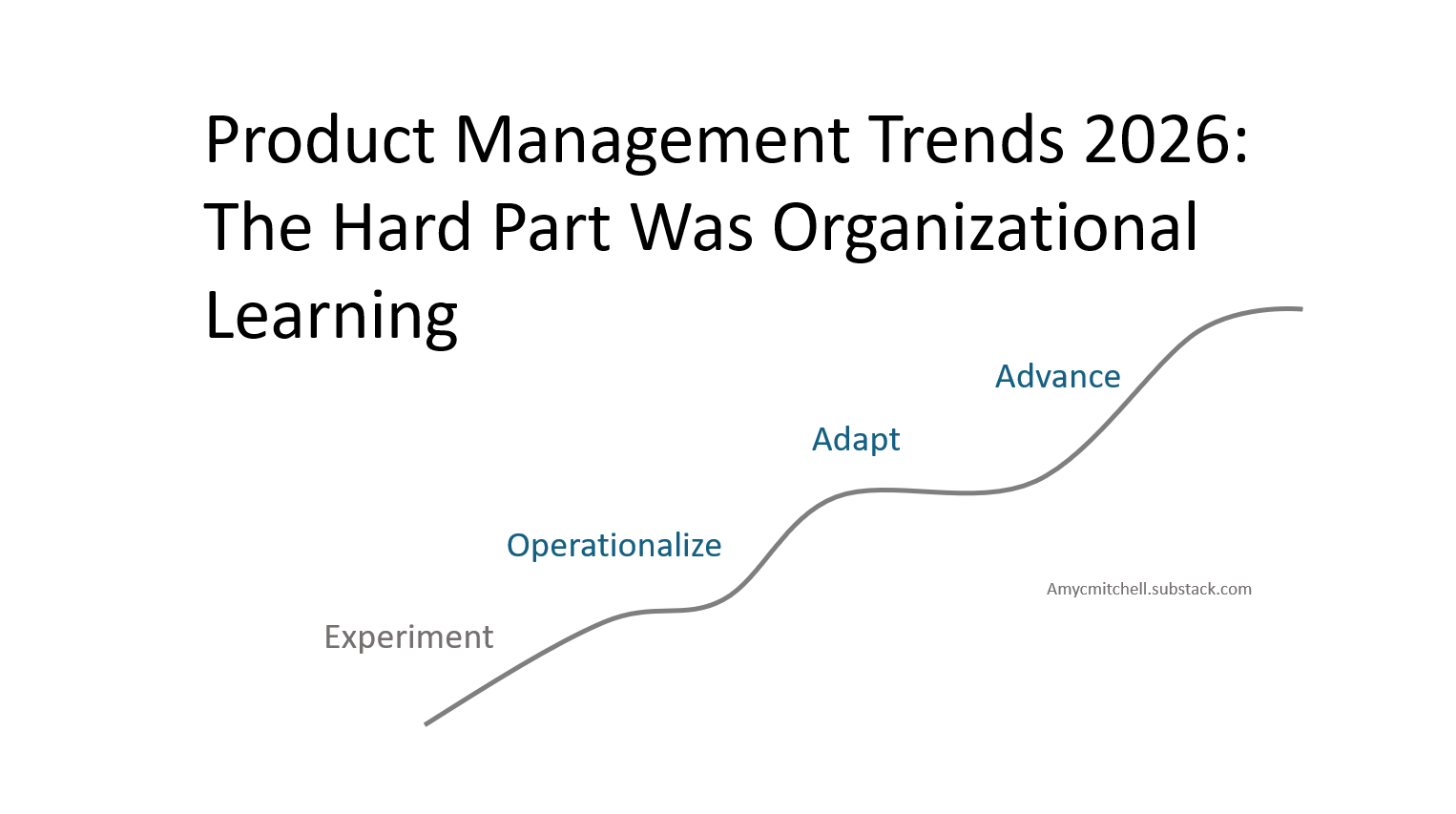
Organizations want faster execution, more adaptability, and stronger product leadership. At the same time, organizations want more certainty and struggle to absorb faster ways of working.
Six months ago, product people were trying builder PM strategies, developing product context and growing product business with AI-accelerated product work.
The surprise was how unevenly teams absorb these changes in product management.
The expectation was that the new product work would be rapidly absorbed by leaders and stakeholders.
Comments from product managers highlight the disconnect:
“They just reopen requirements instead of deciding.”
“No one reads the decision log.”
“Do I discuss this live or put it in a dashboard?”
“Can you share templates that worked?”
Stakeholders are gradually absorbing a different way of operating with the product management changes.
The trends were real but unevenly absorbed
A quick recap of the trends from six months ago includes AI acceleration, faster execution and higher product management expectations.
The changes are visible in day-to-day product work. Teams are experimenting faster, product context is improving discoverability, and product managers are increasingly influencing customer and business outcomes.
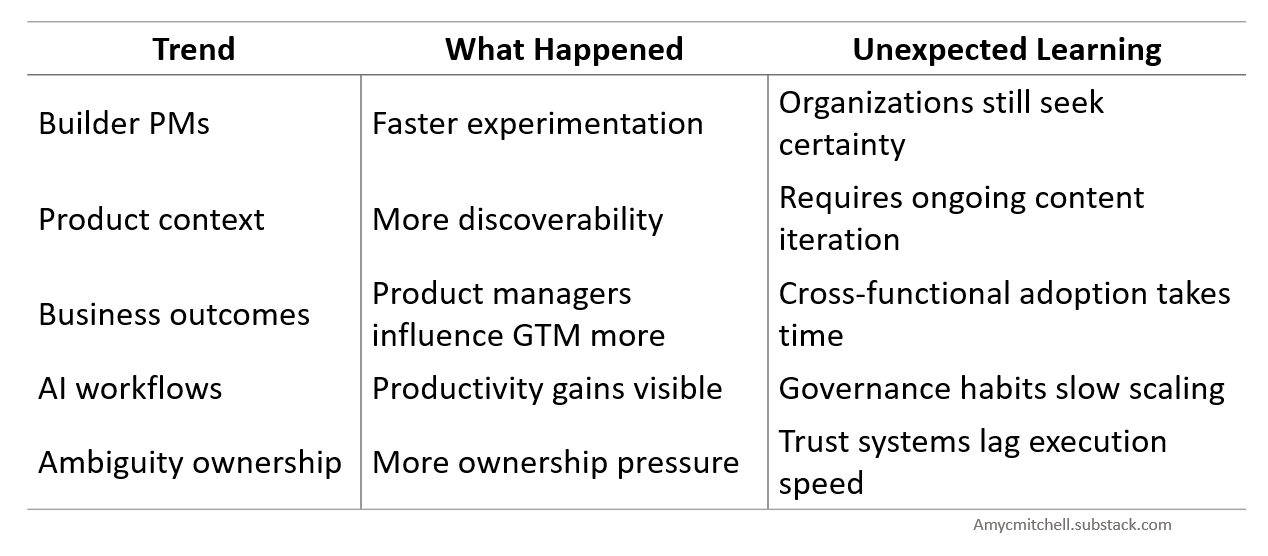
What changed in product work
Six months ago, product managers felt that building and experimenting with their business sense would be widely adopted.
And now:
Product managers don’t feel ahead on these changes
Teams are still learning how to operate with less upfront certainty
Everyone feels held back from product development changes
The changes are still uncomfortable for many teams.
Teams are learning new operating habits in real time
Teams are seeing real changes that speed delivery to customers. At the same time, there is a lot of change to assimilate. Signs that these ways of working are hard to soak up:
decisions reopening
endless alignment
documentation uncertainty
communication overload
pressure for speed without reduced process friction
Organizations are moving, but change comes at the pace of learning.
What progress looks like
Slowly, product managers are making progress despite these setbacks. Examples of progress:
Product context enables customers to find you quickly
You can show a product change to stakeholders
You have more options to fix issues early
More ways for customers to give feedback
Sales efficiencies from AI assistance
The changes in product management are visible. And not yet absorbed.
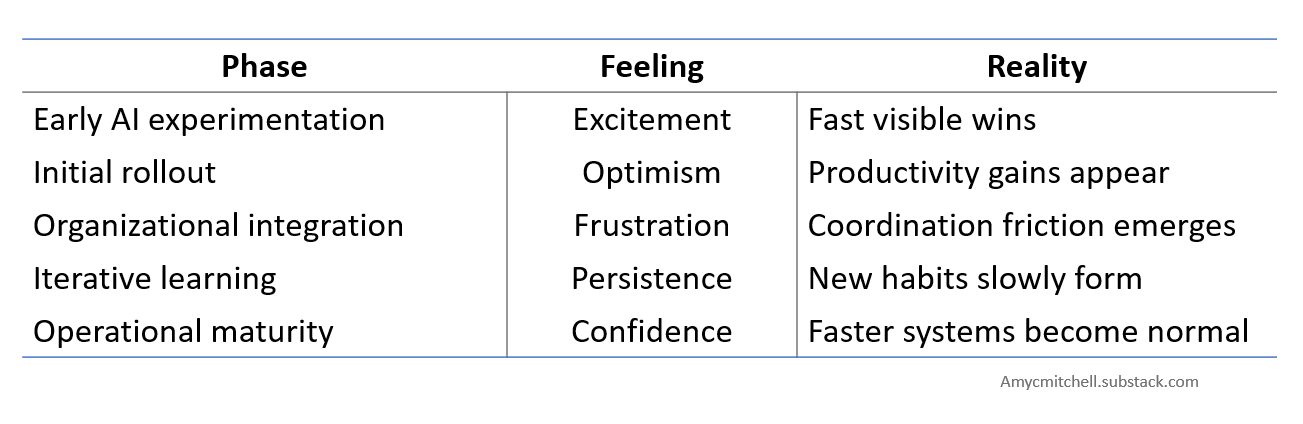
The progress is encouraging. Everyone wants it faster.
Why the speed feels uncomfortable
Product managers are moving faster and, at the same time getting mixed feedback:
AI creates visible productivity gains
organizations absorb change socially
trust systems change slower than tooling
operational habits lag capability shifts
These changes take time to absorb.
Persistent learning may be the real trend
Product people are being persistent in their learning. The setbacks are part of the learning.
The gains from the trends are visible, but teams are still learning how to absorb faster product work, AI-assisted workflows, and more adaptive ways of operating.
That learning is messy.
Decisions reopen. Alignment slows momentum. New workflows create uncertainty before they create confidence.
But still we make progress.
Many product managers are already doing the difficult work of helping stakeholders adapt one iteration at a time: showing product changes earlier, improving customer context, experimenting faster, and helping teams learn through real outcomes instead of perfect certainty.
Maybe that is what this phase of product management actually looks like.
Persistent learning.
Related articles:
Looking for more practical tips to develop your product management skills?
Product Manager Resources from Product Management IRL
Product Management FAQ Answers to frequently asked product management questions
Premium Product Manager Resources (paid only) 4 learning paths, 6 product management templates and 7 quick starts. New items monthly!
TLDR Product featured Product Management IRL articles recently! This biweekly email provides a consolidated list of recent product management articles.
drpp The Drip featured Product Management IRL articles. This newsletter has handpicked product management articles every day, summarized to give you the big picture of product management and tech.
Connect with Amy on LinkedIn, Threads, Instagram, and Bluesky for product management insights daily.
the thing that stands out here is what "organisational learning" is actually trying to absorb. teams get faster with AI-accelerated work. the bottleneck just shifts upstream. decisions that used to be made in a 2-week planning cycle now need to be made in 2 days... and most organisations haven't built the muscle for that. so what happens is the decision just gets reopened. "they just reopen requirements instead of deciding" is such a precise description of what happens when execution speed outpaces decision architecture. the learning gap isn't the tools. it's the decision infrastructure that was never built because the old pace never forced it to exist