
The Product Perception Loop
How product managers can measure, prioritize, and improve how AI understands their product

Product managers used to own features.
Now they also own how the product is understood.
A product manager asks an AI assistant to summarize her product.
The answer surprises her.
It skips important capabilities. It relies on outdated framing. It describes a competitor as the stronger option.
Nothing here reflects the product she works on every day.
She doesn’t assume failure. She recognizes a different system at work.
AI didn’t read the product roadmap. It didn’t attend positioning discussions. It didn’t sit in customer calls. It built its understanding from the signals it could find.
She immediately sees ways to respond — an FAQ, an explainer, a comparison page, a whitepaper, and refreshed product pages. Each could help. None comes with a clear way to decide where to start or how to justify the effort.
If this were a feature, she would already know what to do. She would define the outcome, choose the metrics, prioritize the work, and show how investment leads to results.
AI perception doesn’t yet come with that system.
But it can.
As buyers increasingly rely on AI to understand products, product managers now have an opportunity: not to rewrite messaging, but to manage the loop between how a product is interpreted and how it is intended to be understood.
This article introduces a practical way to run that loop.
AI Perception Is Now a Product Variable
Potential customers increasingly consult AI before contacting sales or starting a trial. AI interpretation now shapes evaluation before any human conversation begins.
That interpretation influences which products buyers consider, how they compare options, and what they believe each product is best for.
This makes AI perception a product variable.
Product managers can influence it.
Product managers can learn from it.
Product managers can improve it.
Product context and explainability are how you influence AI’s understanding. (Context engineering explains how product information is structured for AI, while explainability ensures that information can be clearly interpreted.)
Context engineering and explainability already help AI understand products better. What has been missing is a system to measure whether those efforts are working and where to focus next.
That system is the Product Perception Loop.
The AI Perception Improvement Loop
AI responses change on every prompt. This means it is difficult to measure the AI perception of any product.
The solution is to evaluate patterns of individual answers from different AI tools.
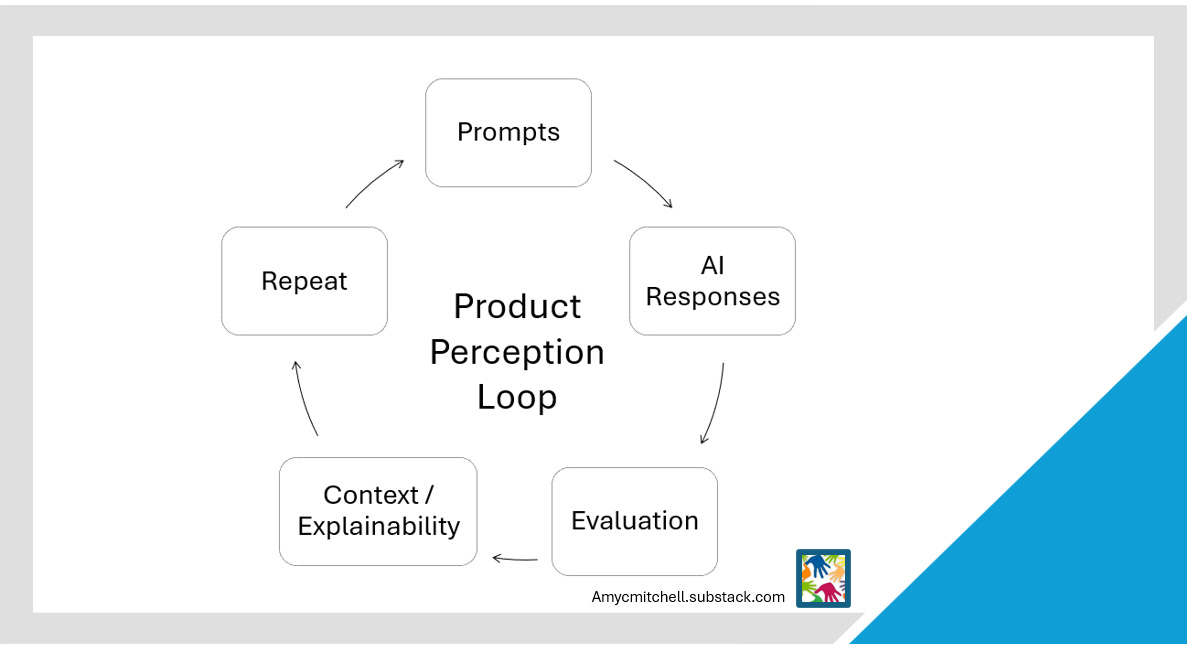
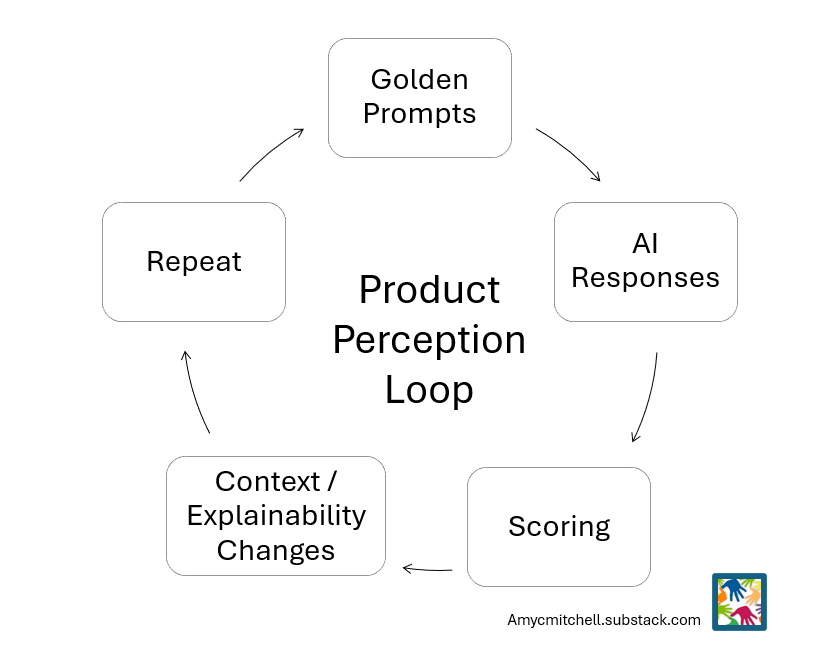
The Product Perception Loop does this through repetition and comparison:
Set up a consistent Golden Set of AI prompts
Run the prompts and judge each response
Adjust product context and product explainability
Repeat the Golden Set periodically
Each cycle turns AI perception into observable product feedback.
How to Measure AI Perception (Practically)
This does not require a large program. It starts with a small, repeatable system.
1. The Golden Set
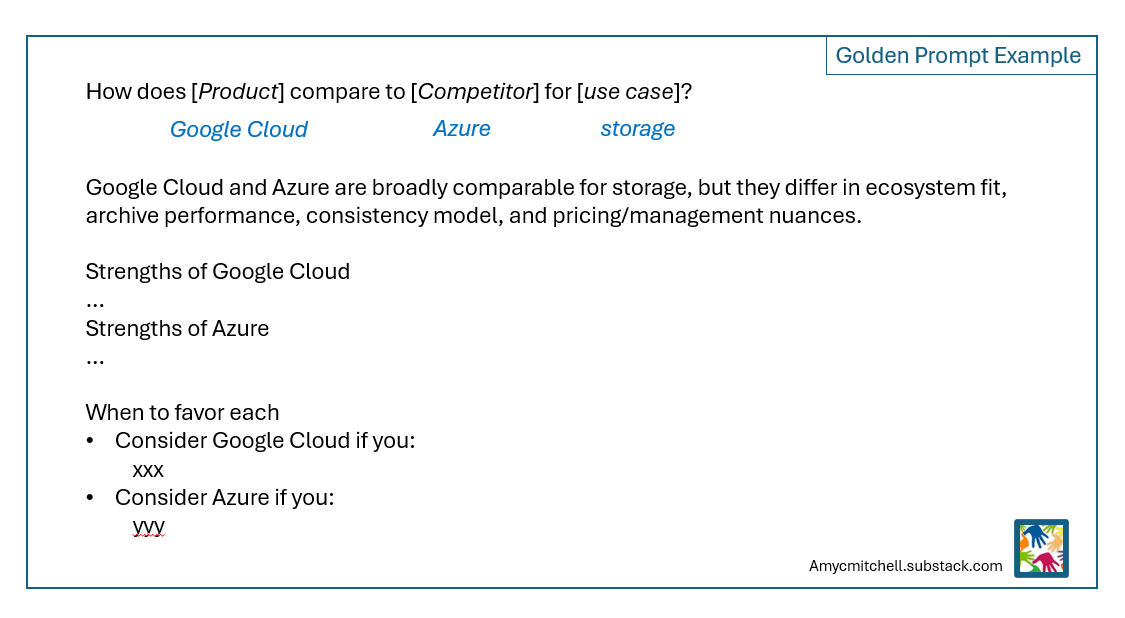
Key questions that reflect what matters to buyers:
Feature attributes — what makes a key feature valuable
Competitive comparison — how your product differs from 1–2 alternatives
Outcome focus — what problem your product solves
2. A Clean Room Test
Run the Golden Set across the AI tools your buyers use:
ChatGPT, Gemini, Perplexity, Copilot, etc.
Use incognito or logged-out mode
Copy responses and citations for later review
3. Simple Evaluation Rules
In the evaluation step, score each response on:
Attribution — how your product is mentioned
Accuracy — how closely it matches your Golden Set
Differentiation — how clearly the advantages are explained
Simple scoring makes AI perception observable and comparable.
4. Identify Business-Risk Gaps
Look for:
Missing information
Incorrect descriptions
Lost differentiators
Hallucinated or outdated sources
These gaps represent real demand risk.
5. Apply Targeted Fixes
These fixes may be owned by product, documentation, marketing or growth. Product managers guide the prioritization.
Adjust:
Product context
Explainability assets
Positioning clarity
Roadmap communication
What the loop teaches over time
6. Repeat
Each loop makes the next loop sharper.
Starting the Loop
The first run will feel imperfect. That is expected.
The goal is a baseline to learn what AI believes about your feature or product.
Each weekly or monthly run reveals:
what the product is known for
what it is confused with
what it is compared against
what it is not yet associated with
Over time, AI perception becomes another product signal like usability feedback, feature adoption, or customer interviews.
AI reflects what the market can easily understand.
This is not a one-time project.
It is a learning system.
Start with a small Golden Set.
Run it in a clean room.
Record what AI believes today.
Change one thing.
Run it again.
Then repeat.
That is the Product Perception Loop.
Related reading:
Q&A About the Product Perception Loop
What is a Golden Prompt?
A Golden Prompt is a saved AI prompt that lets you learn what knowledge AI has about your product or feature. Think of it as a product interview question for AI.
How do you come up with Golden Prompts?
If a buyer were to ask it, AI should be able to answer it correctly. Use the questions your buyers would ask AI when investigating potential purchases of a product or feature related to your offering. Consider the problem the buyer is trying to solve and your most valuable features.
How many Golden Prompts are needed?
More prompts increase coverage. Fewer prompts increase focus. Start with focus. Over time, you might need more or less granularity to evaluate the perception from the different AI tools that your buyers use. You can add prompts on successive iterations for different buyer personas, features, use cases and market conditions.
How do you score the response from AI if there is no mention of your feature or product?
If AI doesn’t respond with any relevant information, then this is a diagnostic signal about your product’s or feature’s perception. You can do root cause analysis to “debug” the AI visibility:
Indexing lag: Is the feature so new that AI hasn’t crawled it yet?
Semantic Mismatch: Are you using an internal name while AI is looking for a natural language term?
Authority Gap: Does AI trust 3rd party reviews more than your website? AI models often require multiple sources on other reputable sites before they’ll repeat it as a fact.
Structural Barriers: Is your most important data buried in an image or behind a login wall that prevents AI from reading it?
Who should own the product perception loop in a product team?
Any product manager can start it. Over time, it naturally becomes shared with product marketing, documentation and growth. Product is best positioned to initiate it because product sees the full loop.
Looking for more practical tips to develop your product management skills?
Product Manager Resources from Product Management IRL
Product Management FAQ Answers to frequently asked product management questions
Premium Product Manager Resources (paid only) 4 learning paths, 6 product management templates and 7 quick starts. New items monthly!
TLDR Product listed Product Management IRL articles recently! This biweekly email provides a consolidated list of recent product management articles.
Connect with Amy on LinkedIn, Threads, Instagram, and Bluesky for product management insights daily.
The framework for measuring AI understanding of products is valuable. Product data optimization for AI agents is a different discipline than SEO.
How AI is reshaping commerce: https://thoughts.jock.pl/p/agentic-commerce-ai-shopping-for-you-2026
Thank you for your insights and for sharing the Loop, Amy. Do you have any thoughts on Personalization settings? I would also suggest adding a sentence to this Loop, such as
"Before answering, identify any ambiguous or missing details in my request and ask me clarifying questions to ensure your response is factually accurate and grounded."
And then answering the questions it provided.
Have a nice day!