
Builder PMs When Product Pace Increases
How offer and customer context support speed

Tammie isn’t a technical product manager.
When she realized her product depended on a third-party component she didn’t fully understand, she didn’t assume someone else had it covered. She reached out to a few technical product managers and asked them to walk her through how that partner product was used inside the product.
That conversation surfaced a compliance gap that would have put her product out of bounds with the partner’s terms. Fixing it early saved a release and a difficult conversation later.
Jonathan is a technical product manager. His product integrates multiple AI partner products, and like many seasoned product managers, he assumes partner teams are managing those relationships. There isn’t time to meet with everyone.
Over time, his engineering team stops coming to him for product direction. It’s faster to decide without him. He still owns the roadmap, but the system quietly routes around him.
Jonathan is doing what experienced product managers were taught to do by working through cross-functional teams.
When product development speeds up, product managers can be bypassed because the system found a faster path.
What changed wasn’t the people.
What changed was the speed of the system around them.
Builder PM isn’t an identity. It’s a response to pace.
As products absorb AI, components, APIs and partners, product managers rely on abstraction to keep pace.
Abstraction works when the cost of getting context is low. At today’s pace, that cost shows up as missed signals, late escalations, and decisions made without you.
In this environment, engineering and sales need product managers who help them survive another day.
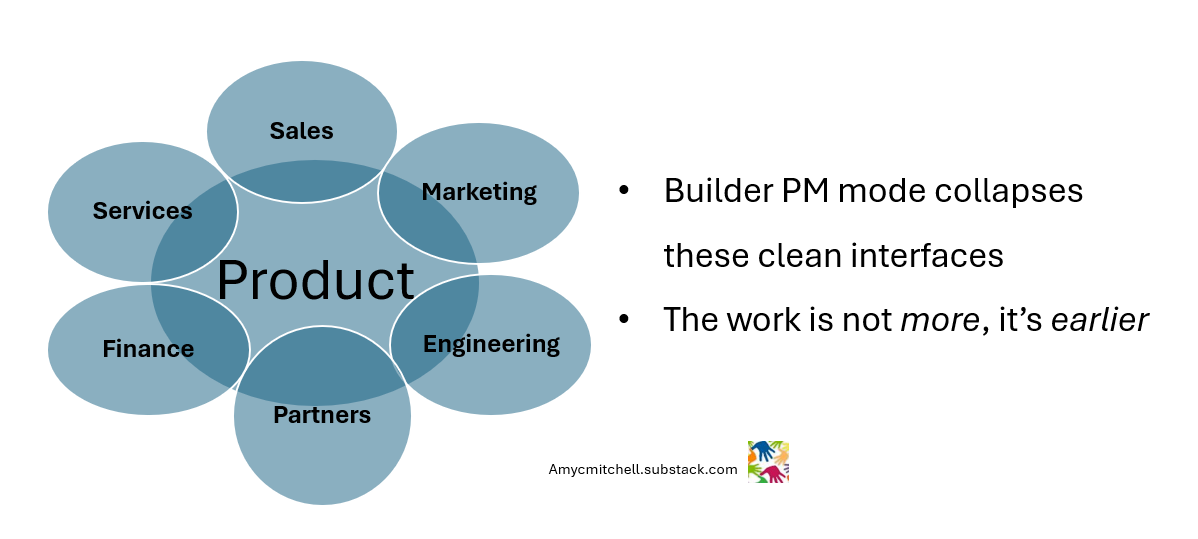
This is where abstraction quietly stops helping and starts hurting.
The quiet cost of abstraction
In stable systems, product managers cultivate long-term relationships. These relationships let product managers anticipate customer needs and plan for innovation.
With rapid change and fast-moving competitors, your team of subject matter experts unintentionally becomes a boat anchor when pace outstrips coordination. You no longer have the luxury of discussing patterns with your team for a durable response.
Engineering, sales and the rest of the product team have silently gone to other places for solutions:
Engineers stop asking product questions because it is faster to decide for themselves
Sales escalations come too late because they found workarounds
Finance puts excessive risk factors on free-running partnerships
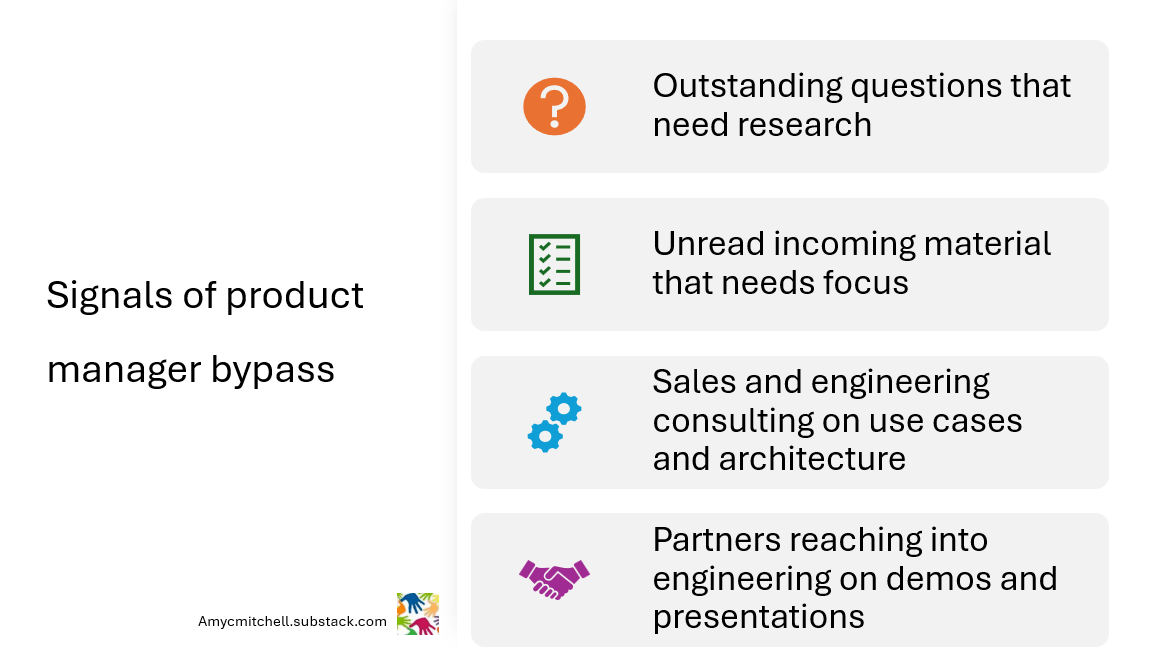
Nothing is broken. Product management just isn’t always the fastest path anymore.
Sales leadership contacted engineering to reduce the CPU and memory resources in the customer portal. Engineering reduced the resources 50% by running without redundancy. With most customers using the portal for mission-critical work, there is no reduction in customer portal resources.
A quick self-check
Balancing efficiency with adding value is tricky in a fast-paced team. Here are some questions to consider:
Who explains partner constraints to engineering?
Who notices compliance or promise risk first?
Who gets pulled into tradeoffs early?
Who do people DM when something “feels off”?
If it’s rarely you, that’s not a motivation problem.
It’s a context gap created by speed.
Builder PM isn’t about doing more work.
It’s about moving the work earlier, before speed removes your options.
Builder PM moves that scale with speed
In builder PM mode, you have a different abstraction from relationships and roles. Flatter organizations and AI mean a more granular abstraction at a system level.
Instead of dealing with the head of sales, now you need to work with account managers and sales engineers in configuring your product for a customer use case. Product managers have AI to learn the subfunctions in the flattened organization.
Builder PMs handle scale by:
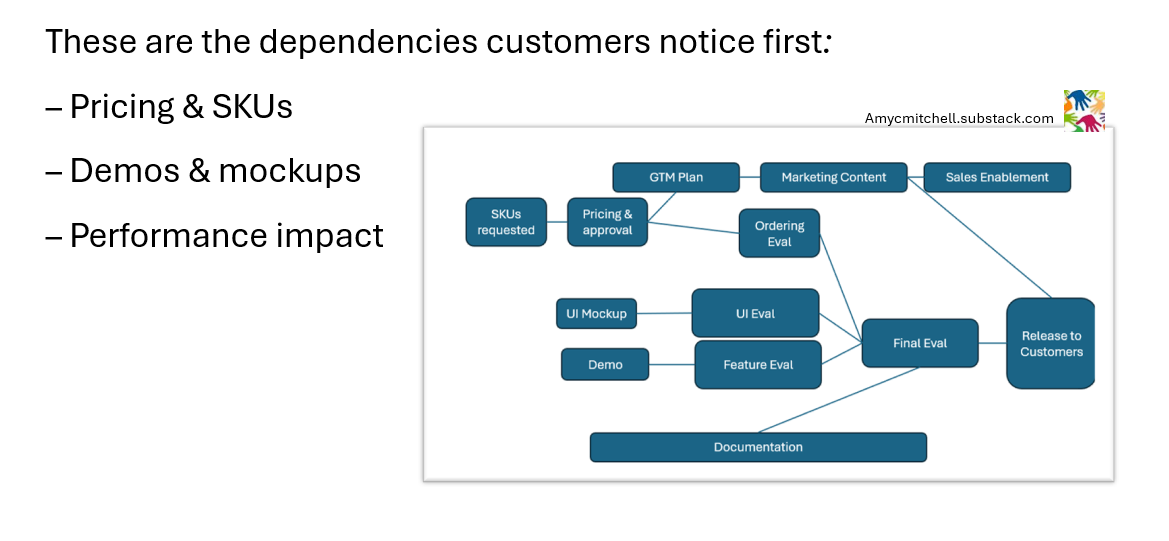
Builder PM Scale Move 1: Mapping dependencies that are customer visible
If everything is customer visible, then you can prioritize into:
Risk of customer satisfaction
Revenue or margin risk
Renewal risk
Level of performance impact
This prioritization guides where you learn first, not what you own forever. You choose where to spend your time based on the iteration cycle, your customer use cases and your product maturity.
Sales has an opportunity and the only missing item is integration with a 3rd party container platform. Engineering says ok since it is like the last container platform. The product manager discovers from the competitive team that the 3rd party container platform is about to be acquired by a competitor. The product manager redirected sales to one of the supported integrations.
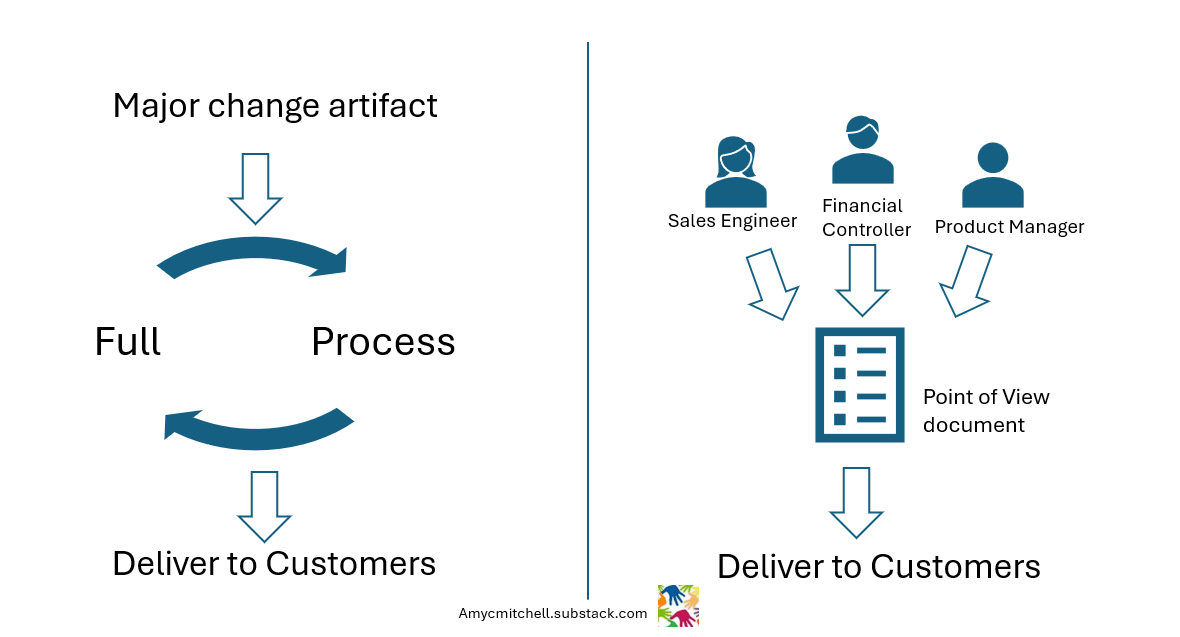
Builder PM Scale Move 2: Borrow expertise instead of waiting for artifacts
Builder PMs develop informal influence so they consult with subfunctions across the product team. A short consulting conversation beats a deck or a document in fast-paced product teams.
You can set an example of loaning your expertise across subfunctions by building in a shared space and offering your expertise. Simple information like what you heard in a recent customer meeting, can make a difference to teams that have no customer contact.
In fast teams, documents explain the past.
Conversations shape the next sprint.
You are working on the requirements for your next feature. You’ve defined over 10 major items that affect sales motion, the business case and pricing. You reach out to a sales engineer to get feedback before writing the PRD. The sales engineer says only 1 requirement matters (customer qualification). Instead of multiple requirements reviews and a lengthy PRD, you add the requirement to the next launch plan.
Builder PM Scale Move 3: Learn where the offer breaks first
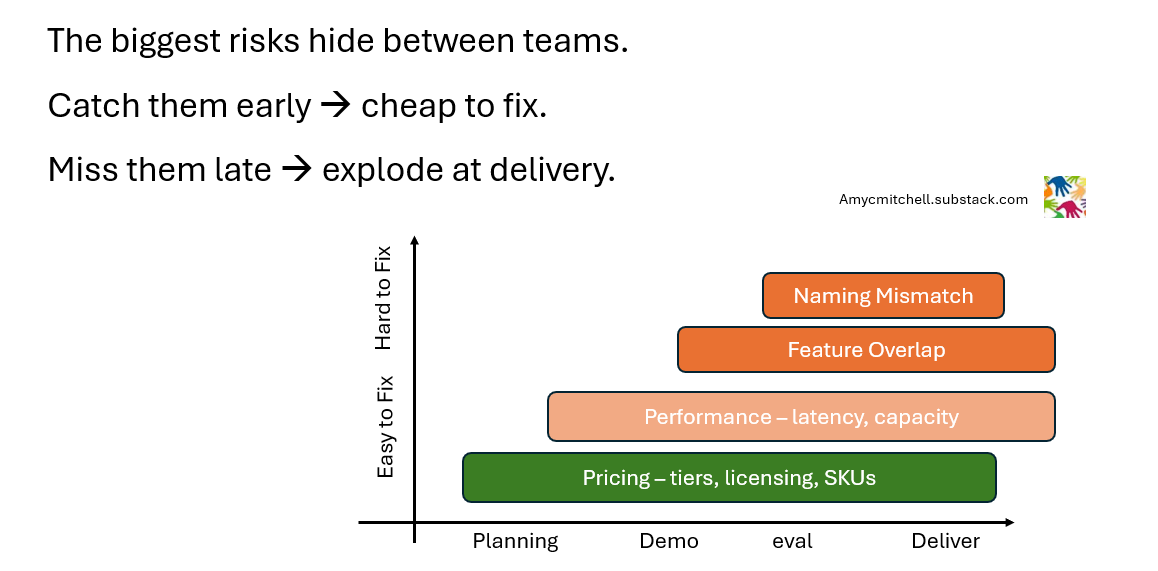
Some of the frequent breaking points in products are:
Pricing edges - tier breaks, customer use cases, licensing, customer onboarding, SKUs
Naming conventions - mismatches can stick out and confuse customers
Compliance - security, privacy, accessibility
Feature overlaps - fast independent teams can have gaps and overlaps
Performance - latency, capacity, bandwidth, responsiveness
Central teams in the organization - platform constraints that impact your product
Builder PMs focus here because this is where speed creates irreversible outcomes.
Sales has a potential customer requesting root cause analysis of problems. Sales bypasses product management and contacts Engineering. The response: Engineering doesn’t do root cause analysis. The product manager didn’t have a chance to respond that the customer success manager analyzes every issue that affects the customer. The customer goes to the competition even though the competition doesn’t offer root cause analysis.
Conclusion - Builder PMs become the backbone as the pace increases
Builder PMs emerge because product speed changes where value lives.
As pace increases, the product managers who hold offer and customer context become the ones teams route through.
Because they help the product keep moving without breaking.
Related articles:
Orchestration for Product Managers
Looking for more practical tips to develop your product management skills?
Product Manager Resources from Product Management IRL
Product Management FAQ Answers to frequently asked product management questions
Premium Product Manager Resources (paid only) 4 learning paths, 6 product management templates and 7 quick starts. New items monthly!
TLDR Product listed Product Management IRL articles recently! This biweekly email provides a consolidated list of recent product management articles.
Connect with Amy on LinkedIn, Threads, Instagram, and Bluesky for product management insights daily.