
Products Are Evaluated Twice Now
Context is the new gatekeeper of purchase decisions

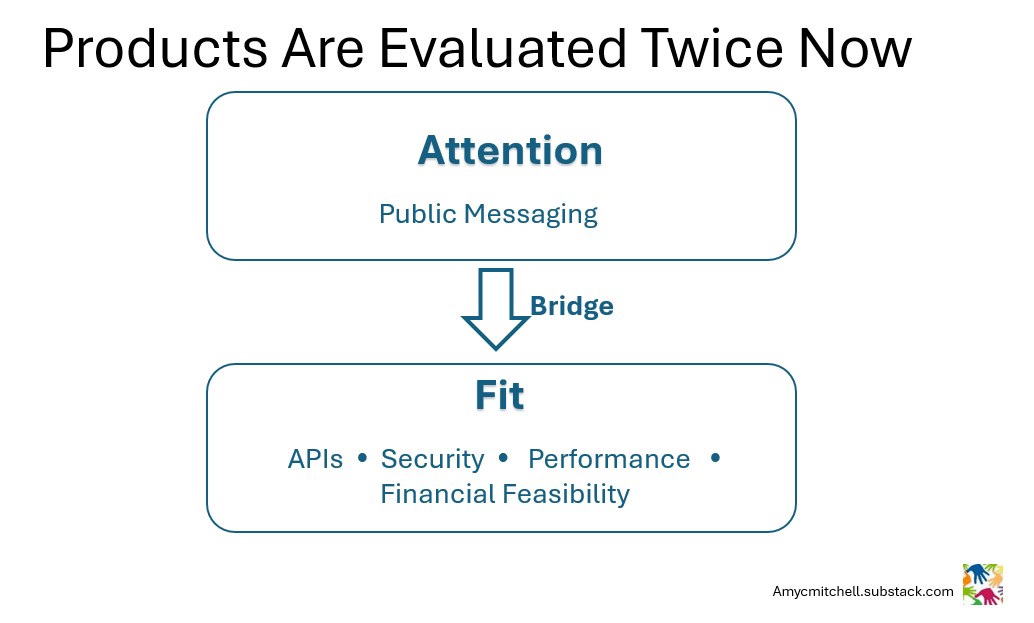
Products are evaluated twice now.
You feel it in customer meetings.
The awareness material worked.
A potential customer shows up interested.
The positioning resonated.
Then the technical questions begin.
How does your API authenticate?
What happens at failure boundaries?
What are the performance constraints under load?
You answer confidently and then realize something.
The material that explains this clearly lives in operational documents.
Customer-only reports.
Internal architecture decks.
It exists. It just isn’t structured for someone deciding whether to buy.
That moment exposes a shift.
Products are no longer evaluated only for relevance.
They are evaluated for fit often before your sales team is involved.
And those are two different evaluations.
One gets you in the room.
The other determines whether you stay.
The Pressure Is Real
Business metrics still matter.
Awareness drives pipeline.
Simplification reduces friction.
Clear messaging helps potential customers know about your product.
Complexity, when introduced too early, can drive buyers away.
Procurement teams and decision-makers already coordinate across more stakeholders than ever. They need clear, high-level material to determine whether something deserves deeper evaluation.
None of that goes away.
Awareness still matters. But awareness is no longer the only gate.
What’s Changed
Purchase decisions now begin long before someone hits a pricing page.
AI tools are used for exploration.
Technical teams independently research integration constraints.
Security teams investigate risk posture.
Finance models cost scenarios before a demo is booked.
Customers have changed too:
Organizations are flatter.
Decision-making is distributed.
Evaluation happens in parallel. And often before your sales team is involved.
And increasingly, part of that evaluation is mediated by AI systems that classify, summarize, and recommend based on the product context that is available.
Which leads to a structural shift.
Products are evaluated twice now.
There Are Two Evaluation Loops
Loop 1: Attention
Skimming webpages and blogs
Scanning datasheets
Checking for broad coverage of pain points
Determining basic category fit
This loop answers:
Is this even relevant enough to spend time on?
Loop 2: Fit
Reviewing APIs and interfaces
Assessing architectural compatibility
Evaluating trade-offs
Investigating security posture
Modeling financial impact
Stress-testing feasibility
This loop answers:
Can this actually work in our environment?
Most products are optimized for
Attention and awareness (Loop 1)
Gated product context for paying customers (Loop 2)
Serious buyers move through awareness quickly — and then begin operating inside the fit loop.
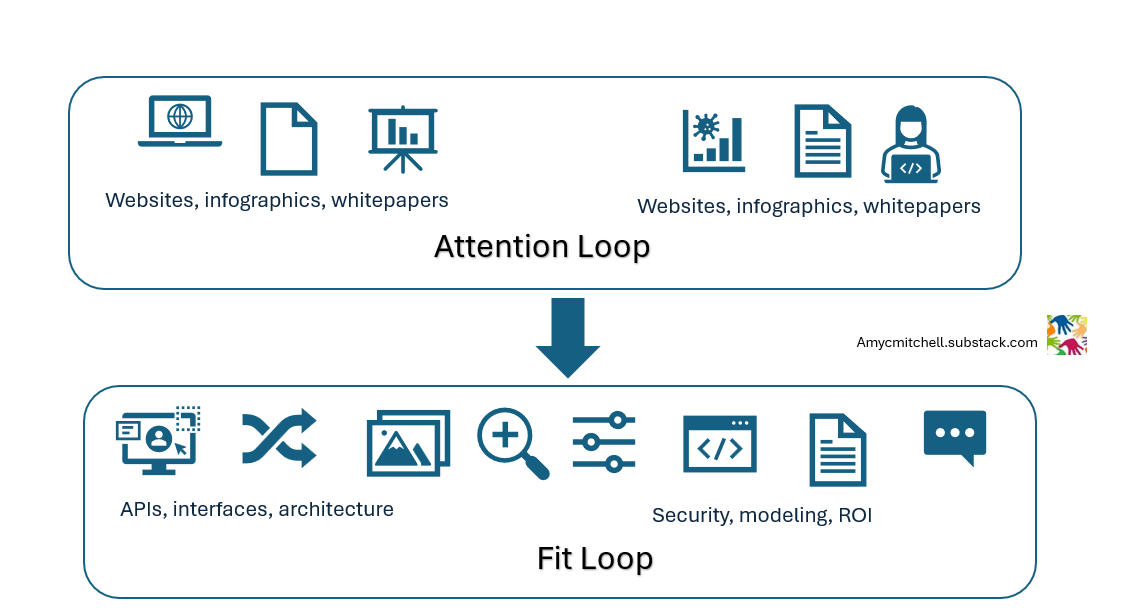
If you optimize only for attention, you generate interest without enabling decisions.
If you optimize only for fit, you risk invisibility.
The challenge is in designing for both. But once teams recognize the two loops, the instinct is predictable: add more context.
The Context Paradox
At this point, many teams reach the same realization:
“We need more context.”
But context introduces tension.
Too little context and your product looks generic.
Too much context and you expose proprietary detail.
Ungated material can benefit competitors.
Over-gated material slows serious buyers.
And internally, no team has capacity to produce endless versions of everything.
This is where the real work begins. Designing context for two evaluation loops is new work for many product teams.
Where the Gap Appears
Product teams feel this most clearly in customer meetings.
The awareness material has done its job. A potential customer shows up interested.
Then the technical questions begin.
How does your API authenticate?
What protocols are supported?
How is data segmented?
What are the performance constraints?
What happens at failure boundaries?
This is not a messaging failure.
It’s a structural gap.
And often, the answers live in proprietary documents — partner portals, customer-only reports, internal architecture decks.
In that moment, you notice the gap.
Your awareness material cannot connect cleanly to the context required for serious evaluation.
The Common Objections
When teams consider creating structured context for evaluation, two objections surface quickly.
First:
“We already have that information. It’s in the operational documentation.”
Operational documentation is written for users who have already committed.
Evaluation context is written for buyers who are deciding whether to commit.
Those are different jobs.
Second:
“Every potential customer asks for something different.”
At first glance, that’s true.
But patterns emerge.
Security teams consistently ask about threat models.
Technical teams ask about interfaces and failure modes.
Finance asks about cost drivers.
If every conversation feels unique, it usually means the material hasn’t been structured yet.
Product managers know this intuitively.
Most have a master deck with a core narrative they adapt across situations.
External materials for potential customers work the same way.
Designing Bridges Between Attention and Fit
The solution is designing bridges between awareness material and product context.
1. Map Roles to Evaluation Depth
Different buyer roles need different depths of context:
Procurement needs enough signal to justify internal time allocation.
Technical decision-makers need interface-level clarity.
Security requires documentation artifacts.
Finance needs pricing structure and cost drivers.
Mapping this explicitly reveals what types of documents are needed to support purchase decisions.
Business roles need to understand the financial picture with your product.
Technical roles need to know the cost of using your product.
Both business and technical roles need gated material.
2. Context Gating to Enable Sales
Gating often happens for valid reasons:
For sales follow up and nurturing with lead generators and opt-in offers
For paying customers to get key operational and architectural product information
For channel partners in reseller programs who resell your product
In the world of product context for serious buyers, the product context is often gated information used for operating your product.
Product teams use these options to provide product context to serious buyers:
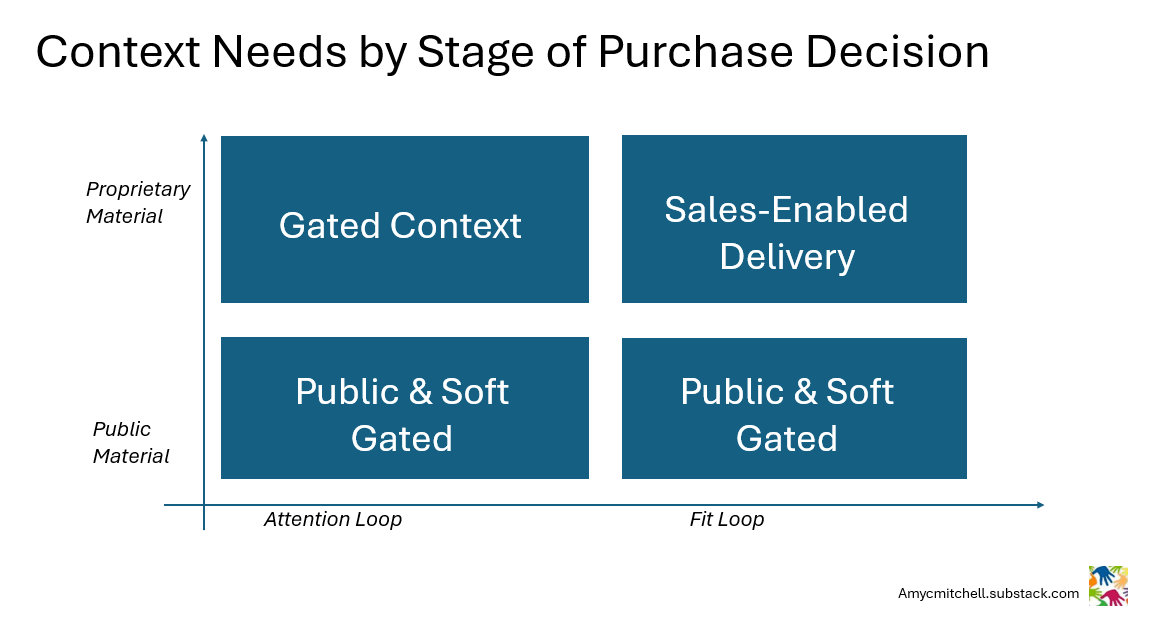
Public material that explains key aspects of your product
Soft gating with an email signup
Hard gating after sales qualification
Sales-enabled direct delivery
A serious buyer should be able to see that a deeper context exists and understand how to access it.
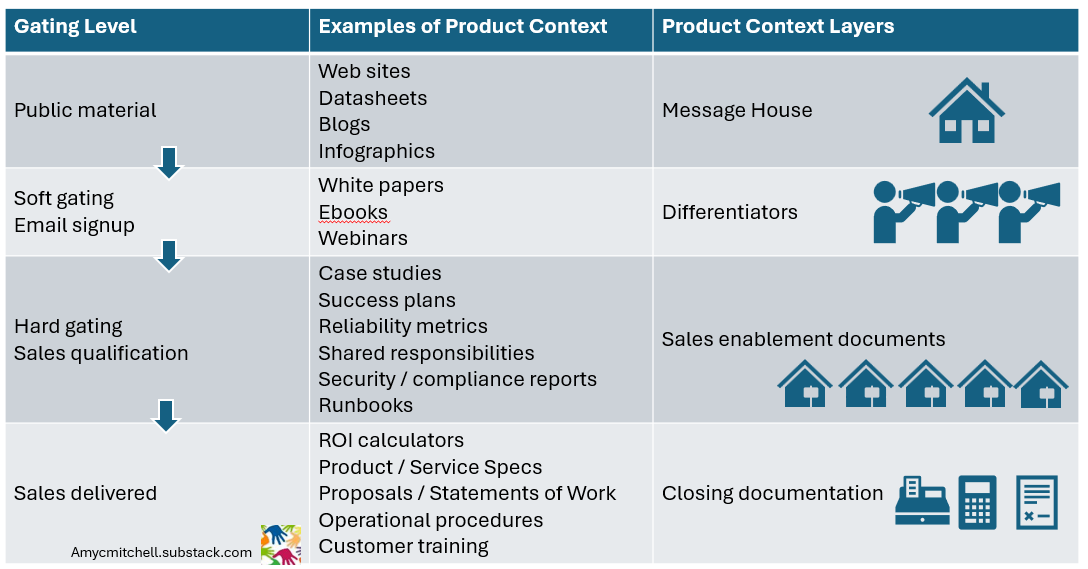
Context gating is good to protect intellectual property but it also prevents AI from finding key product information.
This is where modern product communication becomes architectural: you must decide what the market can see, what AI can classify, and what only serious buyers can access.
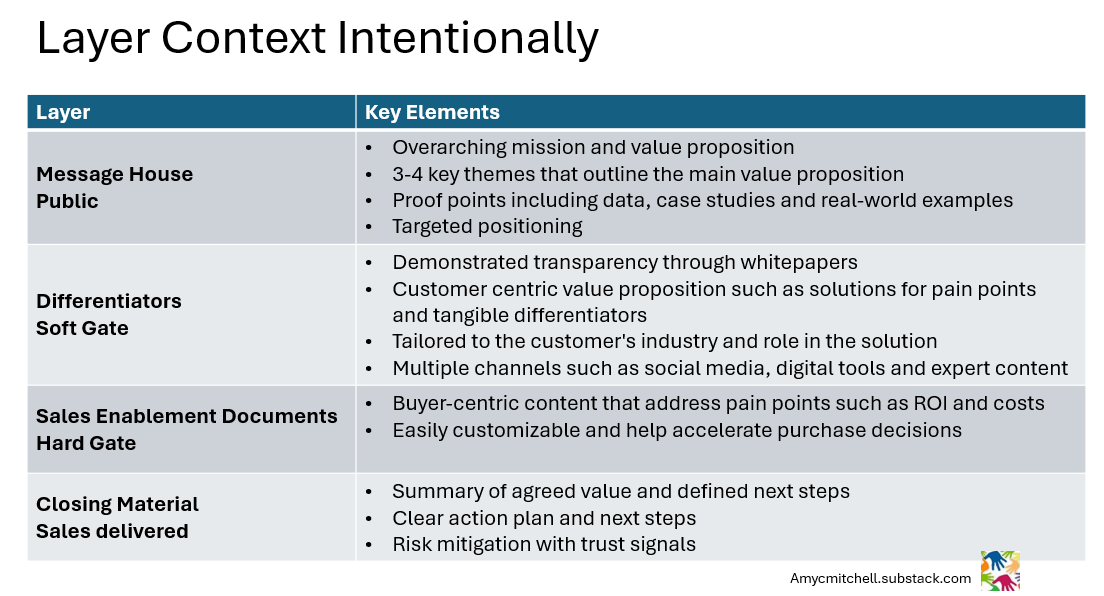
3. Layer Context Intentionally
Not all context needs to exist at the same resolution. Product context plans keep alignment from public communications through each external piece of product context.
The layers to plan after purchase role mapping and gating decisions are:
Message House for public strategy statements
Differentiators to demonstrate transparency
Sales enablement documents that accelerate purchase decisions
Closing material that summarizes agreed value
For example:
Performance information can move from:
Public datasheet language
To use-case-specific whitepapers
To validated performance tables
To customer-only benchmarking reports
Security information can move from:
Compliance summaries
To architecture overviews
To testing methodology
To detailed penetration test results
Why This Matters Now
When potential customers are evaluating your product, they use AI to summarize your awareness material:
Your message house as it appears in public sites
You differentiators that come out of whitepapers
When potential customers move to evaluating fit, they need material crafted for purchase decisions:
Customized sales enablement documents provided in gated product context
Product teams take the lead in architecting the connections from awareness through fit when it comes to product context for purchase decisions.
How Awareness and Context Work Together
In a world where evaluation begins before conversation, disconnected context slows decisions and slows growth.
Awareness material and product context are connected layers in the same evaluation system.
When designed intentionally:
Awareness signals relevance.
Context signals feasibility.
Gated material signals seriousness.
Together, they reduce wasted time for buyers and for product managers.
Context is no longer a byproduct of operating the product.
It is part of how the product is purchased.
The advantage will go to teams who architect their product context as carefully as they architect their product.
Related Articles:
Context Engineering for Product Managers Building a system for product teams to build product context
The Product Perception Loop How to measure and improve how AI understands your product
Builder PMs How to develop product context
Product Explainability Helping AI understand your product
Looking for more practical tips to develop your product management skills?
Product Manager Resources from Product Management IRL
Product Management FAQ Answers to frequently asked product management questions
Premium Product Manager Resources (paid only) 4 learning paths, 6 product management templates and 7 quick starts. New items monthly!
TLDR Product listed Product Management IRL articles recently! This biweekly email provides a consolidated list of recent product management articles.
Drippie Digest featured Product Management IRL articles this year! Handpicked product management articles every day, summarized to give you the big picture of product management and tech.
Connect with Amy on LinkedIn, Threads, Instagram, and Bluesky for product management insights daily.