
Context engineering for product managers
Why product knowledge is becoming key to product managers—and how to build a lightweight system that scales your product, your team, and your AI capabilities.

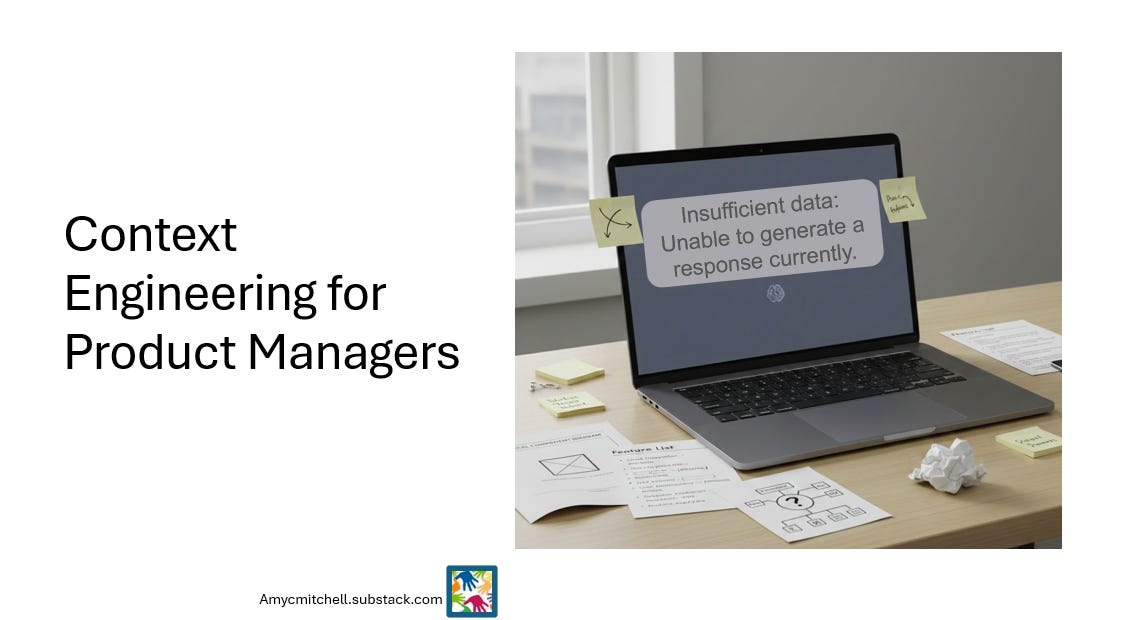
A salesperson pings you with a simple question:
“Does analytics come with the base SKU?”
You open your internal copilot—because that’s supposed to be the fastest way to get the answer.
But today, the answer isn’t there.
You check the old FAQ.
Also outdated.
And then you remember:
You haven’t updated the product repository or the copilot’s context materials since the last release cycle.
A quick question turns into a 45-minute disruption:
answering the question
updating the ordering guide
cleaning up the FAQ
refreshing the AI context so it doesn’t mislead anyone else
This is the real cost of product knowledge drift.
And product managers everywhere are feeling it.
Why This Isn’t Documentation Work—It’s a Growth Lever
Product knowledge used to be an afterthought—docs, FAQs, internal notes.
Not anymore.
Today, it’s the raw material for context engineering: the practice of structuring product information so people and AI systems can understand, explain, and scale your product.
It’s no longer just internal documentation.
It’s how your product behaves when you’re not in the room.
And product managers are feeling the pressure.
Product Managers Say This Work Is Increasing
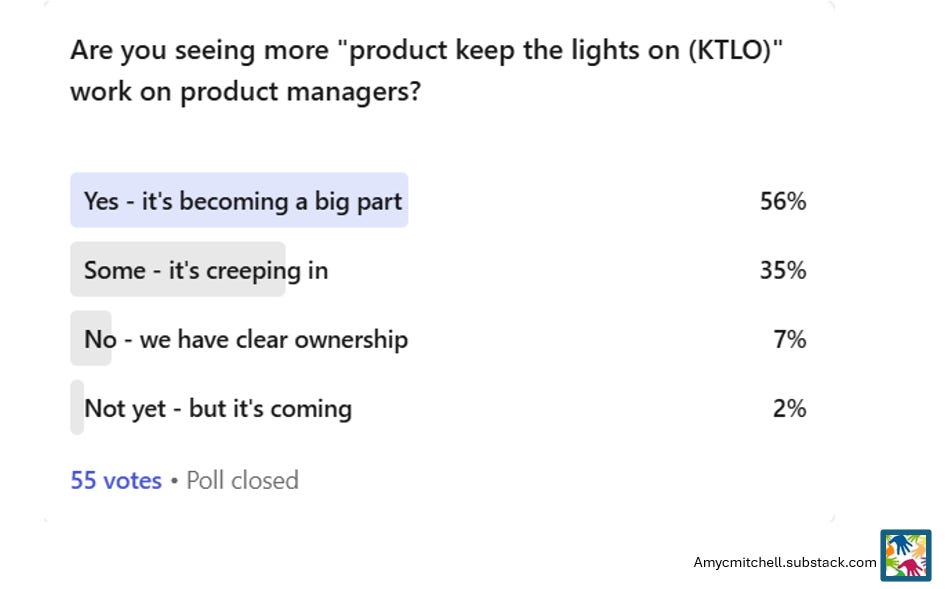
Over 90% of respondents report that maintaining product knowledge is now part of their job.
Typical examples include:
service & product catalogs
pricing sheets and calculators
ordering guidelines
release notes
sales FAQs
AI context & prompt libraries
This used to be shared work.
Now it needs a tight business linkage, and it needs to be updated fast.
Because without it, every workflow—sales, GTM, onboarding, support, internal AI agents—starts giving different answers.
Your product becomes a system of interpretations instead of a system of truth.
Why Maintaining Context Accelerates Growth
Maintaining a clean product context is a commercial and growth advantage.
A well-maintained context system leads to:
1. Faster, more accurate sales cycles
Fewer qualification issues. Less discounting. Shorter paths to “yes.”
2. Stronger GTM alignment
Everyone tells the same story. Messaging amplifies, not fragments.
3. Fewer implementation escalations
Customers know what they’re getting before they sign.
4. AI tools inside your company actually work
When your context is clean, copilots answer with high confidence and less drift.
5. More product manager time for deep product work
Less routing, fewer repeated explanations, tighter focus.
This is about designing the shared understanding that lets the product scale faster than you can personally be present.
Product Knowledge as Context Engineering
People need product knowledge to understand your product.
AI systems need structured context to work reliably.
Together, this becomes your context system—
a repeatable way to maintain structured product knowledge in a shared repository.
Most product managers are already doing this informally:
editing FAQs
correcting copilot outputs
updating pricing logic
writing “quick clarifications” in Slack
explaining the same thing to three different stakeholders
The problem isn’t the work.
It’s that the work is unstructured, reactive, and invisible.
A simple system turns this chaos into leverage.
A Lightweight Way to Start
Here’s a minimal Product Context System you can set up this week.
Step 1: Create a Single Source of Truth (your repository)
Put 5 items in one place:
product & service descriptions
pricing & packaging
release notes
sales FAQ
AI context & prompts
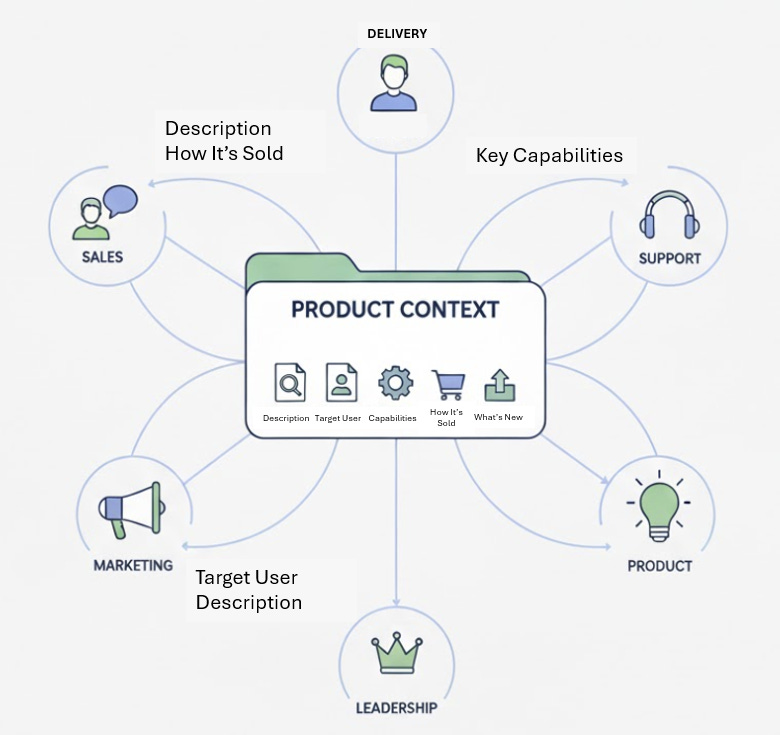
This is your product’s backbone.
Step 2: Add One Layer of Structure
Structure only what you need:
a version number
a simple template
a “what changed” section
Enough to anchor people, not enough to slow you down.
Step 3: Add a Review Cadence
Use existing moments:
planning
pre-release
release announcements
quarterly cleanup
This makes context maintenance routine, not a project.
Step 4: Add One AI Assist
Start small:
AI checks for mismatches between pricing and product description
automatic summaries for sales enablement
draft release notes
highlight drift between versions
This turns AI into a consistency checker.
Step 5: Only Maintain What People Actually Use
If a page or element isn’t used, archive it.
Your context system should be lean, not comprehensive.
The goal is velocity, not new documentation rituals.
Closing: The Work Behind the Work
The product work that creates growth isn’t just what ships.
It’s the context layer that tells the world how your product works, who it’s for, and why it matters.
When product managers build a lightweight context system:
teams align faster
AI becomes trustworthy
sales ramps quicker
onboarding smooths out
escalations drop
and product managers reclaim the time needed for deep product work
Your product can’t scale faster than its context.
But with a simple system, you can make that context work for you—not the other way around.
If you want to see how I’m applying these ideas to my own messy product (this newsletter), I’m sharing the first behind-the-scenes update for paid subscribers.
I’m rebuilding my paid content library so it’s more usable—for me and for you.
In this first update, I walk through:
What I discovered when I tried to make my content “AI-ready”
Why my old structure was holding the whole product back
The early signs that adding structure helps find content
It’s the same challenge many product managers face: we’re expected to scale our product knowledge, but we’re operating with scattered and unstructured material.
Join me as I rebuild mine—slowly, simply, and in public.
Looking for more practical tips to develop your product management skills?
Free Product Manager Resources from Product Management IRL
Premium Product Manager Resources (paid only) 4 learning paths, 6 product management templates and 7 quick starts. New items monthly!
Connect with Amy on LinkedIn, Threads, Instagram, and Bluesky for product management insights daily.