
The Invisible Product Work AI Didn't Replace
Fast Products Still Need Someone Connecting the Pieces

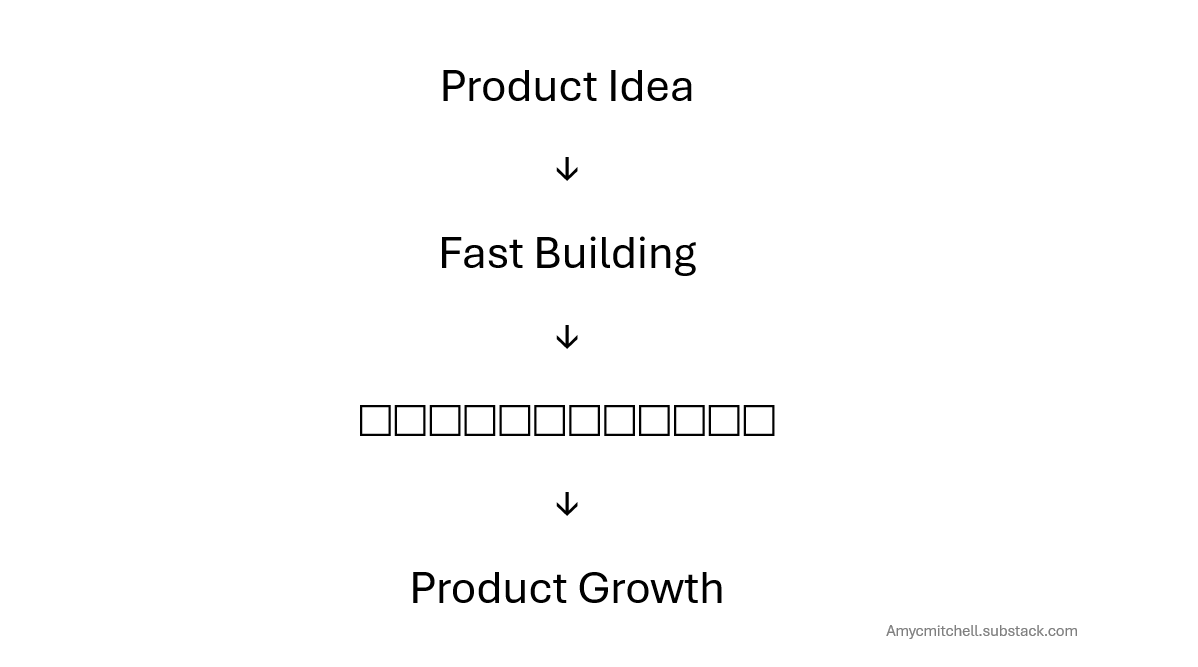
Your product initiative is moving faster than ever.
You have AI helping with research, requirements, and documentation. Subject matter experts answer questions in minutes instead of days. Engineering can prototype ideas almost immediately.
Everything looks like it’s accelerating.
Yet somehow the initiative still feels harder to handle.
New dependencies appear every week. Teams interpret the same requirements differently. Sales asks questions no one anticipated. Small UX decisions don’t quite fit together. The product works, but it doesn’t feel cohesive.
That’s because acceleration didn’t eliminate integration work. It made it easier to overlook.
But products still need someone to connect the work that happens between teams, functions, and decisions.
If no one owns that invisible integration, acceleration starts creating fragmentation instead of product growth.
Acceleration creates more decisions than it removes. Someone still has to connect those decisions into one coherent product.
Builder PMs changed the game
Builders now spend more time validating their ideas, defining solutions and experimenting. Whether the outcome is delivered to customers or improves internal workflows, you see progress daily.
This acceleration creates coordination pressure across your product. That pressure rarely shows up as missed deadlines. It shows up as disconnected decisions.
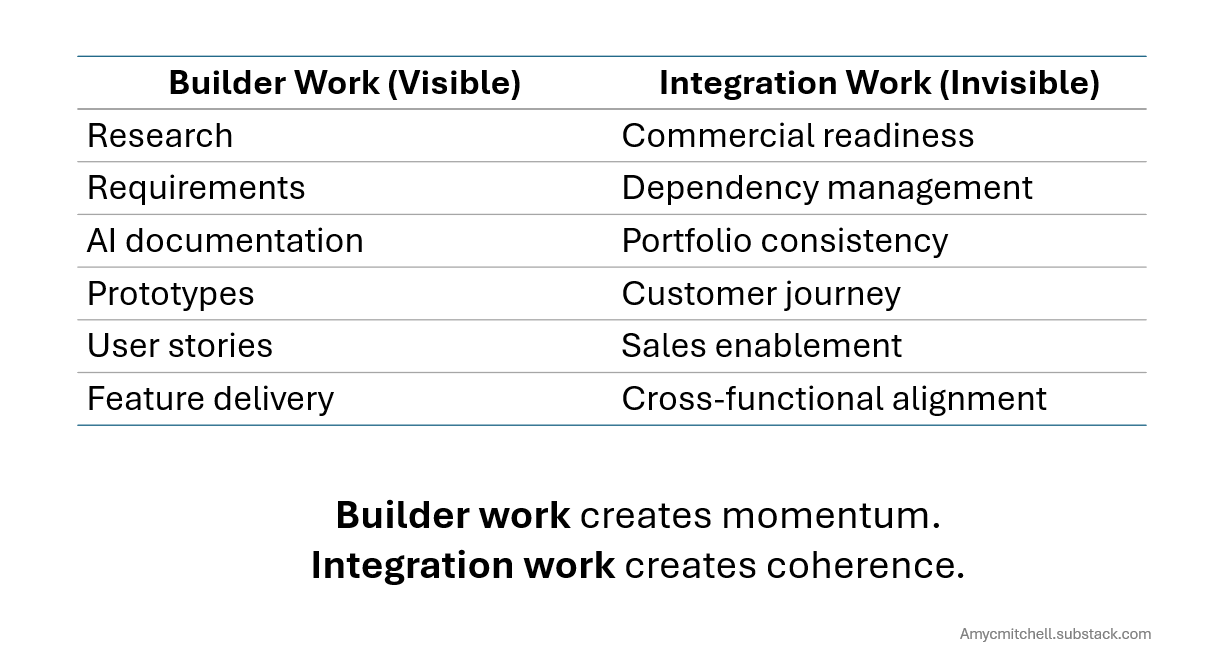
Why fast products become fragmented
On the surface, you’re accelerating:
Requirements
Prototypes
Documentation
Analysis
The invisible integration work has become orphaned.
Most of the team is lulled into good feelings about products shipping.
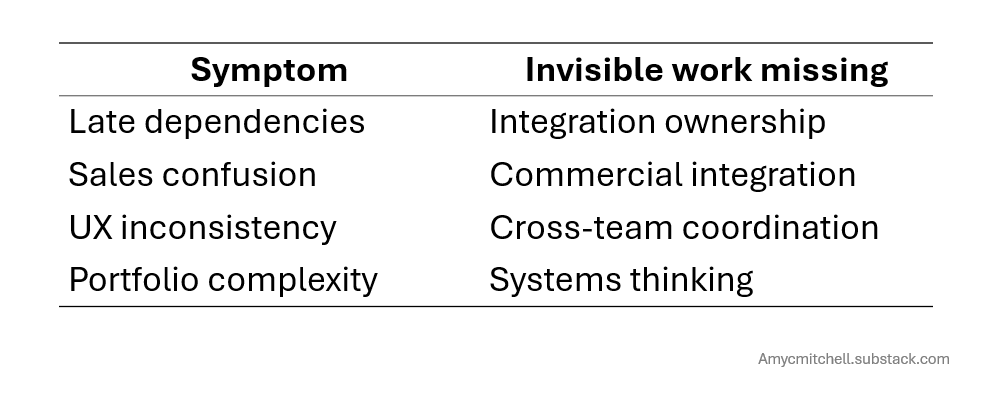
Then the signs that some invisible work is missing:
Requirements are excellent, but sales still can’t position the product.
Teams keep discovering dependencies during implementation instead of before it.
UX is consistent within features but inconsistent across the product.
Every team optimizes locally while the portfolio becomes harder to understand.
The project looks on track until late-stage integration reveals commercial or operational gaps.
If you’re new to Builder PMs, here’s the operating model: https://amycmitchell.substack.com/p/product-operating-model-product-management
If you’re wondering how product decisions become commercial products, this article on solution packaging provides additional context: https://amycmitchell.substack.com/p/builder-pm-product-context
Don’t become the only integrator
The usual fix to these problems is calling you. Because cross-functional issues flow to product managers.
Even though most invisible integration problems land with product managers, that doesn’t mean product managers need to pick up integration work.
The early integration work prevents those last-minute issues that end with “call the product manager”.
But innovative product managers usually aren’t positioned to cover how a product comes together.
Invisible integration often catches preventable problems, such as:
Pricing assumption conflicts
Support isn’t prepared
Onboarding that doesn’t match the workflow
Sales can’t explain positioning
These problems are caused because no one continuously connected the pieces. Your goal is to make sure invisible integration has an owner.
Most organizations solve these problems by pulling the product manager back into coordination. That’s the wrong long-term solution.
Four ways to expose invisible integration
There are a few things product managers can do to get integration owners early while staying focused on product work.
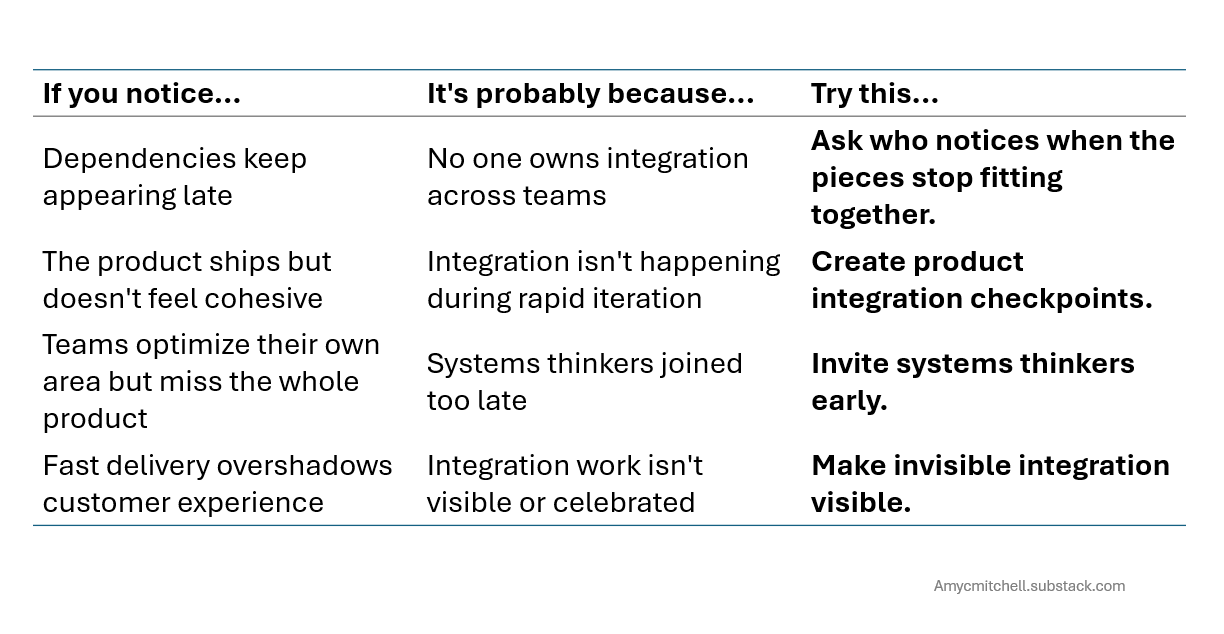
Who notices when the pieces stop fitting together
Often, the job of protecting the product is about handling risks and dependencies. But if product work is iterating rapidly, product managers are in the middle of the pieces coming together.
The thinking goes: people closest to the work know the risks and dependencies. Watching out for integration issues isn’t a priority in accelerated builder PM work.
Watch for this:
No one is asking how the changes affect sales or support of the customer journey.
Why this happens
People in the middle of product work won’t realize when pieces stop fitting together.
What to change:
Before building starts, ask “Who will notice if this change misses the mark?”
Instead of waiting for customers or stakeholders to notice a problem, you can get an owner for risks and dependencies.
Create product integration checkpoints
How your product touches sales and business operations is easy to overlook. Instead of focusing on schedules and critical paths, you can organize integration checkpoints as you build.
Typical checkpoints are:
Early architecture review of an upcoming change - look for disconnects between business and technology
Review commercial readiness - some teams do a walk-through of the changes in the customers’ journey
Customer experience consistency - demo planning and demos with the cross-functional team
Watch for this:
End-stage surprises that conclude with “no one told me about this”.
Why this happens
Fast-moving teams don’t see the inconsistencies across the product.
What to change:
Pause for value-add integration check points so everyone can see the product come together.
Invite systems thinkers early
Systems thinkers recognize patterns long before specialists do. Each product team has system thinkers:
Architects
Program managers
Delivery leaders
Operations
These are the people who see around corners and don’t hold back on feedback. These systems thinkers can grasp your barely started concept and discuss risks.
Watch for this:
You are making changes, but people are too busy to give feedback.
Why this happens
“Early” doesn’t have meaning when features take days to develop.
What to change:
Bring in systems thinkers earlier than ever before to prevent problems.
Make integration visible
When people notice an integration gap and handle it, then celebrate it. There is more to your product than shipping the next feature. Delighted customers value the whole product and not one part.
Celebrate the things that make a difference to customers:
avoided rework
dependency discovery
consistent customer journeys
reusable capabilities
Watch for this:
Heroic last-minute saves before customers are affected.
Why this happens
Attention to fast customer delivery overshadows delivering an exceptional customer experience.
What to change:
Recognize the integration moments to give focus on the customer experience.
Conclusion - Connecting pieces for growth
AI lets one product manager accomplish the work that once required several people.
The faster your product organization becomes, the more valuable invisible integration becomes.
Your next acceleration challenge may be ensuring someone owns integration.
Acceleration builds products. Invisible integration builds product growth.
Q&A
Isn’t invisible integration just product management?
No. Product managers own product decisions. Invisible integration ensures those decisions become one coherent customer experience.
Different organizations assign that work differently.
Who usually owns invisible integration?
It depends. Sometimes: program managers, staff product managers, architects, product operations, or engineering managers.
The important part is that someone owns it.
Do program managers and project managers do this kind of work?
Yes, they are some of the key systems thinkers who work on product initiatives. Their value comes from seeing connections across teams. Fast product iteration can unintentionally bypass that perspective unless they’re involved early.
Why do product managers need to invite program and project managers to join their initiatives?
The rapid product development loops make it difficult to find an insertion point. Bringing them in early shows the bigger picture where they can contribute. Once in the product development loop, it is challenging for program/project managers to have enough background to anticipate dependencies that affect customers.
Looking for more practical tips to develop your product management skills?
Product Manager Resources from Product Management IRL
Product Management FAQ Answers to frequently asked product management questions
Premium Product Manager Resources (paid only): This month’s guide focuses on AI-assisted product initiatives. It helps you build context that your whole product team can use.
TLDR Product featured Product Management IRL articles recently! This biweekly email provides a consolidated list of recent product management articles.
drpp The Drip featured Product Management IRL articles. This newsletter handpicks product management articles every day, summarizing them to give you the big picture of product management and technology.
Connect with Amy on LinkedIn, Threads, Instagram, and Bluesky for product management insights daily.