
How to Move Fast Without Pulling the Product Apart
A builder product manager's approach to architecture, offers, and business signals

Vivek is moving fast in his product work.
Every few weeks he would show something impressive — a new capability, a clever optimization, a tool that made part of the system better.
From the outside, the product looked busy and innovative.
But those capabilities rarely showed up anywhere else.
They weren’t part of an offer.
They didn’t complete a customer solution.
Sales didn’t know when to talk about them.
The problem was that the work didn’t connect to the product system that turns capabilities into growth.
Over time the product accumulated bright spots. Impressive capabilities that exist in the product but never connect to the system around it.
Most fast-moving product teams eventually experience this pattern.
Capabilities ship quickly. The product looks active. But the work doesn’t compound.
Builder PMs play an important role here.
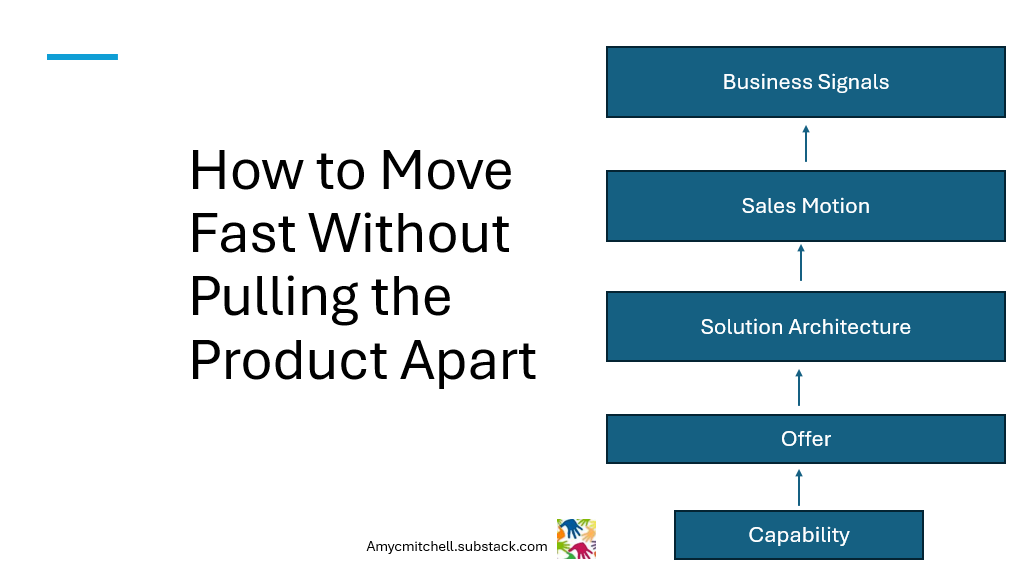
They help connect those capabilities to the product spine — the part of product context that ties together:
offers
solutions
sales motion
and the business signals leaders care about.
When those connections are clear, capabilities compound into momentum.
When they aren’t, the product fills with bright spots.
Most product managers are focused on their new capability. They are working with engineers, reviewing architecture, and trying to move something meaningful forward.
They rarely have time to step back and consider how each new capability connects to the broader product system.
When Bright Spots Don’t Add Up
Builder PMs are often celebrated for cutting through red tape and shipping quickly. They combine technology understanding, customer curiosity, and persistence to move work forward.
That speed can create impressive capabilities.
But customers don’t buy capabilities.
They buy solutions to their problems.
It’s common to see situations like these:
AI features that support every infrastructure stack—from NVIDIA to AMD to Intel—but customers can’t see how to move from proof-of-concept to production.
Storage that works across virtualization platforms—from VMware to OpenShift to Hyper-V—but customers can’t clearly see utilization or efficiency.
A new product with APIs, MCP integration, and webhooks—but no clear guidance around security or governance.
Each of these can feel like a win inside the product team.
But to customers and sales they appear as isolated capabilities.
Bright spots.
Customers quietly move on because the pieces don’t add up to a solution they can buy.
Builder PMs often respond by building more.
Eventually, something will stick.
But in today’s environment, tolerance for misses is low. Leadership is looking for clear signals of profitable growth.
Bright spots only matter when they contribute to solutions and when those solutions connect to business results.
The problem usually isn’t the capability itself.
It’s the missing connections around it.
Strong products have a structure that holds those connections together.
The Product Spine
Products have a structure that holds the business and technical elements together.
Think of it like a spine.
New capabilities should connect to that structure so the product moves forward as a system.
Without that connection, features behave like loose limbs. They may be impressive on their own, but they don’t help the product move in a clear direction.
The Product Spine connects new capabilities to four things that matter to the business:
The offer
The solution
The sales motion
The business signals
Builder PMs often use a simple rule.
Before shipping a capability, ask how clearly it connects to these four parts of the product spine.
When the connections are clear, the capability strengthens the system.
When they aren’t, it’s likely becoming another bright spot.
When a product manager introduces a new capability, I use a set of questions with teams.
It’s four questions that quickly reveal whether a new capability strengthens the product or becomes another bright spot.
I’ll walk through the thinking in this article, and I’ve collected the diagnostic and working practices in a short guide at the end.
1. Offer Attachment
Every capability should strengthen a clear offer.
An offer includes the core value, packaging, pricing, and positioning story that customers understand.
When a capability reinforces the offer, sales can easily explain why it matters.
When it doesn’t, the capability becomes another add-on that complicates the product.
Before shipping, builder PMs ask:
Which offer does this capability live inside?
Does it reinforce the packaging?
Does it simplify or complicate pricing?
Can sales position it clearly?
If a capability can’t attach to an offer, it will likely remain a bright spot.
2. Solution Attachment
Customers rarely buy a single capability. They buy a solution that helps them accomplish a goal.
Solutions combine multiple products and capabilities into a coherent outcome.
Builder PM work strengthens that solution architecture.
Questions to ask:
What part of the customer problem does this complete?
Does it integrate naturally with adjacent capabilities?
Does it simplify the solution story or complicate it?
If the capability doesn’t make the solution more complete, sales will struggle to include it in the conversation.
3. Sales Motion Attachment
Even strong solutions must fit the sales motion.
Sales teams rely on repeatable ways to introduce, demonstrate, and expand product value.
Builder PM additions should make that motion easier, not harder.
Questions to consider:
Does this shorten the sales cycle?
Does it create a clear entry point for customers?
Does it enable expansion into adjacent capabilities?
Does it simplify demos and customer conversations?
Capabilities that complicate the sales motion, often go unused. Even if technically impressive.
4. Business Signal Attachment
Leadership ultimately looks for signals of business progress.
Every builder initiative should connect to a signal the business already cares about.
Examples include:
Attach rate
Expansion revenue
Increased average deal size
Faster sales cycles
Lower cost to serve
When those signals move, leadership can see the strategy working.
Without those connections, even strong product work looks like experimentation.
The Payoff
Most builder PMs don’t control the entire product spine.
They may not own pricing, packaging, architecture, or sales plays.
But they can still work through the spine.
Builder PMs strengthen products by asking a few important questions before they build.
Over time, those questions help the team:
surface fragmentation risks early
connect capabilities to solutions
raise trade-offs through product coherence
tie product work to visible business signals
Small improvements compound.
Instead of creating isolated bright spots, builder PMs help the product move forward as a system.
Over time, I’ve found a few practical techniques that help builder PMs. I’ve collected these practices into a short guide I use when working through new capabilities.
It includes:
a quick diagnostic for identifying bright spots early
simple architecture review questions
a method for whiteboarding solutions with your team
a way to map new capabilities into the sales motion
These small steps help builder PMs strengthen the product spine while continuing to move quickly.
Closing
Builder PMs don’t just ship capabilities.
They quietly strengthen the structure that turns capabilities into solutions—and solutions into growth.
Over time, that structure becomes the difference between a product full of bright spots and a product that moves forward together.
Looking for more practical tips to develop your product management skills?
Product Manager Resources from Product Management IRL
Product Management FAQ Answers to frequently asked product management questions
Premium Product Manager Resources (paid only) 4 learning paths, 6 product management templates and 7 quick starts. New items monthly!
TLDR Product listed Product Management IRL articles recently! This biweekly email provides a consolidated list of recent product management articles.
Drippie Digest featured Product Management IRL articles this year! Handpicked product management articles every day, summarized to give you the big picture of product management and tech.
Connect with Amy on LinkedIn, Threads, Instagram, and Bluesky for product management insights daily.
One pattern I've seen work: treat the brightest bright spots as accelerants. Let a thousand flowers bloom, identify the two or three with real signal, then invest in connecting those to the full product spine. The sequencing matters — you can't force ecosystem effect before you know what's actually resonating.