
From Product Integration to Product Acceleration
Why IC product managers need a new operating model

At some point, as an IC product manager, your calendar starts to change.
Reading the meeting transcript is quicker than attending the meeting. Operational decisions resolve themselves before you step in. Product teams mock up experiences directly with customers and fix issues in hours instead of weeks.
You suddenly have open space again.
And instead of feeling productive, it feels disorienting.
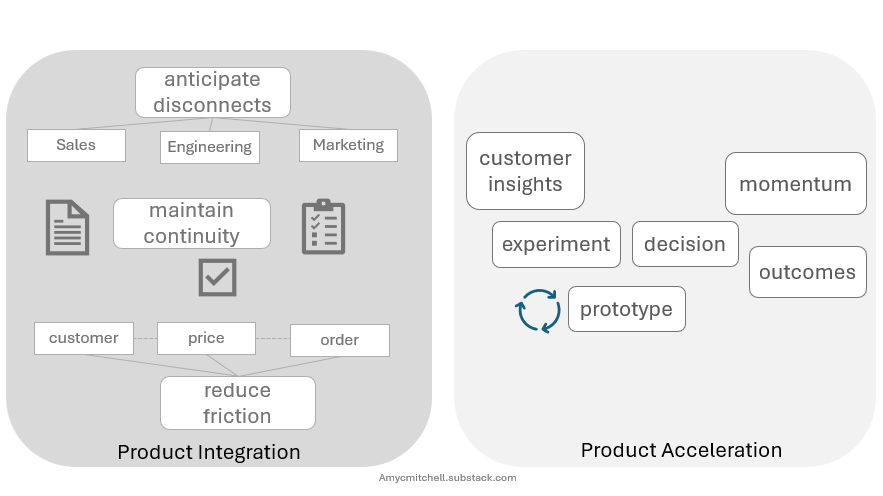
For years, product manager leverage came from product integration:
connecting stakeholders,
driving alignment,
ensuring releases met requirements,
reducing delivery friction,
anticipating disconnects before customers saw them.
But teams move differently now. There is less need for product managers to constantly stitch work together.
The uncomfortable realization is that many product managers still operate like product integrators in an environment that increasingly rewards product acceleration.
This article is about learning how to use the freedom well.
The uncomfortable moment: your product integration can become avoidance
Being busy and in demand isn’t as valuable as it used to be.
A lead engineer can’t remember why a customer wanted that UI change. Finding the screenshot is easy. Just look it up and move on.
This simple act takes away a chance to collaborate on the customer experience. Together, you and engineering can see other UI rough edges, like headers not aligned with data.
You’re substituting easy responses in place of handling the harder work.
Your challenge is putting your deep work on:
Reducing ambiguity
Identifying real customer pain
Making strategic judgment calls
Creating momentum
Your product integration instincts become a substitute for confronting uncertainty directly.
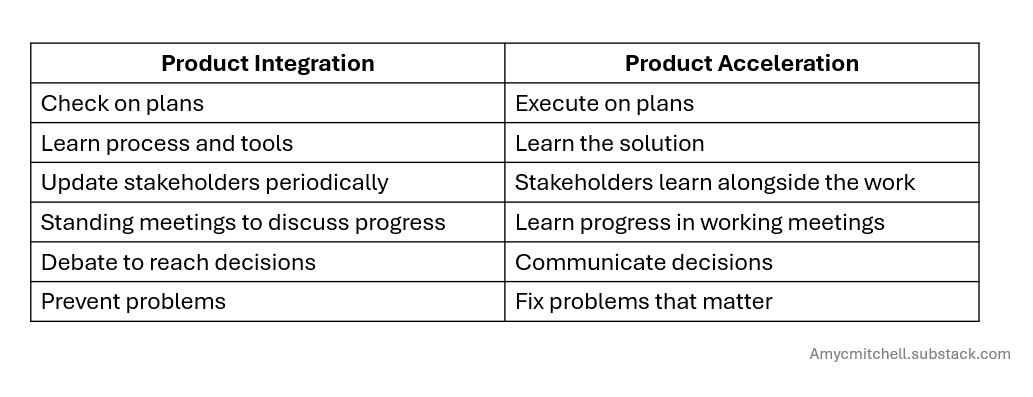
Product integration still matters in complex environments, large cross-functional launches, and dependency-heavy programs.
But for many product managers, integration is no longer the primary source of leverage.
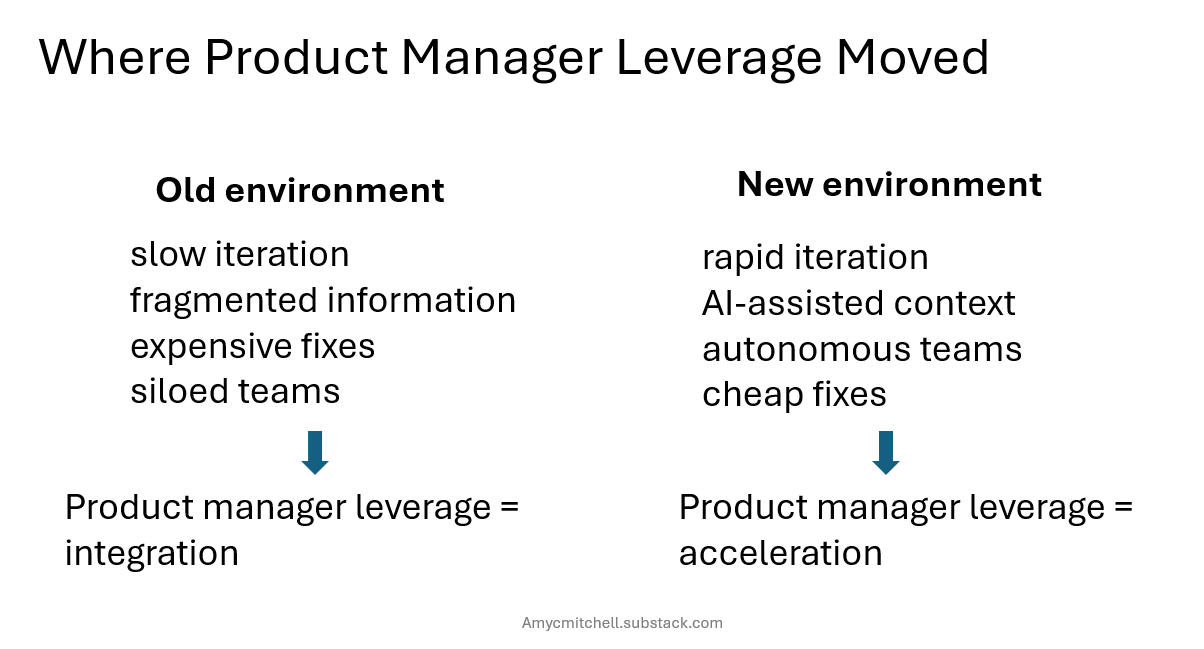
Why the environment changed
When everyone has access to data and AI helps organize data, then there isn’t much need for product integration. Teams have:
Fast communication loops: meeting transcriptions minutes after the meeting
AI assistance: to organize context
Easy self-correction: fixing the misses is fast
This means each person in the product team can be autonomous. The bottleneck moves to tangible product acceleration.
What does product acceleration work look like?
Builder PMs create momentum by sharing context and learning earlier. Examples:
You clarified a confusing customer problem
Now, engineering, design, and GTM all understand the same thing.
You identified the real adoption blocker
The issue wasn’t missing features. It was onboarding friction.
You changed the narrative
The product wasn’t “missing capabilities.”
Customers simply didn’t understand the value
You connected the disconnected signals
Support issues, sales objections, and usage drops were actually one underlying problem.
You exposed false urgency
A noisy stakeholder request turned out to have no customer impact.
You made the next decision obvious
This is huge leverage and is rarely celebrated enough.
These outcomes don’t come from polished status updates. They come from faster learning loops:
Constant build-in-the-open: sharing research and point of view before it is “ready”
Working teams: build relationships and compare work
Experiments: hypothesis as a precursor to decision-making
Rapid iteration: learn and adjust with working teams
These outcomes require a different way of spending attention and time.
The product acceleration operating model
Adapting to a different operating model can shift you out of product integrator to product builder. Your operating model has served you well. Small adjustments let you build on the environment changes.
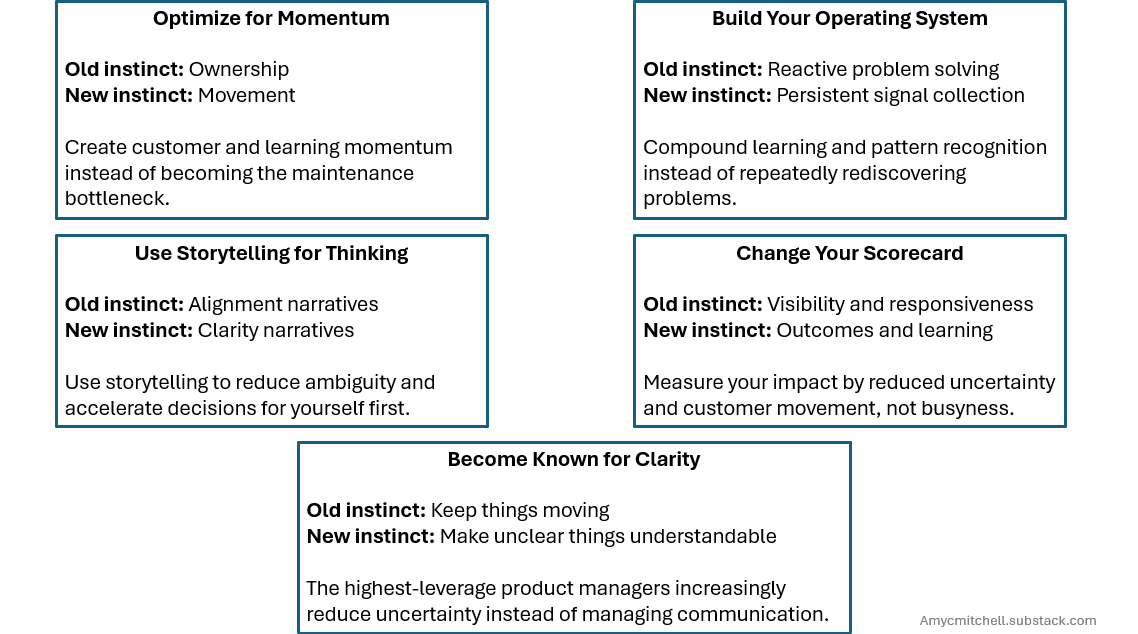
Optimize for momentum over ownership
Ownership creates maintenance gravity.
Momentum creates learning and movement.
The product integrator instinct
Owning living documents. Acting as the approval layer to prevent costly problems.
Why it breaks down
Ownership creates maintenance and turns you into a coordination bottleneck.
The builder shift
Focus on users of the living document and drive to their needs. Living documents move to build-in-public.
What this looks like practically
No longer paying attention to issues and changes in the living document. The living document is maintained by the team.
This frees you to:
Address customer pain points with fast loops
Handle undefined opportunities
Support the unowned workflows
Why this matters
You spend less time maintaining systems and more time creating movement.
Build your own operating system
Builder PMs compound learning instead of repeatedly rediscovering problems.
The product integrator instinct
Reactive problem solving.
Why it breaks down
Because teams can self-correct quickly, product integration reactions are wasted time. Evals catch problems and generate fixes faster than reaction meetings.
The builder shift
Persistent signal collection
What this looks like practically
Your operating model shifts from preventing problems to monitoring signals. Monitoring is continuous:
Customer friction points with your product
Demand validation points
Potential adoption blockers
Evals and feedback
Identifying hidden stakeholders
Why this matters
You stop solving isolated problems and start building reusable judgment.
Use your storytelling skills for building
Narrative is no longer just stakeholder management. It becomes a tool for thinking clearly.
The product integrator instinct
Storytelling to gain alignment
Why it breaks down
If you can’t explain the opportunity to yourself, then you probably can’t build a solution.
The builder shift
Using storytelling to reduce ambiguity for yourself.
What this looks like practically
Build your own narrative to explain to yourself:
The user pain
Identify the conflict simply
Suggest the solution
Describe the outcome
Using this plain language, you can move from problem to solution very fast.
Why this matters
Create a stakeholder story for yourself to build quickly.
Change your scorecard
Changing your scorecard to learning and customer benefits leads to real growth.
The product integrator instinct
Measuring how you are needed:
Meetings
Responsiveness
Stakeholder visibility
Coordination heroics
Organizational presence
Why it breaks down
Debating possible efficiency gains that aren’t visible to customers
The builder shift
Measure and celebrate progress to results
What this looks like practically
Measuring your results:
Clearing confusion
Improved customer understanding
Shipping something
Behavior changed
These results are more valuable to celebrate than how much you are needed.
Why this matters
The hardest part is that deep product work often feels quieter than product integration work.
Become known for clarity
As teams become more autonomous, the highest-leverage product managers increasingly reduce uncertainty instead of managing communication.
The product integrator instinct
Product integrator reputation:
The person who keeps things moving
Why it breaks down
Monitoring for likely outcomes is slower than an eval and fix.
The builder shift
Product accelerator reputation:
The person who makes unclear things understandable
What this looks like practically
Shift your reputation to the person who figures things out: Some of the clarity-finding actions are:
Find clarity on something unclear
Make new opportunities real
Turn vague strategy into customer value
These things take continuous learning and relationship building to put into action.
Why this matters
Figuring out what works and doesn’t is a high-value skill.
Shifting from product integrator to product accelerator
In the past, being the product integrator gave constant reinforcement:
People need you
You’re busy
Meeting show importance
Responsiveness created validation
Building work for product acceleration is harder because:
Progress is quieter
Ambiguity is uncomfortable
Nobody tells you what to do
You must decide your best next step
Product integration work gives immediate social feedback. Builder work gives delayed outcome feedback. That’s why many product managers unconsciously drift back toward product integration.
Builder PMs get more satisfaction from product acceleration:
Uninterrupted thinking
Discovering hidden opportunities
Seeing patterns compound
Customer understanding
Momentum from clarity
Creating direct outcomes
In a fast-iteration environment, the work becomes quieter, but you can get more done.
Conclusion - building is more satisfying
The strange part of becoming a builder PM is that your work can start feeling quieter while your impact grows larger.
Fewer meetings.
Less debate.
Less visible coordination.
More clarity.
Faster learning.
Better judgment.
More tangible customer outcomes.
You stop measuring your value by how much work flows through you.
You measure it by how much uncertainty disappears because of you.
And eventually, you realize something unexpected:
Building products is more energizing than managing the movement around them.
Q&A
Won’t customers be impacted if I don’t make sure the parts come together as planned?
Product acceleration does not mean abandoning quality checks. It means shifting from personally stitching everything together to creating fast feedback loops that expose issues early. Modern teams can detect and fix disconnects much faster than traditional release cycles allowed.
If my time is on clarifying the unknowns, then how do my leaders know I’m doing my job?
Your leaders want to know your decisions about handling the unknowns. Leaders can check a dashboard and your built-in public artifacts to get details. For example: “I decided to delay the ordering guide by one week to include the feature that 5 customers requested.”
Won’t salespeople take advantage of product acceleration for more customization and experiments?
More contact with salespeople is always valuable. If you get more invalid requests for product changes, then you have a good signal of where to work. Your reaction to increased sales and customer interactions is what matters. You ultimately get to decide your delivery plan.
How can I possibly have an impact alone without project managers and engineering?
You are already alone. Your program managers and engineering team are waiting for your experiments, decisions and clarity. Once you make it clear what is next, they will run with it.
What if my organization still rewards visible integration and coordination activities?
Then some integration work remains politically necessary. But even in those environments, your highest leverage still comes from clarity, momentum, and customer understanding.
Looking for more practical tips to develop your product management skills?
Product Manager Resources from Product Management IRL
Product Management FAQ Answers to frequently asked product management questions
Premium Product Manager Resources (paid only) 4 learning paths, 6 product management templates and 7 quick starts. New items monthly!
TLDR Product featured Product Management IRL articles recently! This biweekly email provides a consolidated list of recent product management articles.
drpp The Drip featured Product Management IRL articles. This newsletter has handpicked product management articles every day, summarized to give you the big picture of product management and tech.
Connect with Amy on LinkedIn, Threads, Instagram, and Bluesky for product management insights daily.