
Solution Packaging Is a Product Problem
A lifecycle framework for turning modular products into repeatable customer outcomes

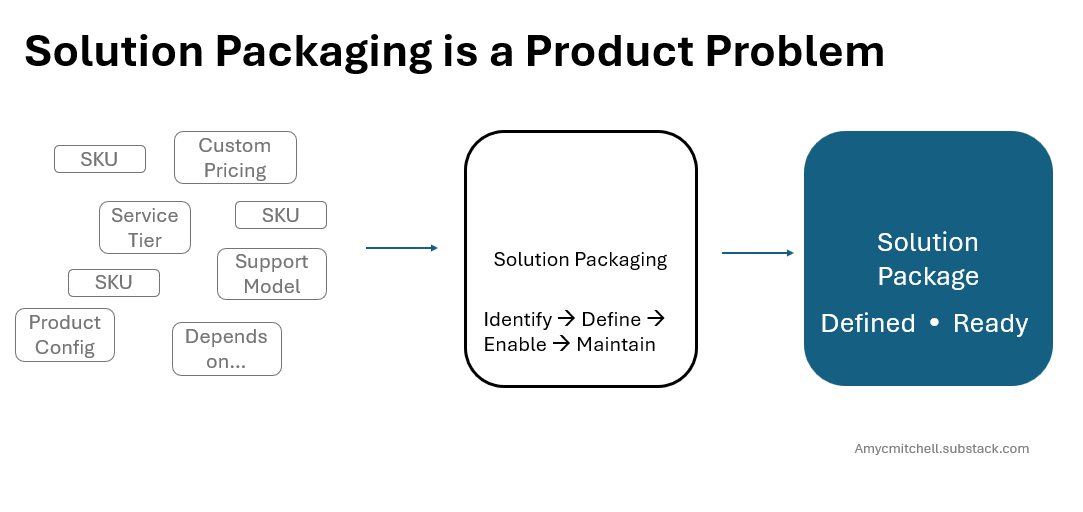
Vivek’s modular products for AI infrastructure aren’t getting adopted.
He’s tried pricing changes. He’s adjusted the positioning. Nothing sticks.
Sales tells him the same thing each time: customers don’t buy the products. They buy a solution.
So subject matter experts step in. They design a full solution for each customer. Assembling the same core components in slightly different ways. Deals close. But each one takes weeks.
The pattern is clear: the same solution is being rebuilt over and over.
But none of it scales.
Adoption isn’t blocked by the product. It’s blocked by packaging.
Most organizations already have solution packages. They’re just scattered, inconsistent, and unowned.
The Hidden Reality of Solution Packaging
You’ll find solution packages scattered across:
sales decks
reference architectures
validated designs
customer implementations
Each one represents a way your products come together to deliver an outcome.
But they drift, diverge, and no one owns keeping them usable.
So the same work gets repeated across deals, customers, and teams.
It’s not whether packages exist. It’s whether product managers design them intentionally.
Product managers who take this seriously don’t treat solution packages as artifacts.
They treat them as products.
That means giving them structure, ownership, and a lifecycle.
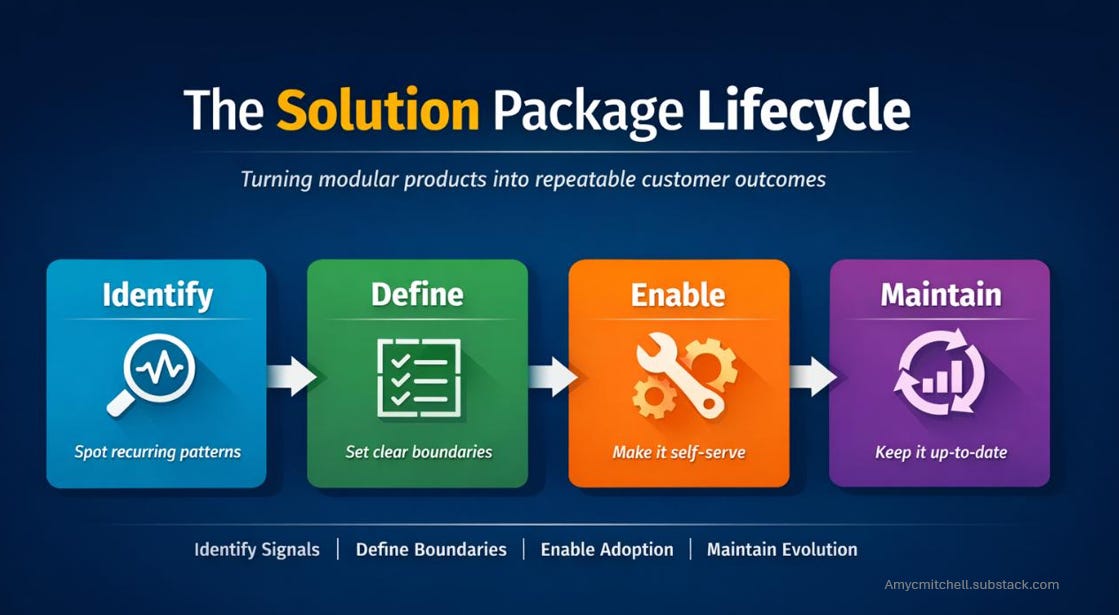
The Solution Package Lifecycle
Identify → Define → Enable → Maintain
Identify → signals
Define → boundaries
Enable → adoption
Maintain → evolution
Each stage is product work. Not sales or services work.
Here’s what that lifecycle looks like in practice:
And importantly, this doesn’t require a heavy process.
Most teams already have the raw material.
The shift is treating it as something to design, not something that just happens.
Phase 1 - Identify (Signals of a Solution Package)
Most solution packages start with a pattern you can’t ignore.
You’re likely ready to define a solution package when you see:
The same customer architecture appearing again and again
The same set of products used together across deals
Heavy solutioning effort from sales or SMEs
Long evaluation or onboarding cycles
At this stage, you don’t have a defined package.
You have a repeatable solution pattern.
And that’s enough to start.
Key insight:
If customers keep assembling the same solution, you have a packaging gap, not a product gap.
Phase 2 - Define (Boundaries of the Package)
Once you see the pattern, anchor the package to what the customer has in 30 days.
Three decisions to define the boundaries of the package
1. What outcome does this package deliver?
Anchor the package to a specific use case and customer type.
Not a broad capability but a concrete result.
2. What’s inside vs. outside the package?
Decide which components are part of the “black box” and which are not.
Include what’s required to deliver the outcome reliably
Exclude what varies too much across customers
If everything is included, it’s not a package.
If too little is included, it’s not usable.
3. Where are the clean interfaces?
Look at where customers struggle today:
data handoffs
system boundaries
operational ownership
Your goal is to minimize friction at the edges, not eliminate it entirely.
Pressure test the package
Before moving on, validate one thing:
Can a typical customer understand the value and see progress within ~30 days?
If not:
the package may be too small (missing key pieces), or
too broad (unclear outcome)
Key insight:
The solution package is the smallest unit that delivers a complete outcome.
Phase 3 - Enable (Make the Package Usable Without You)
A solution package isn’t real until someone can use it without you.
This is where most packages break down.
They’re defined well enough to explain…
…but not well enough to use.
Think like a product
Before writing anything, treat the package like a standalone product:
Who is it for?
Narrow to a specific buyer and use caseWhy would they choose it?
Clarify the value and expected outcomeHow is it bought?
Connect it to pricing (bundled, modular, or incremental)What needs to be true for it to work?
Surface assumptions and constraints early
This keeps the package grounded in adoption and not just architecture.
Then make it usable
At this stage, your job is simple:
Turn the package into something others can reliably implement.
You don’t need a new product build.
You need clear, structured guidance.
Most solution packages require three things:
1. How it works
Make the system understandable as a whole
Architecture and component relationships
Interfaces between products
Data and control flow across the package
2. How to use it
Make the outcome achievable without guesswork
Reference use cases and starting points
Deployment and configuration guidance
Day 1 and Day 2 operations (monitoring, scaling, support)
3. How it evolves
Make it sustainable over time
Versioning and upgrade paths
Compatibility across components
Guidance for extensions and expansions
This is where most of the effort goes.
And it’s also where most of the value comes from.
Key insight:
The documentation is the product.
A practical way to start
You don’t need to build all of this up front.
Start with:
one use case
one configuration
one clear path to value
Then expand as you see adoption.
Phase 4 - Maintain (Keep the Package Real Over Time)
Without maintenance, packages drift back into custom solutions.
New product versions ship.
Customer environments change.
Teams adapt the package to close deals.
Without active ownership, the package drifts and trust in it erodes.
What you’re managing
Maintaining a solution package isn’t about perfection.
It’s about keeping it reliable enough to reuse.
Focus on three things:
1. Version alignment
Keep the package working as underlying products evolve
Track compatible versions across components
Define upgrade paths
Flag breaking changes early
2. Drift from the standard
Understand how real usage differs from the package
Where are teams customizing?
What gets added or worked around?
Which parts are consistently modified?
Drift isn’t failure.
It’s signal.
3. Adoption and reuse
Measure whether the package is actually scaling
Time to first value
Reuse across customers
Rate of customization on top
If reuse is low, the package may be:
too narrow
poorly defined
or not enabled well enough
Close the loop
The goal of maintenance isn’t just upkeep.
It’s learning.
High reuse → reinforce and expand
Consistent customization → pull into the package
Low adoption → revisit boundaries or enablement
Key insight:
High reuse → reinforce. Consistent customization → pull in. Low adoption → revisit boundaries or enablement.
Start small
Product managers often are in Vivek’s situation: new products that buyers are learning to evaluate.
He does four things
Identify a solution package: his last sale was to a research institute and he is getting similar interest from others.
Define the boundaries: he decides on 5 modular products for the solution package. He pressure tests this and confirms most research institutes use the products he selected.
Make it usable: start with a sales 1-pager that includes:
Pre-configured baseline infrastructure
Pre-configured expansions
Operational documentation
Enable sales
By putting the pieces of the AI infrastructure together for a frequent use case, Vivek generated new interest in his products because buyers see the outcome for their use case.
Closing - solution packages for repeatable outcomes
Modular products create the building blocks.
Solution packages create the path to value.
The most valuable feature you can ship?
A package that makes your product easy to buy.
Questions on Building Solution Packages
What are the signs that a solution package would help product adoption?
Evaluating one or two modules is straightforward for most customers. But once a solution requires multiple pieces, buying slows down. There is a tipping point. When customers need five or more modules to solve their problem, adoption often stalls. The 5 module rule for solution packaging decisions.
What if my org doesn’t have a process for packaging?
Since you’re using released products, you don’t need a heavy process. You can lean in to your builder PM skills to define and maintain your initial solution package. Until there is more demand and a need to prioritize engineering resources, you can start with a sales 1-pager that links to the modular products in the solution.
What if sales won’t adopt this?
The solution package starts as a pattern of products sold together. If individual products are selling but the package isn’t being used, that’s a signal to revisit positioning or scope. Allocate time to monitor solution packages for 1-2 quarters after launch. If the solution package isn’t helping with demand or cost reduction, then retire the package and stop maintaining it.
Do I need full automation before doing this?
You don’t wait for automation. Packaging is what makes automation possible. As demand grows, you can layer in solution-specific automation. Stages of automation can be:
Stage 1: Defined manually (your current step)
Stage 2: Read-only solution-specific dashboard
Stage 3: Connect to configuration and ordering tools
Looking for more practical tips to develop your product management skills?
Product Manager Resources from Product Management IRL
Product Management FAQ Answers to frequently asked product management questions
Premium Product Manager Resources (paid only) 4 learning paths, 6 product management templates and 7 quick starts. New items monthly!
Drippie Digest featured Product Management IRL articles. This newsletter has handpicked product management articles every day, summarized to give you the big picture of product management and tech.
TLDR Product featured Product Management IRL articles recently! This biweekly email provides a consolidated list of recent product management articles.
Connect with Amy on LinkedIn, Threads, Instagram, and Bluesky for product management insights daily.
This framework is very useful. I've been on the Solutions side for nearly two decades and having to package custom solutions is always a pain. As products mature they should be more like experiences and not disjointed pieces.