
When Customers Don’t Buy
Why modular products slow adoption and how solution packaging restores demand

Vivek priced his AI compute and infrastructure offerings competitively.
His team had strong modular products: GPU compute, AI networking, GPU scheduling, and storage appliances. The stack supported NVIDIA, AMD, and Intel hardware.
But after weeks in market, almost no opportunities appeared.
At first, Vivek suspected pricing. Then he wondered if it was positioning.
But when he checked the market, he found the opposite problem.
Demand for AI infrastructure was booming.
Meanwhile, the company’s custom solutioning team was having its best quarter in years.
The technology clearly had value.
The real problem was different.
Customers couldn’t see how Vivek’s modular products fit together into a working solution.
This is a common challenge with modular products: the more modular a system becomes, the harder it can be for customers to recognize the solution.
Building modular products can quietly create a demand problem.
The Modular Trap
With the fast pace of product work and customers avoiding vendor lock-in, product managers are doing lots of modular products. Fast release cycles means you need to release a complete capability quickly.
Reducing the size of your capability release to a small modular unit lets you get your product in customers’ hands. No waiting for dependencies, full regression testing or documentation.
This small modular approach plays well to your customers too. Customers can’t get locked-in to your organization, if they only get discreet modules from you.
Modular architecture helps teams build faster.
But customers don’t buy modules. They buy solutions.
The symptoms of the modular trap are:
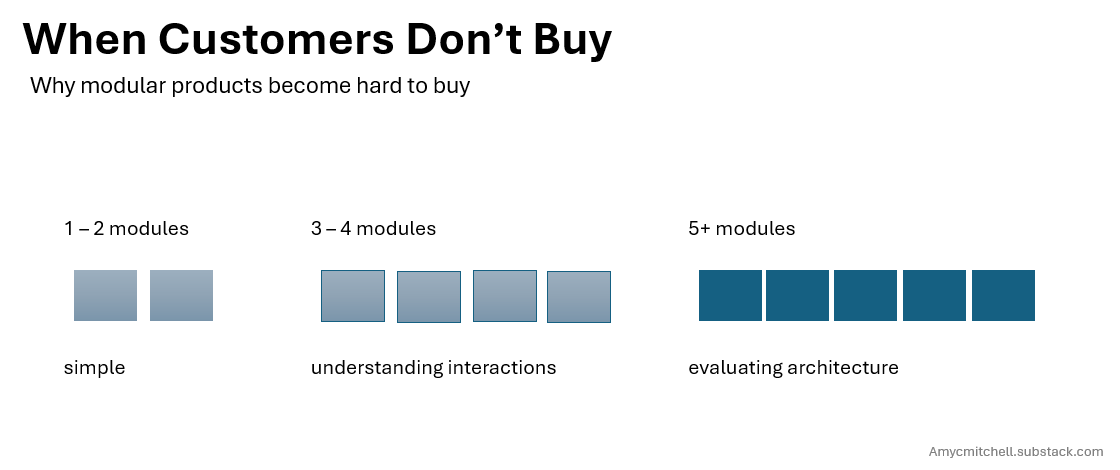
The solution to the customer’s problem needs 5 or more modules.
The customer hesitates to evaluate how the modules fit together
You discount your price to “help” the customer decide
The customer continues to evaluate the solution
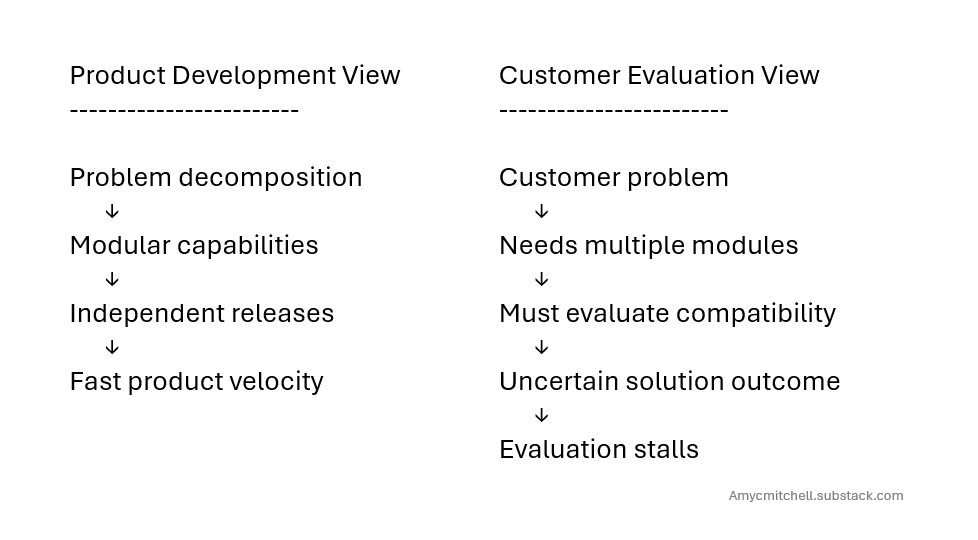
The root of the problem is subtle. Modular systems simplify development, but they change how customers experience complexity.
The Modular Illusion
Modular products feel easier than they actually are.
For product teams, modularity simplifies development. Each capability has a clear boundary, teams move independently, and releases happen faster.
But customers don’t experience the modules the way product teams do.
Customers experience the coordination problem between modules.
Every additional component raises new questions:
Do these pieces work together?
Who integrates them?
What happens when something breaks?
For product teams, modularity reduces complexity.
For customers, it often moves the complexity somewhere else.
Over time, many product teams notice the same pattern: complexity becomes visible to customers once enough modules are involved.
The 5-Module Rule
Evaluating one or two modules is straightforward for most customers. But once a solution requires multiple pieces, buying slows down.
There is a tipping point.
When customers need five or more modules to solve their problem, adoption often stalls.
At that point customers are no longer evaluating a product.
They are evaluating a system architecture.
When a customer solution requires five or more modules, product managers should assume the customer now needs a solution package.
The reason is simple.
Each additional module multiplies the questions customers must answer:
Do these pieces work together?
Who supports the integration?
What happens if one component changes?
Even technically sophisticated buyers hesitate when the answers aren’t obvious.
The cognitive load becomes too high.
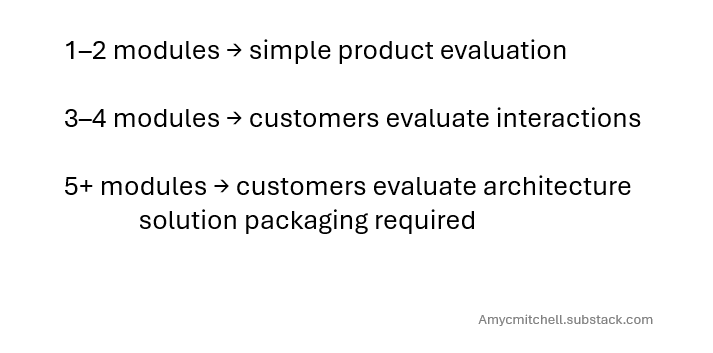
Vivek’s AI infrastructure offers easily crossed the five-module threshold.
Compute, networking, storage, scheduling, and orchestration all had to work together.
Customers weren’t buying a product anymore.
They were evaluating an architecture.
When modular complexity blocks adoption, organizations often reach for a familiar workaround.
The Consulting Shortcut
Some organizations solve this problem by using forward-deployed engineers (FDEs) or consulting teams to customize a solution to the customer’s problem.
But if your strategy is to sell modular products repeatably, you don’t have FDEs and customization teams to build demand.
Instead of relying on consultants to assemble solutions every time, product teams can solve the problem directly through solution packaging.
Solution Packaging in Response to the 5-Module Rule
Solution packaging is the practice of combining modular capabilities into repeatable customer outcomes.
Instead of asking customers to assemble a system from individual components, the product organization defines a working solution.
The underlying products remain modular.
But customers experience them as a coherent solution.
Solution packaging shifts the integration work from the customer to the product organization.
To understand where solution packaging fits, it helps to look at how customers and product teams think about systems differently.
Builder PM Solution Stack
Builder PMs see the system layers from the product perspective and the customers’ perspective:
The components of the product
The products sold independently
The solutions with combinations of products
The outcome the customer is trying to achieve
Builder PMs operate across all four layers of the stack.
Engineering teams often focus on components and products.
Customers care about outcomes.
Solution packaging is the bridge between the two.
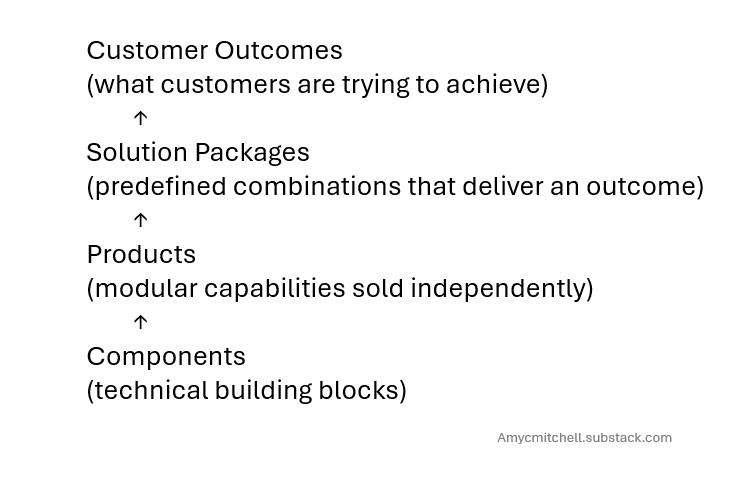
The hardest product work often happens in the layer between products and outcomes. That’s where solution packaging lives.
Vivek saw this pattern play out with one of his customers.
Real-World Example
Vivek’s latest customer is a university building out research infrastructure. Vivek and sales composed a winning solution package for the university:
AI compute nodes
AI networking devices
Unstructured data storage appliances
AI scheduler software installation
Orchestration with the customer
Vivek and the sales team had normalized these individual products into an AI Research Infrastructure Package.
The sales team wasn’t selling four products.
They were selling a working research environment.
Implications for Product Managers
Product managers are key to bridging modular products into solutions. Three implications:
1. Monitoring modular complexity
Track how many components are required for common customer solutions.
2. Identifying repeatable architectures
If multiple customers assemble the same set of products, you have a solution package opportunity.
3. Reducing the time for customer evaluation
The goal is making the solution visible faster.
Closing - Solution Packaging Bridges Modular Products to Customer Solutions
Modular architectures help product teams move faster.
But customers don’t adopt modules.
They adopt solutions.
When modular systems grow large enough, the challenge shifts from building capabilities to making the solution visible.
Solution packaging bridges that gap.
It connects modular products to the outcomes customers are actually trying to achieve.
For builder PMs, that bridge is where some of the most important product work happens.
Questions on solution packaging
Is a solution package just a “Marketing Bundle” of existing products, or is it a new technical entity?
It’s a strategic evolution of both. While a marketing bundle simply puts items in the same cart, a Solution Package creates a “functional glue” between them. It includes the pre-configured settings, the common data schema, and the “connective tissue” that ensures those products solve a specific problem out of the box. Think of it as moving from selling “flour, eggs, and sugar” (a bundle) to selling a “pre-mixed cake kit” (a package).
Does solution packaging mean “Power Users” can’t build their own systems from scratch?
Not at all. Solution packaging is about pre-configuring products for a use case. Your Power Users will still use your underlying APIs and modular products to build to their needs. The packages are for the 80% of customers who have the problem but lack the 18 months of engineering time to build the “System of Systems” themselves. You aren’t removing the “Lego bricks”; you’re just offering a “Lego Set” with instructions.
When does a product manager create a solution package?
Start when customers consistently need multiple products to solve a problem. The 5-Module Rule is a useful signal.
Does solution packaging reduce modularity?
No. The underlying products remain modular. Packaging simply reduces the work customers must do to assemble a solution.
Who owns solution packages?
In many organizations, builder PMs coordinate them because they understand both the product architecture and customer outcomes.
How does a builder PM get started making a solution package?
You look at what FDEs (Forward-Deployed Engineers) and customization teams are building over and over again for their customers. This is your first grouping for a solution package. I’ll cover more about the phases of building a solution package in the near future.
Looking for more practical tips to develop your product management skills?
Product Manager Resources from Product Management IRL
Product Management FAQ Answers to frequently asked product management questions
Premium Product Manager Resources (paid only) 4 learning paths, 6 product management templates and 7 quick starts. New items monthly!
Drippie Digest featured Product Management IRL articles this year! Handpicked product management articles every day, summarized to give you the big picture of product management and tech.
Connect with Amy on LinkedIn, Threads, Instagram, and Bluesky for product management insights daily.