
Every Product Manager Is Disappointing Someone
The question is whether it is happening accidentally or by design

Early in her career, a product manager worked for a leader with a simple philosophy.
He would delegate until someone “squawked.”
He did not mean complaining or saying, “I am too busy.”
He expected something else.
He expected one of two things:
A clear confirmation of priority tradeoffs
Or a proposed solution that did not rely on longer hours
If neither came, he assumed capacity existed.
Years later, she worked for another leader who set aggressive deadlines by default. He expected tension. He expected friction to surface. He expected constraints to be raised early so he could help resolve them.
Neither leader tried to meter workload perfectly.
Both assumed something quieter.
Professionals choose where to disappoint.
Silence signals consent.
Most product managers are already disappointing someone.
The difference is whether it is intentional.
Disappointment Is Structural
Product management is aligned to growth. Ideas expand faster than capacity. Organizations rarely staff product management to cover every opportunity deeply.
When demand exceeds attention, something absorbs the gap:
Quality
Depth of effort
Responsiveness
Stakeholder satisfaction
Your personal time
If you do not choose where that cost lands, it lands somewhere anyway.
How you learn to choose evolves over your career.
Early Career: Making Your Work Visible
Early product managers often carry quiet pressure. You want to prove you can operate across domains. You want to be responsive. You want to show depth.
At this stage, outcomes can feel distant. Even when releases are frequent, the connection between your effort and business results is not always visible.
One useful lens is outcome visibility.
Outcome visibility through collaboration
Every product manager in your organization carries inside knowledge that is rarely written down.
You learn this through conversations about:
Margin estimates and margin targets
How sales navigates tradeoffs,
How engineering expects product managers to contribute,
How leadership language translates into product decisions.
Outcome visibility through expertise
Sometimes visibility comes from choosing one area to develop deeply. You are not expected to excel everywhere early in your career. Building expertise in one domain gives you a foundation. It creates clarity about where your judgment carries weight.
You can build expertise by:
Reading or taking a class about your focus area
Give your point of view on your focus area and incorporate feedback
Apply your knowledge on-the-job
Keep your environment strategy in mind so you learn just enough to contribute now.
Outcome visibility through tradeoffs
Sometimes visibility comes from signaling tradeoffs early. Sharing your plans invites fast feedback. You make the connections from your work to the product by talking about your intentions.
Over time, you begin to see the chain:
Discovery summaries influence requirements.
Requirements influence features.
Features influence revenue or retention.
Bug handling influences architecture resilience.
A new product manager may refresh sales training material. It can feel like stating the obvious until you present a new feature to sales. A well-prepared summary becomes leverage.
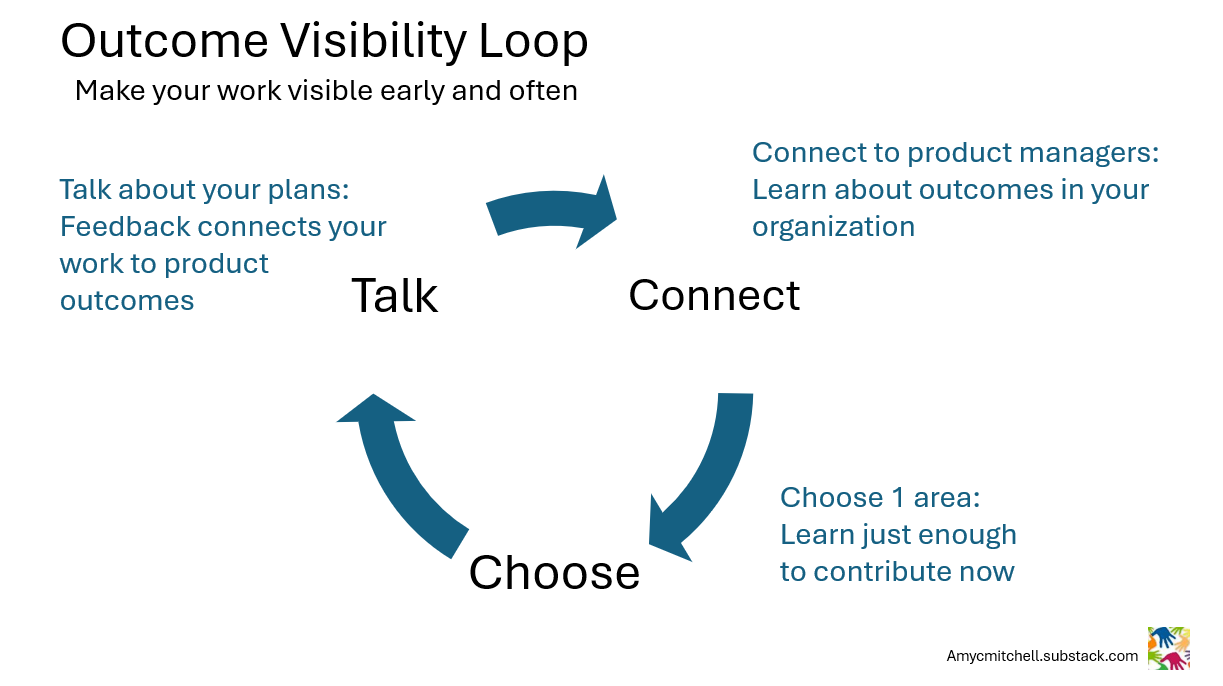
This loop helps early product managers place their strongest work where it can be seen and adjusted.
Over time, outcome visibility becomes easier. Judgment becomes the differentiator.
Growing Into Judgment: Investment Choices
As experience grows, capability expands. You can write the PRD. You can build the business case. You can coordinate stakeholders. You can present to customers.
Judgment requires something different. It requires deciding where your depth compounds.
Investment choice by thinking in multipliers
Teaching two people to write strong requirements expands impact beyond your own output. Enabling others builds durable capability.
Catch yourself before you do a basic task by checking if anyone else can do it. Your environment strategy can help you focus on your highest value work.
Investment choice by changing outcomes early
Experienced product managers see patterns earlier. Investing thinking time into cross-functional relationships, competitive signals, lifecycle materials, and architectural implications allows you to surface risks.
With experience, product managers open time for thinking a few steps ahead, and they can quietly prevent rework. These judgment calls take preparation and ongoing work:
Building cross-functional relationships for inside information
Studying competitive materials and market analysis to anticipate customer needs
Following product lifecycle materials, such as PRDs, architecture/design, and demos to prevent disconnects
These steps allow you to share just enough knowledge to keep the rest of the team effective.
Investment choice through heading off disappointment
Senior product managers think about pre-disappointment conversations. Stakeholders rarely react well to abstract worry. They engage with specific, framed tradeoffs.
Most stakeholders want a chance to control outcomes within the constraints of the organization. Experienced product managers translate signals into meaningful action.
Using judgment with stakeholders
Product managers have an uncanny way of connecting the dots and heading off trouble. A senior product manager estimates the size of a feature based on complexity and past feature work. When the estimate exceeds the engineering capacity, a senior product manager comes up with options and a recommendation to right-size the feature.
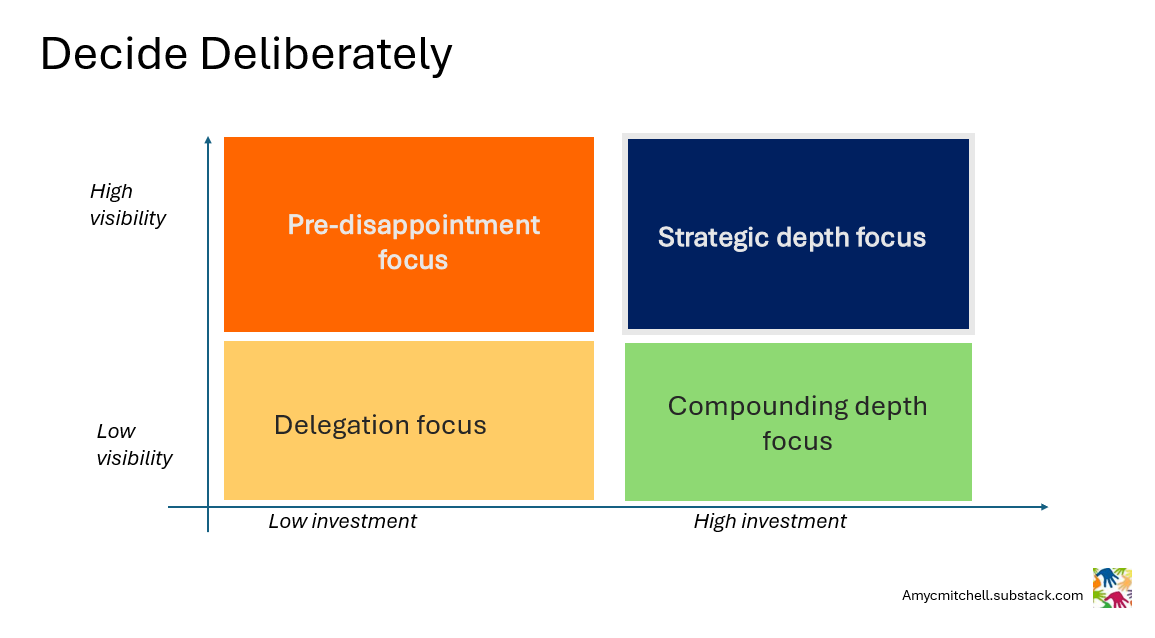
These investment choices often mean something else receives lighter handling. Meetings are delegated. Documentation is shorter. Response times stretch slightly. Coverage becomes designed rather than universal.
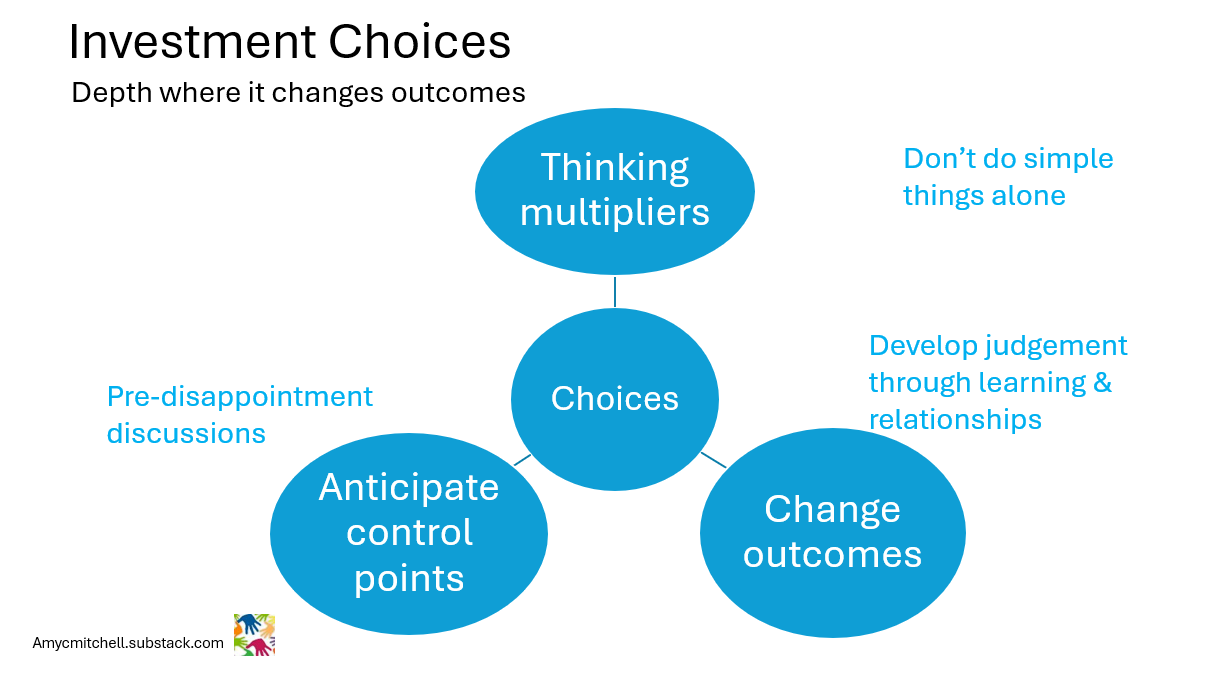
Your investment choices lead to productive tradeoffs with stakeholders that help the whole product team.
Depth always creates a gap somewhere else.
What Designed Non-Coverage Looks Like
Choosing where to disappoint does not look dramatic. It looks measured.
It can look like contributing analysis when the team is ready, rather than months in advance.
It can look like enabling engineering with a focused customer summary rather than exploring adjacent automation immediately.
It can look like deferring exploration of a new technology until you understand its data source and customer benefit clearly.
It can look like letting a feature be correct rather than elegant.
It can look like attending fewer meetings and deepening one initiative.
Designed non-coverage means timing your involvement, understanding the business outcome, and letting excellence live in specific environments.
Why Leaders Expect This
Returning to the two leaders at the beginning.
Both created tension deliberately. Both expected professionals to surface constraints constructively. Neither expected silent endurance.
Leaders depend on their teams to expose tradeoffs. If tradeoffs remain invisible, leaders assume alignment.
Choosing where to disappoint is part of professional maturity. It signals that you understand constraint and consequence.
Choosing where to disappoint becomes repeatable when it becomes a routine.
When my workload shifts or when a new initiative appears, I reset my environments on paper before reacting.
I built the Choosing Where to Disappoint worksheet that helps choose where to put your thinking time (paid subscribers only).
Closing
Every product manager leaves something under-optimized.
A relationship receives less attention.
A feature receives less polish.
A response arrives later than ideal.
Planning where that disappointment lands changes how the work feels.
It shifts energy toward just-in-time outcomes.
It creates space for judgment.
You have a choice in your focus.
You also have a choice in where coverage becomes lighter.
Choosing deliberately is part of the craft.
Related article on environment strategy for product managers:

Looking for more practical tips to develop your product management skills?
Product Manager Resources from Product Management IRL
Product Management FAQ Answers to frequently asked product management questions
Premium Product Manager Resources (paid only) 4 learning paths, 6 product management templates and 7 quick starts. New items monthly!
Drippie Digest featured Product Management IRL articles this year! Handpicked product management articles every day, summarized to give you the big picture of product management and tech.
TLDR Product listed Product Management IRL articles recently! This biweekly email provides a consolidated list of recent product management articles.
Connect with Amy on LinkedIn, Threads, Instagram, and Bluesky for product management insights daily.
One of the universal truths in product management! I gave one of my first product talks in the mid 2000s titled, “Welcome To Product Management, Why is Everyone Mad at Me?”
A similar truth of that if you don’t discard good product ideas, you lack focus.
You describe the same on another level. Very helpful to make conscious choices!