
When Doing Everything Right Still Feels Wrong as a Product Manager
How some product managers navigate fast, fragmented product environments

Alex is a conscientious product manager.
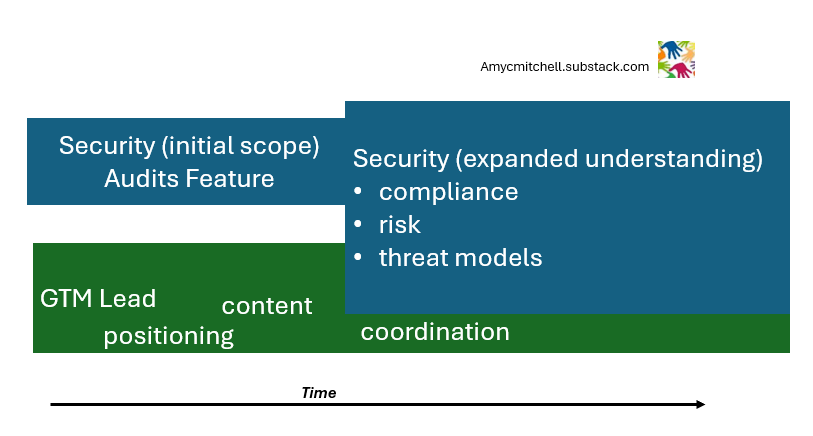
He’s responsible for a customer‑requested security feature that looks straightforward. The kind of low‑hanging fruit product managers are encouraged to tackle. At the same time, Alex also owns product marketing strategy for his area and coordinates GTM across peers.
Doing what good product managers do, Alex decides to deeply understand the problem.
He dives into product security and quickly discovers that “security” isn’t a problem. It’s a landscape. Threat models. Compliance standards. Internal SMEs. Adjacent systems. Long‑term risk tradeoffs. The deeper Alex goes, the less contained the original feature feels.
Meanwhile, product marketing moves on.
With Alex underwater in security, GTM discussions shift toward other priorities. New asks appear across his domains. The simple feature is no longer simple, the context has moved, and Alex feels behind everywhere at once.
Nothing went wrong.
Alex followed the advice.
Focusing on the why,
Investing in understanding,
Acting responsibly across domains.
What failed was that Alex had no way to decide how to operate across fast‑moving, incompatible contexts at the same time.
And that’s a situation more product managers are finding themselves in as product work accelerates.
When good product manager behavior creates bad outcomes
Alex’s story isn’t an exception. It’s a pattern that shows up as:
product development speeds up
organizations flatten
AI accelerates research and discovery
Product managers are encouraged to go deep. And increasingly, builder PMs can. But depth has a cost.
Every area you go deep into has subdomains, experts, and implications that pull you further in. And while you’re focused there, the rest of your work doesn’t pause.
Doing the right thing changes with timing and context. Advice that works in a slower, more bounded environment can quietly backfire in a fast, fragmented one.
Why focus breaks before strategy does (and why that’s new)
Product managers are good at compartmentalizing work. We switch contexts, sequence tasks, and juggle priorities.
But in flatter, faster organizations, each “task” now requires more coordination. What once looked like a single activity, for example, defining a customer‑requested feature, becomes a chain of discovery, stakeholder alignment, SME learning, and synthesis.
While you’re learning, you often don’t yet know enough to decide. At the same time, other domains still need attention.
Most product managers now operate across product, platform, GTM, and internal systems simultaneously. That’s part of what makes the role interesting. Operating like this also makes focus fragile.
Focus breaks because product managers have open decisions accumulating across too many contexts at once.
Why product strategy doesn’t save you
Product strategy and strategy cascades are useful for orientation. They help explain where the organization is headed.
But they don’t resolve the day‑to‑day question many product managers face:
Given everything happening right now, where should my thinking go today?
Complex solutions often have many valid paths to an outcome. When demands collide across functions or products, last quarter’s strategy can’t answer how to allocate your attention this week.
Strategy is just not designed to manage decision density.
What’s missing: a strategy for your environment
One option some product managers use in these situations is an environment strategy.
An environment strategy is how a product manager decides where to apply their thinking, energy, and learning across fast‑changing contexts.
Your environment strategy translates high‑level direction into choices about attention.
This kind of strategy is often private. It doesn’t need executive approval to be useful. Its job is simple: help you decide where your judgment matters most right now.
Seeing your work as multiple environments
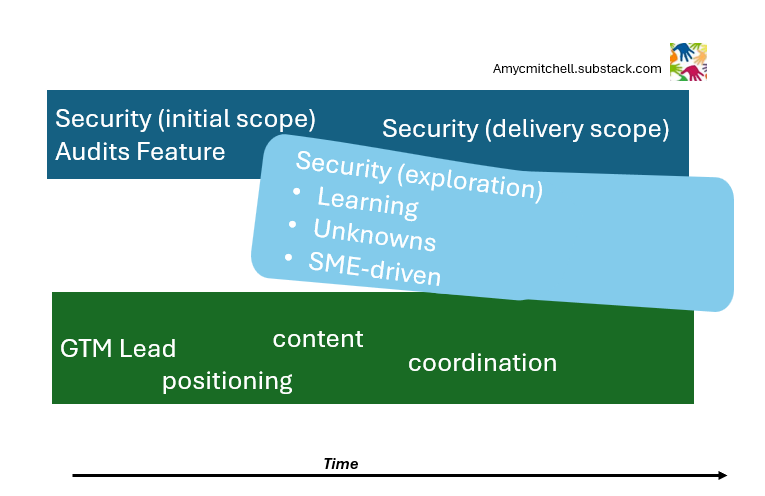
Instead of seeing your role as one continuous backlog, you can view it as a set of environments that need different product management behaviors.
Using Alex:
GTM coordination — fast, narrative‑driven, externally paced
Security feature delivery — constrained, outcome‑focused
Security exploration — slow, deep, high‑ambiguity
Each environment rewards different actions. Going deep is essential in some. Speed and timing matter more in others.
Problems arise when we try to apply the same level of depth, rigor, and presence everywhere.
One practical shift: decide what each environment deserves
The point of an environment strategy isn’t to do less work. It’s to step back from the day‑to‑day and decide how much of yourself each environment gets.
A useful question is not “Am I done?” but “What does done mean here?”
In fast‑paced environments, being done may mean small, frequent decisions and clear signals so others can move.
In exploratory environments, being done may mean pausing without output because the work is still forming.
In maintenance or support environments, being done may mean intentionally limiting effort so it doesn’t crowd out higher‑leverage work.
Deciding this up front reduces clutter. It lets you focus while you’re working instead of renegotiating expectations mid‑stream.
When your manager can’t engage (and why that’s normal)
Managers are operating under their own environment constraints. They’re accountable for outcomes across the whole team, not for choosing which path a product manager takes to get there.
Asking a manager to decide where your thinking belongs is often unanswerable. At best, you may get coaching. More often, you’ll get silence or redirection toward immediate needs.
A private environment strategy lets you manage your attention without waiting for that engagement.
What changes once you have an environment strategy
Product managers who use an environment strategy don’t try to be equally strategic everywhere.
They choose where to think deeply. They accept “good enough” elsewhere. They time their contributions to land when teams are ready to act.
As product work accelerates, strategy doesn’t disappear. It becomes personal; a quiet way to keep contributing meaningfully without burning out or backing away.
Related Articles
Orchestration strategy for product managers:

What Builder PMs do

Handling strategy a bit at a time

Looking for more practical tips to develop your product management skills?
Product Manager Resources from Product Management IRL
Product Management FAQ Answers to frequently asked product management questions
Premium Product Manager Resources (paid only) 4 learning paths, 6 product management templates and 7 quick starts. New items monthly!
Drippie Digest featured Product Management IRL articles this year! Handpicked product management articles every day, summarized to give you the big picture of product management and tech.
TLDR Product listed Product Management IRL articles recently! This biweekly email provides a consolidated list of recent product management articles.
Connect with Amy on LinkedIn, Threads, Instagram, and Bluesky for product management insights daily.
Nice, very practical advice.