
When Product Work Starts Going in Circles
AI, subscription models, and the hidden shift from execution to organizational learning

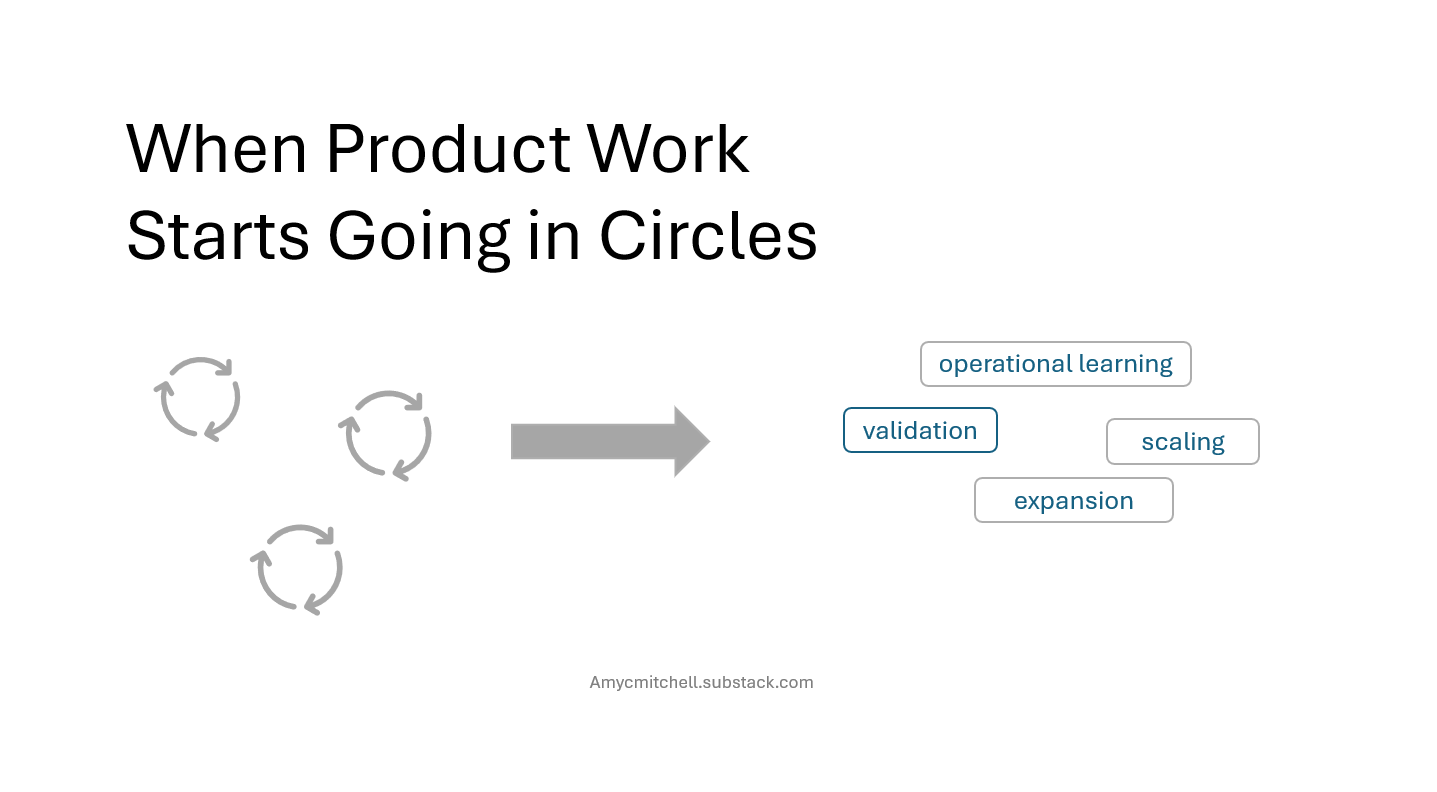
Not long ago, the product manager's job was figuring out answers before execution started.
You explained the business model.
You defined a winning scope of work for the opportunity.
You validated the assumptions.
You took care of the hard questions upfront.
Then the product team executed.
A lot of teams still expect product work to behave that way.
But AI initiatives, subscription products and platform transitions don’t work like that anymore.
Because now, some of the most important answers only show up after customers, operations, partners and delivery systems start interacting in the real world.
Which means your job changes from:
“Figure it all out before we begin”
To
“Figure it out enough to begin and help the organization learn the rest safely.”
Then you get to experience “enough” and “safely” on your product. It goes like this:
You bring a proposal.
Leadership asks for more detail.
You refine it.
The questions shift.
You answer those too.
Then new concerns appear:
Scaling
Margins
Customer expansion behavior
Operational trust
Automation dependencies
Partner execution
The harder you work on “enough” and “safely”, the more gaps show up.
And then the feedback starts feeling a little personal:
“I still don’t think we fully understand this.”
“This needs more detail.”
“I’m not confident we’ve thought this through.”
At first, you think this means you aren’t working hard enough to explain.
Often, something else is happening:
The organization is looking for impossible certainty from product managers.
This article gives you a way to keep moving without turning every unresolved uncertainty into your problem.
The work changed underneath you
Product management work has changed rapidly from AI and recurring revenue business models:
the product depends on operations
customer usage changes the offer
scaling reveals new constraints
partner ecosystems create unpredictable interactions
You can no longer predict the business before customers interact with the system.
This is a learning-stage product. A learning-stage product is a product where key parts of the business model can only be learned through real customer and operational usage.
This new type of learning-stage product blindsides your leaders. Almost every leader is under pressure to grow the business. They want certainty and not unplanned risks.
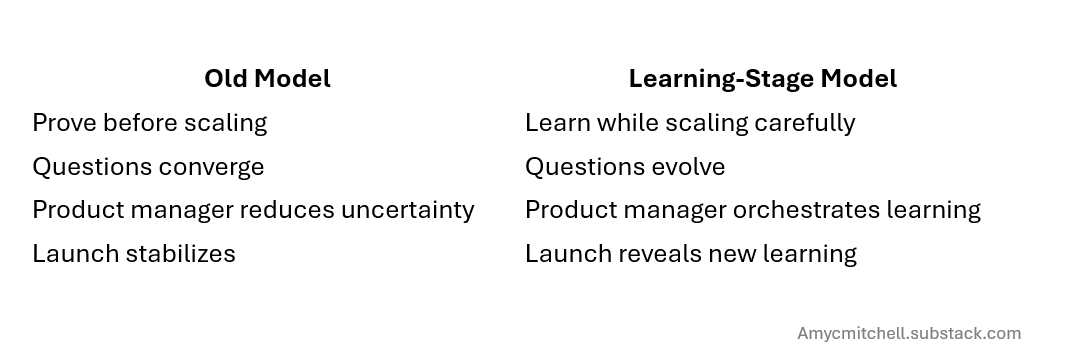
Now you show up with an opportunity for a learning-stage product. Your leaders want certainty that will only come from execution.
This is where many product managers start feeling stuck.
Take Vivek, a product manager adding third-party networking capabilities to an AI product.
He already has two successful customer deployments. He’s validated the technical path and identified broader market demand.
But once the proposal reaches leadership, the questions begin shifting:
How sales changes to offer networking
Handling partners, pull-through revenue, scaling and ongoing support
He answers the questions and then more clarity is needed
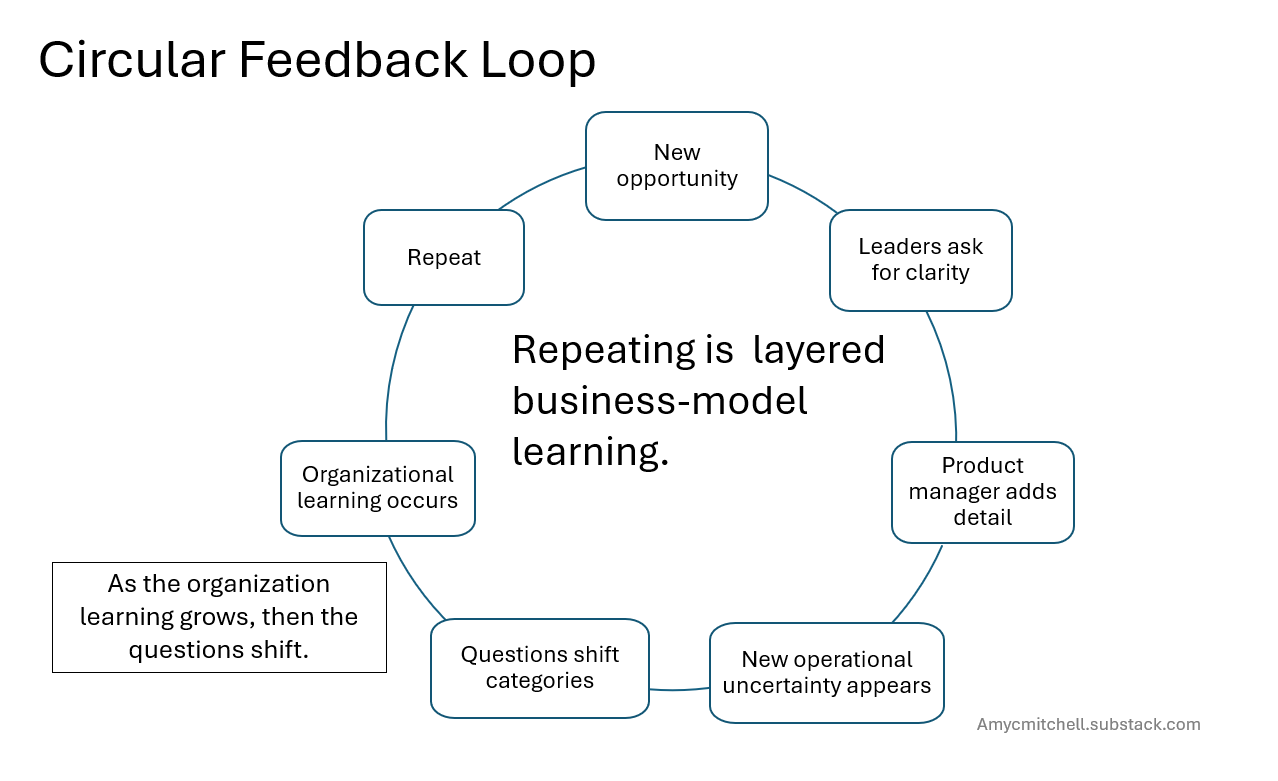
Circular feedback is a learning signal
Your opportunity is clear-cut. But the stakes are high for your leaders. They need certainty.
The circular feedback starts with a minor issue that needs more detail.
Then the business opportunity is missing pull-through from related products.
Then scaling needs investment.
Then the feedback goes back to clarity on details.
The questions keep moving because the organization is absorbing the business model in layers.
The product manager role shift
Your role moved from having the answers to bringing the team along to get answers together. There are too many unknowns for you to have all the answers.
Product managers naturally adapt as they learn. The challenge is helping the organization adapt at the same pace
Your role shifts because you are developing a learning-stage product. Your job becomes teaching the organization about the unknowns.
Instead of managing dependencies, you are managing learning.
Learning-stage products are governed differently — not less rigorously.
Additionally, many learning-stage products have dynamic pricing and time-bound prices. The organization needs to learn a new business model. Revenue growth and margins are still important. But a learning-stage business model has more risks to track:
Customer retention: depends on customer satisfaction
Expansions: depends on ease of use
Upsells: depends on ease of ordering
Product managers handle this change with organization learning strategies.
How to lead through the new expectations
Product managers learn enough to handle their products. The extra strategy is to bring the organization into the learning.
Learning orchestration: Track the learning
Product managers naturally learn as they go. Prioritizing based on phasing and cost risk. On learning-stage products, product managers expose the learning to the organization.
An example of learning tracking is your answers to opportunity questions. Answers about why a customer would buy can be forgotten when operational questions arise.

Keeping a learning log can remind everyone of the progress to date and future risk handling.
Learning orchestration: phase framing
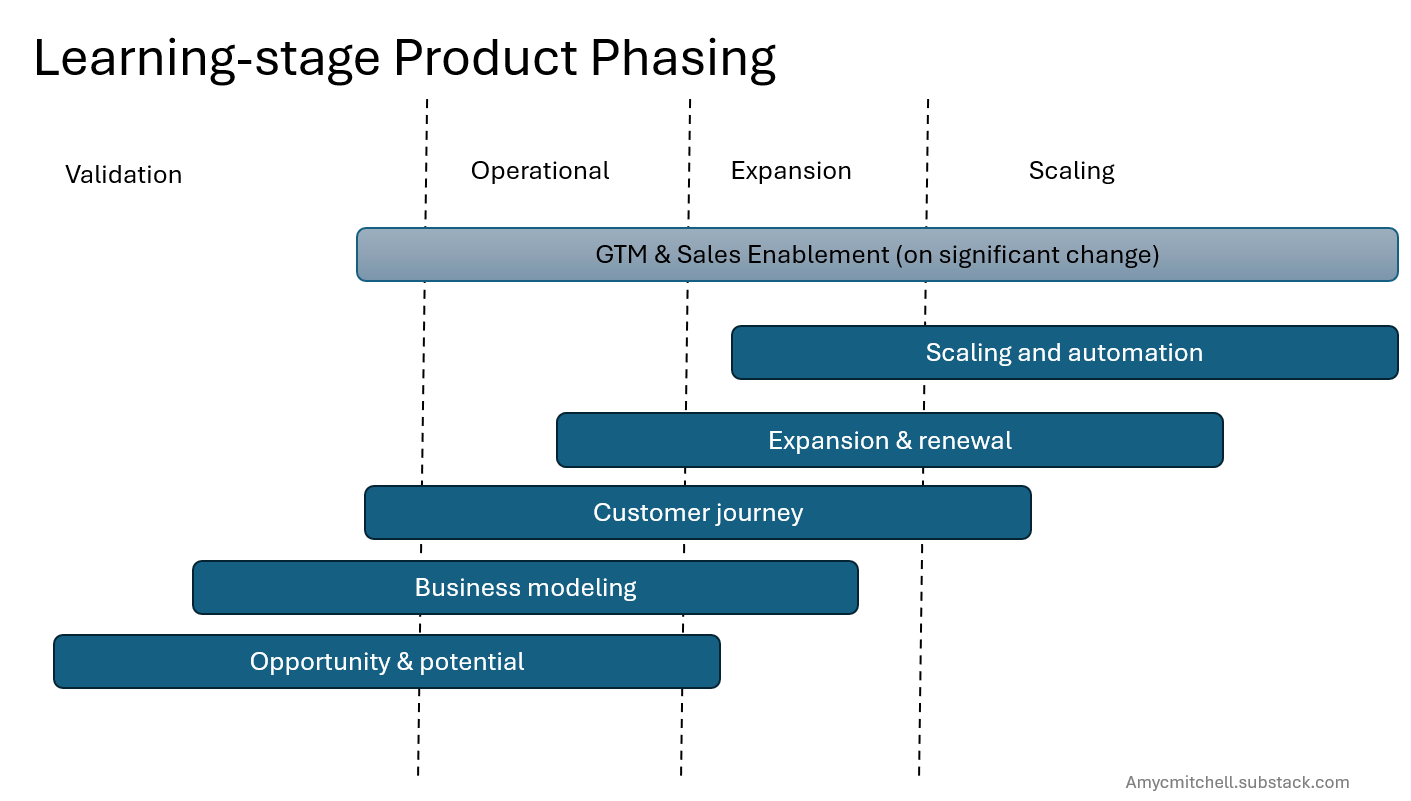
Learning-stage products have a different phasing than mature products. You can remind stakeholders of the learning phase.
Without phases, organizations try to solve scaling, retention, automation, and operations simultaneously and the initiative starts feeling impossibly incomplete.
The typical phases are:
Validation: the opportunity and baseline business model
Operational standardization: a repeatable system to go after the opportunity
Expansion handling: estimating the lifetime value of the customers
Scaling: getting to the full potential of the opportunity
These phases are used to prioritize the learning. The organization needs to learn the basic model before standardizing on the operational handling. Likewise no need to work on scaling before expansion is understood.
Learning orchestration: showing progress
When working on a learning-stage product, it is ideal to establish the phases and track the learning. In the excitement of getting started, you might jump into the product work.
Then the circular feedback reminds you that your learning is getting ahead of the organization.
Sometimes it is more helpful to show the learning log and phases together. Stakeholders who are used to mature products will be puzzled by your learning talk.
Whether you get caught up in circular feedback or want to set early expectations, the way you work with stakeholders has a format built on transformation learning.
The format to help the organization learn with you:
You are not trying to prove the business completely upfront anymore.
You are helping the organization learn the business safely through visible iteration.
Paid Subscriber Resource: Learning-Stage Product Templates
A big part of reducing circular feedback is making learning visible.
To help operationalize this, I’m sharing the templates I use when working through learning-stage products with leadership teams:
Learning log template
Phase-based orchestration tracker
Opportunity presentation templates
Customer journey and operational principles templates
GTM templates
Once Vivek realizes the organization is learning the business model in layers, his role changes too.
Create a learning log
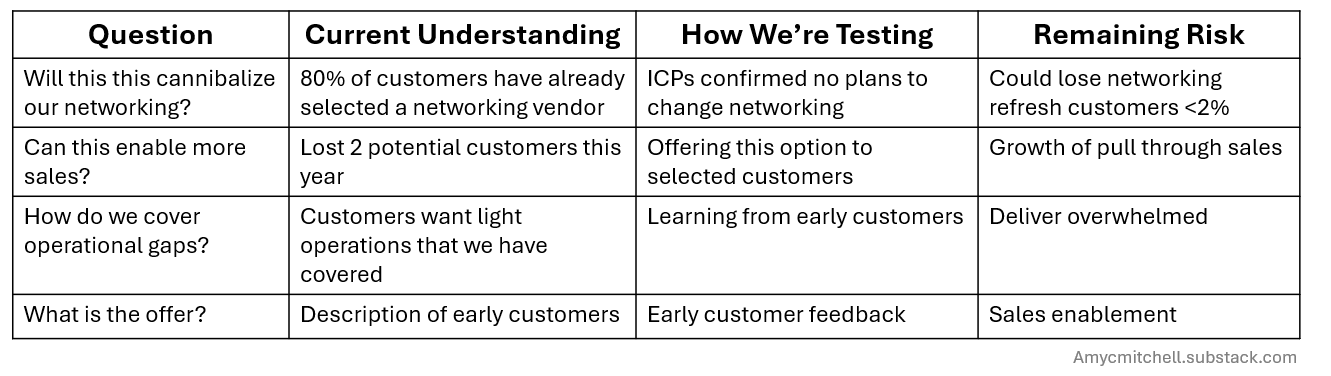
Vivek notices this doesn’t stop the circular feedback. It helps him reuse his offer definition and opportunity summary.
Plan the learning for the organization
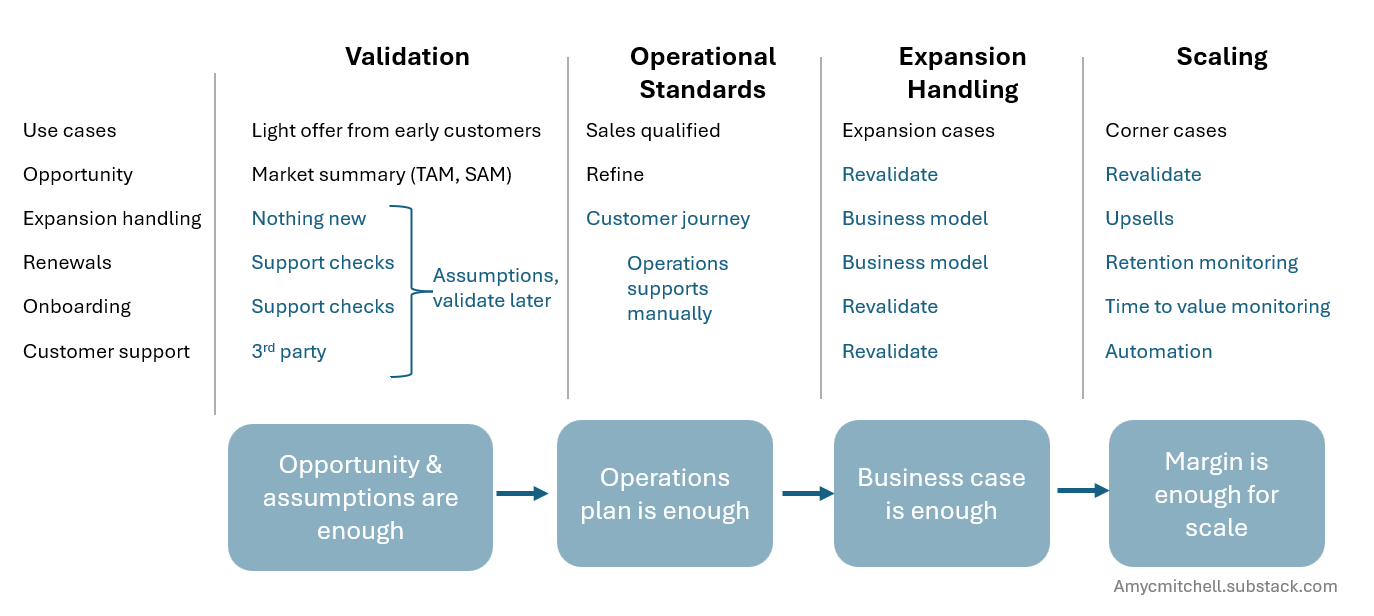
He uses this to sequence his work. When he gets an early question, such as scaling during the validation phase, he adds it to the assumption log to review the question for later.
The circular feedback slows down but Vivek wants business growth. And that depends on sales enablement.
Potential phasing
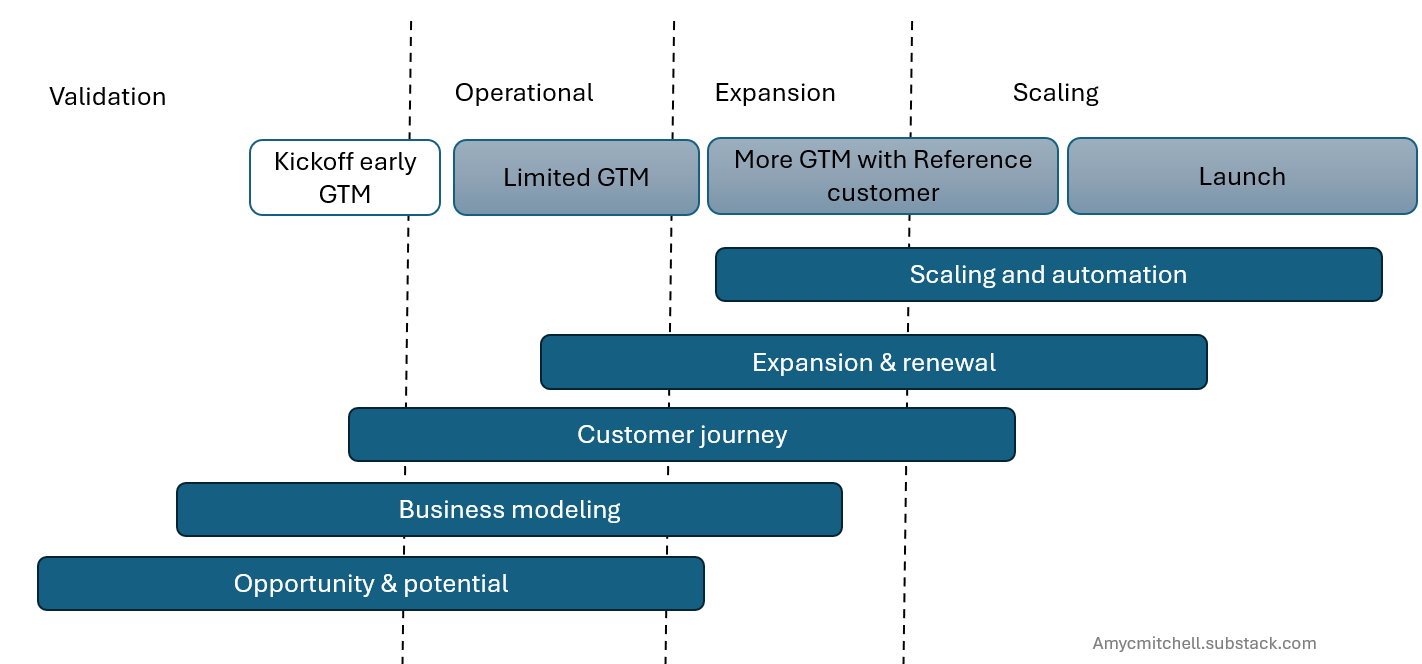
Vivek handles circular feedback with his learning log and phasing. Vivek is ready with small, low risk GTM steps such as sales qualification and limited target customers. In parallel, he works with operations and engineering to be ready for limited new customers.
You still own outcomes (differently)
None of this removes accountability.
Learning-stage products still need revenue growth, operational discipline, and responsible execution.
But the accountability shifts from:
“Prove the final model upfront.”
to:
“Show that the organization is learning, reducing risk, and sequencing investment responsibly over time.”
Your product work is spread out over a sequence of learning phases. You continue to be accountable for clarity over time. This includes responding to unplanned issues and pulling back if the business growth isn’t viable.
The key is frequent and deep collaboration with your stakeholders, who are under extreme pressure to generate growth.
Conclusion: When circular feedback helps
Many product managers think they’re struggling because they can’t get the work to stabilize. Circular feedback is often a sign that the organization itself is still learning how to absorb the new model.
Learning-stage initiatives are teaching the organization how to operate in a new model while the organization is still expecting proof from the old one.
In these cases, the product management skill that matters most is helping the organization learn.
Q&A
How do I know this isn’t just poor planning?
You can distinguish this from planning by the ambiguity of the initiative. Changes in the business model, as well as AI in the workflow, introduce too many unknowns for planning. This approach sequences learning about the unknowns so planning can begin. This means more discipline to show progress in learning enough for the planning.
How do you prevent endless iteration?
Tracking progress through the learning phases is essential for effective collaboration with your stakeholders. Most stakeholders are used to mature products with clear dependencies. Learning-stage products are defined in front of stakeholders. The sequencing of learning provides stakeholders with a clear path to a defined outcome.
What if leadership still expects certainty?
Don’t fight the requests for certainty. Translate the uncertainty into:
A learning phase
A goal in the sequences
Part of the risk reduction steps
Operational checkpoints
Use orchestration to show how you reach certainty together.
How do I know when the product is leaving the learning stage?
As you move from a broad opportunity to use cases, stakeholders will become more comfortable. When the team can “see” the product idea, the questions become predictable. The organization learns about the initiative through:
Discussing why the idea has potential
Contributing to the business model
Reaching consensus on the assumptions
When there is enough learning about these, you can move to experiments and customer adoption activities.
Connect with Amy on LinkedIn, Threads, Instagram, and Bluesky for product management insights daily.
Vivek's circular feedback loop on the networking AI matches what I hear from operators publishing in the AI Founder space. The 'impossible certainty' demand stops happening when the org sees one real customer outcome from the learning phase, not when the PM communicates better. I publish theaifounder.substack.com and watched the same pattern with content experiments: writers loop until one piece breaks through, then stakeholders relax. What signal told you Vivek had moved from learning phase to scaling phase?