
Build Anyway
Creating momentum while the strategy is still emerging

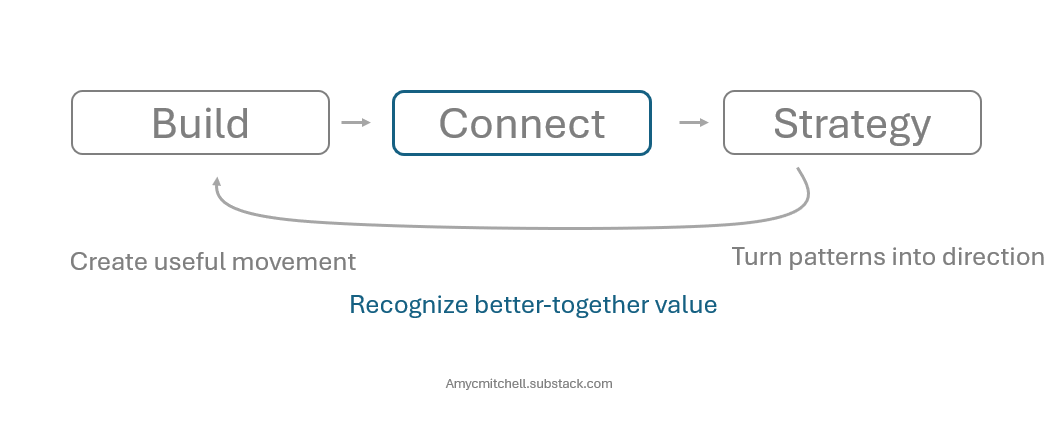
AI makes individual product work faster. Organizations need focus more than ever.
But the faster people can build, the more tempting it becomes to say:
“Don’t start until we know exactly how this fits.”
That sounds like discipline.
But it can create a problem.
Sometimes you can’t know how work fits together until people have created enough useful work to see the connection.
Your product context curation may not make sense until someone reuses it
A workflow improvement may show value after cost savings can be measured
A packaging change reduces sales effort after repeated sales training
Strategy provides direction and constraints. The problem is that strategy can’t answer every next question. Building is one way to discover what the strategy should become.
This article is about building to support strategy.
Build anyway means taking a useful next step when the problem is real, the learning is valuable, and the work can survive more than one possible future.
This doesn’t mean secretly launching products, bypassing prioritization, or using scarce engineering capacity without agreement.
Building can mean creating a prototype, curating customer feedback, testing a workflow, packaging an offer, modeling a business opportunity, or making a small change that lets you learn.
The point is to create enough to make the next decision better.
Building for a product manager might mean:
a prototype,
a customer evidence base,
a commercial model,
a workflow,
a solution package,
a context asset,
a new operating mechanism,
a decision framework,
a tested way of working.
Product managers can create useful material that moves the product forward.
Independent exploration is changing
Product managers and leaders are both under pressure to show business results. That means the focus is on work that supports current business objectives.
This leads to a dilemma for product managers:
Vital learning from exploration
While making execution visible
Exploration happens inside the work:
a customer conversation becomes a prototype,
a recurring problem becomes a workflow improvement,
a collection of notes becomes a reusable context asset,
or a solution experiment becomes a new way to package the product.
These are a few ways to learn while continuing to execute as a product manager.
Useful work can start independently
Some of the best learning comes from product managers supporting each other.
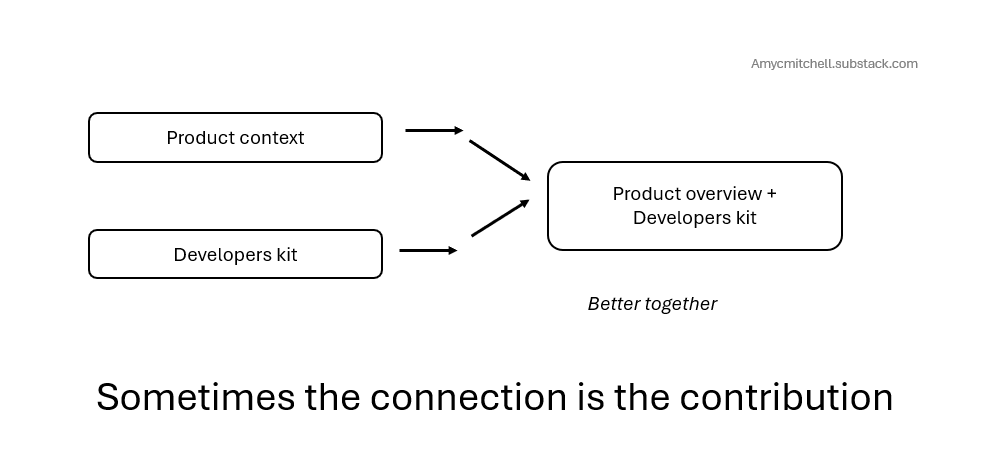
One product manager was developing the product context on how the product worked. Another was creating a way for developers to use the product. Separately, each effort was useful. Together, the context could make the developers’ kit easier for customers to understand and adopt.
Neither person needed to predict the final connection before starting. The connection became visible because both people built enough to see the better-together solution.
The connection was the contribution.
Independent movement is different from independent execution
Eventually, another team needs to invest time, change a workflow, support a customer, or help bring the work to market. That is when the work needs a bridge.
Cross-functional teams are looking for:
how the work connects to something they care about,
what outcome it can produce,
what they will learn,
and why this is worth supporting now.
The Builder PM’s job is to create enough connection that other people can see why the work matters to them.
Build enough to make useful connections and invite others to contribute
Collaborate with purpose by showing the outcome that becomes possible together. Showing a better-together outcome helps others discover connections.
How to operate while building responsibly:
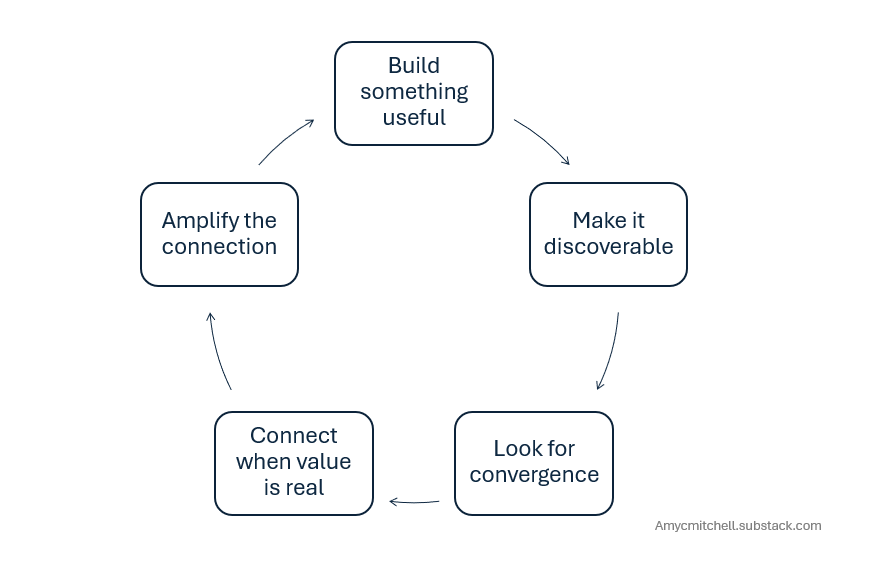
Build something useful
When the problem is real and the next step is reasonably clear, then you create movement.
Movement starts small. Useful work is:
Customer value
Commercial learning
Delivery learning
Reusable capability
Better understanding of the product
You don’t need a complete strategy to take a useful next step.
Build for optionality
If the strategy changes, then there is still useful work. Focusing on reusable contributions leaves your options open:
Changing a workflow that leads to a better customer experience
Consolidating customer needs into actionable change
Solution packaging for a set of customers
Curating product context that helps customers and sales learn your product
These can support many outcomes.
Build things that can survive more than one possible future.
Make the work discoverable
Make what you build discoverable:
What problem were you solving?
What did you build?
What did you learn?
What could this connect to?
Connecting initiatives becomes more valuable than a single initiative done in a vacuum.
Make it possible for another person to recognize the value of their own work in yours.
Look for convergence
Periodically, take a look at the rest of the team for connections:
What did other product managers learn?
Are other product managers seeing the same customer problems?
Are there complementary capabilities underway?
Are there the same commercial constraints?
Is a pattern emerging?
Look up from your own work and see whether the organization is revealing a pattern.
Connect and amplify the connection
The strongest connections show up when two efforts make each other more valuable. Connect when:
one effort makes another more useful,
the combined result solves a bigger problem,
the connection reduces effort,
or the connection creates a clearer path to customer or commercial value.
When you see the connection:
Celebrate the connection
credit the people involved,
explain why the combined work matters,
The Builder PM can contribute by recognizing and amplifying connections.
Good work often needs a connection before other people can see its value.
Winning together means useful work can find its way to the other work that makes it more valuable.
It means your progress becomes shared progress when the connection is real.
It means the organization can learn from movement instead of requiring every answer before movement begins.
Conclusion - Build what is useful. Make it visible. Connect it when the time is right.
You rarely need every connection to be visible before you take the next useful step. Build something useful. Build for optionality. Make the work discoverable. Look for convergence.
When the right connection appears, amplify it.
That is how independent movement becomes collective momentum.
Sometimes that’s how the next strategy gets developed and how more people decide it’s worth building together.
Q&A
Isn’t it better to wait and watch for a strategy from leadership?
Sometimes. If leadership has clearly chosen a direction, your job is to execute against it. But when the strategy is still developing, waiting for leadership to specify the next step can leave valuable learning undiscovered.
You are giving leadership better evidence in developing the strategy.
What if there is no time to build something ahead of product strategy?
You don’t always need a separate project. Build into the work you already are doing.
If something isn’t working for your customer, take the smallest useful step toward a better one. Break the work into phases. Learn as you go. Reuse what you discover.
The goal is to avoid repeating work that is not producing the result you need.
If I’m acting at the next level in my product organization, then don’t I need to handle product strategy along with building?
Acting at the next level means increasing the quality and speed of the connections that impact strategy.
You build something useful. You connect it to customer, commercial, delivery, or product patterns. You make it visible. Then you help the organization decide whether the pattern should change the strategy.
What if my manager tells me to stop?
Then stop and understand why.
“Build anyway” is not a license to ignore explicit decisions, consume resources without agreement, or undermine your manager.
But there is a difference between building something useful as part of your normal work and launching an unauthorized initiative.
If the work is valuable, keep the learning. Ask what would change the decision. Look for a smaller version of the work that fits current priorities.
Sometimes the right move is to pause. Sometimes the right move is to continue building within your existing responsibilities. The key is to distinguish between waiting for permission to learn and ignoring a decision that has already been made.
What if my idea never connects?
Not every experiment becomes part of the strategy. That’s okay. Useful work is still valuable when it teaches the team something, improves a customer interaction, simplifies future work, or helps another PM move faster.
The goal isn’t to predict every winning idea.
It’s to create enough useful movement that the right opportunities become easier to recognize.
Builder product managers use a new operating model that creates product acceleration. From Product Integration to Product Acceleration
Pressure for results means a different approach to collaboration. Collaborate with purpose enables outcomes through learning. Pressure before Clarity
Product managers can create gravity around their initiatives and make progress over time. Going Beyond the Roadmap has some ways to create a solution package.
Looking for more practical tips to develop your product management skills?
Product Manager Resources from Product Management IRL
Product Management FAQ Answers to frequently asked product management questions
Premium Product Manager Resources (paid only): This month’s guide focuses on AI-assisted product initiatives. It helps you build context that your whole product team can use.
TLDR Product featured Product Management IRL articles recently! This biweekly email provides a consolidated list of recent product management articles.
drpp The Drip featured Product Management IRL articles. This newsletter handpicks product management articles every day, summarizing them to provide you with a comprehensive overview of product management and technology.
Connect with Amy on LinkedIn, Threads, Instagram, and Bluesky for daily product management insights.
Amy, I really enjoyed this. You are really good at writing these really detailed strategies and examples that don't just apply to a particular project, or even a particular TYPE of project. While reading, I thought of so many different scenarios where your lessons could be applied. Excellent work, thank you so much for sharing!