
Your Idea Isn't Finished When Everyone Agrees
How product managers create momentum behind their ideas

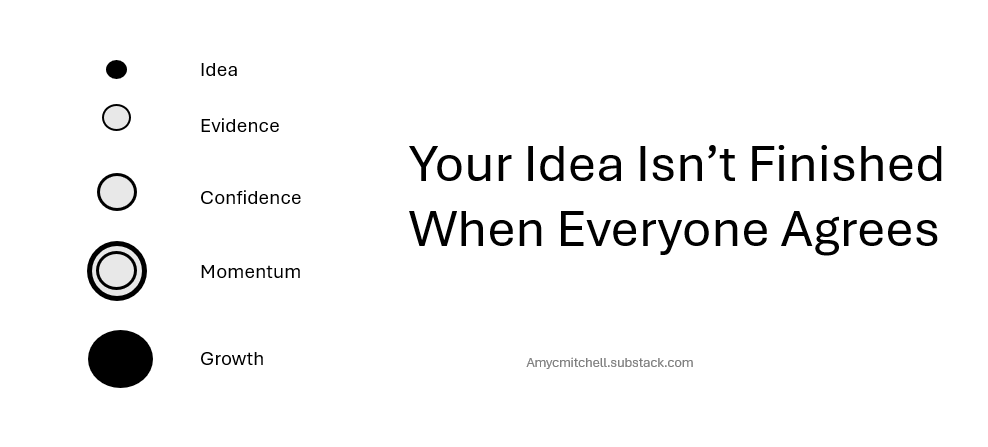
Product managers rarely struggle to find opportunities. The harder problem is helping the organization act on them. Every roadmap is full of good ideas that never become meaningful business results.
There is a bit of magic to go from idea to building products. Some people call this:
Discovery
Market research
Trend analysis
Whatever name it gets, some ideas grow into reality while other ideas fizzle out.
Product managers often find opportunities for growth in their daily work. The other part of the work is going from insight to action.
Spot something worth pursuing
Opportunities usually start as observations that make sense when you connect them:
You notice a customer buying trend.
A senior product manager sends market analysis about market growth.
A customer reports a new use case for your product.
Your boss spots a pattern in competitive wins that shows a new market for your product.
Most ideas lie out there until you can develop them into an opportunity.
The opportunity isn’t the finish line
Good that there is a growth idea for your product. Next is developing the idea into a business opportunity.
To actually pursue the opportunity with others, you need:
A meaningful opportunity or risk
A way to reduce uncertainty
People pulling in the same direction
A path to hand it off
Ideas need your help to turn into a meaningful opportunity.
Build confidence in the idea
At this stage, the organization begins believing the opportunity is real.
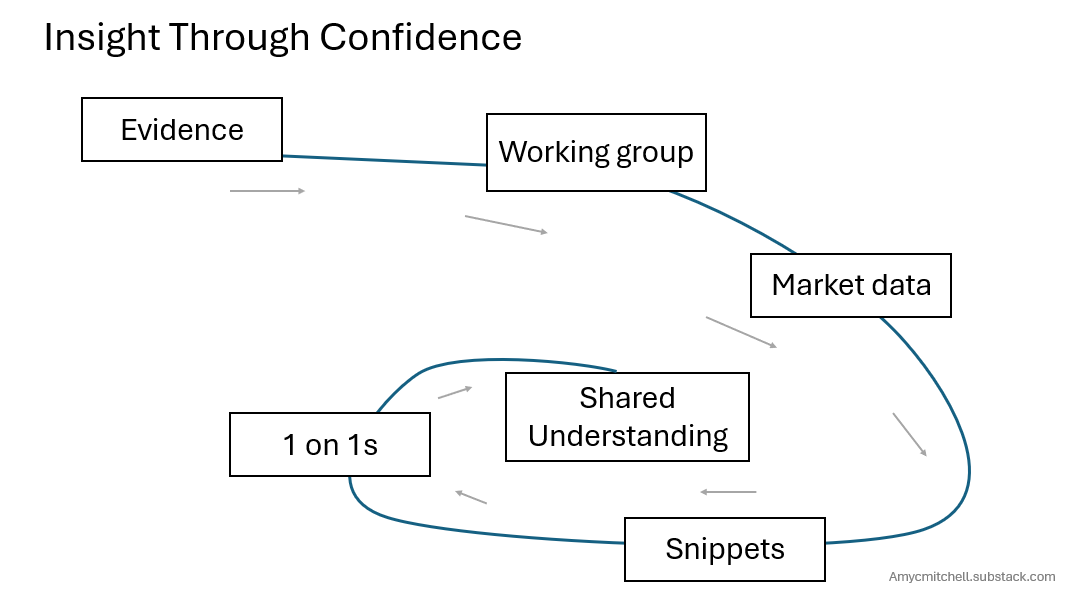
Moving from a hunch about a trend to evidence needs a blend of research and buy-in as you go. Ideally, your research process leads to stakeholders who can be co-creators with you.
You initially find proof of your insight:
Usage and customer comments about how products are being used
Support trends and feature requests
Churn and win/loss analysis
Depending on your organization, you’ll discover what cross-functional teams (Sales, Marketing, Engineering, Architecture) are seeing in their domain. They can help with filling gaps in the story.
Next, take a look at external market data. Summarize for yourself analyst data that relates. Check how competitors position similar capabilities.
Socialize continuously:
Communicate small pieces of evidence as you discover them
Give influential peers or leaders early material in 1-on-1s
Include feedback so it gets into your next update.
Evidence convinces people that the opportunity is real. Momentum convinces them it’s worth changing how they work.
Build momentum
At this stage, people begin changing how they think about the opportunity.
Moving from shared understanding to operational change requires stakeholders to accept real tradeoffs and workload shifts. This is where many promising ideas stall. Everyone agrees with the opportunity, but no one has yet agreed on how their work will change.
You are moving the idea with stakeholders to the real world.
Start with the choices the organization will and will not take. Define “Where to Play” and “How to Win” based on the opportunity. Be sure to document what you are not doing. Product managers usually show “Is / Is Not” at this point.
Use the “Is / Is Not” non-goals list to offset concerns about work disruption. A lot of the concerns are about the size of the change and available capacity. The tradeoff discussion is crucial to a handover that sticks.
Socialize continuously:
Co-design the potential execution with “no surprises” as you reach early commitment
Some product managers organize solution workshops, design reviews, or customer journey discussions
Summarize the solution with the tradeoffs into an actionable overview. Topics you can cover:
The problem and opportunity with the evidence
Quantified impact with clear success metrics
Possible next steps to validate, such as a pilot or smoke test for proof before full rollout
At this point, you and a close working group have a draft understanding of what the idea means. You have hard-won agreements about putting the idea into practice.
Transfer ownership
At this stage, the initiative can continue making progress without depending on you.
Your job is less about convincing others that the idea is good and more about transferring the agreements to others for execution.
Think about the cross-functional needs in your organization:
Engineering and architecture to translate into technical feasibility
Marketing and sales enablement for the market narrative, pitch decks and pricing/packaging strategies
Operations and delivery to support customer onboarding and workflow changes
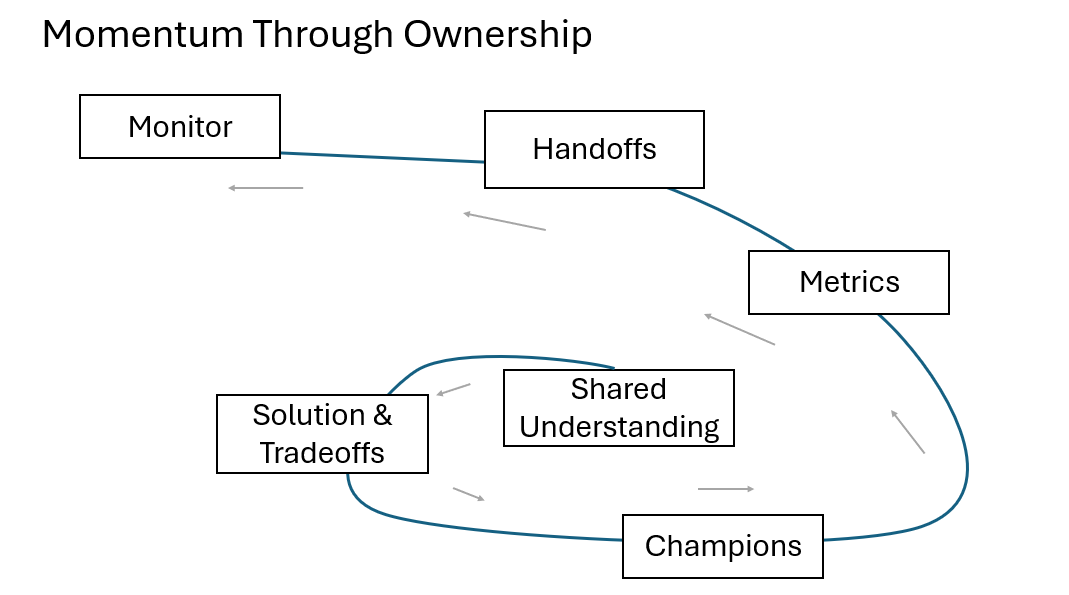
Find and encourage functional champions as you collaborate on the actions to hand over. Give them early reviews and credit them for contributing.
Align on metrics with leadership for shared ownership:
Tracking the adoption or velocity of customers after the change
Monitor lagging indicators that apply, such as revenue, user retention, cross-selling and market share changes
Periodically check back and update the strategy as conditions change
Socialize continuously:
Handle any lingering doubts through risks and mitigation
Some product managers orchestrate a readiness review across product, engineering, marketing, sales and operations
These steps get the idea into the hands of the affected teams.
Your job isn’t to do everything
Getting cross-functional teams moving on your idea is a significant job that requires focus. While you might be able to do the work on carrying out the idea, don’t do it. You will lose your proactive concentration on getting movement.
Your goal is to get the idea over to others for implementation.
Leadership and stakeholders need you to tie together the evidence into actions.
At every stage, your job is to leave the idea stronger than you found it.
Closing - create change along with ideas
Taking ideas into growth is one of the unique jobs of product managers.
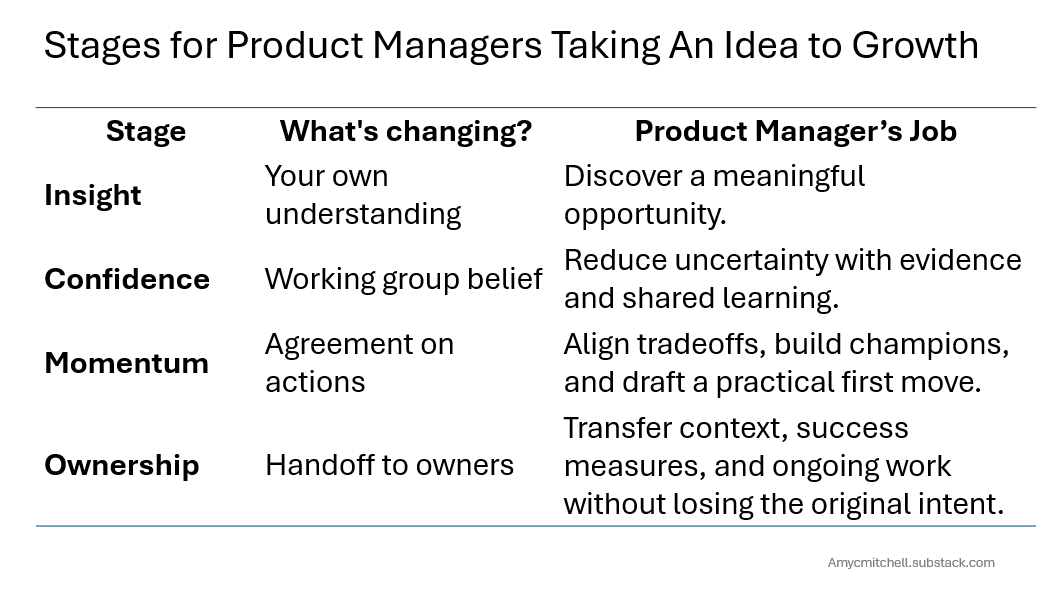
It’s about
Finding relevant evidence
Building confidence with peers and stakeholders
Socializing the work
Transferring to cross-functional teams
This is how product managers create change that’s larger than a single product manager.
Q&A
What if another team owns implementation?
This is ok. Your goal is ownership transfer and not retaining ownership.
What if I’m not senior enough?
Developing ideas to evidence and action builds on communication and relationships. Product managers of all levels can contribute.
How do I know when to hand off?
When stakeholders understand:
Why
What
Tradeoffs
Success metrics
Without you in the room.
What if nobody agrees?
Then keep researching. Don’t keep presenting.
Looking for more practical tips to develop your product management skills?
Product Manager Resources from Product Management IRL
Product Management FAQ Answers to frequently asked product management questions
Premium Product Manager Resources (paid only): This month’s guide focuses on AI-assisted product initiatives. It helps you build context that your whole product team can use.
TLDR Product featured Product Management IRL articles recently! This biweekly email provides a consolidated list of recent product management articles.
drpp The Drip featured Product Management IRL articles. This newsletter handpicks product management articles every day, summarizing them to provide you with a comprehensive overview of product management and technology.
Connect with Amy on LinkedIn, Threads, Instagram, and Bluesky for daily product management insights.
The proposed idea for momentum is terrific. And transition from momentum to ownership transfer is the ideal stage for every PM getting fab ideas! Thanks for writing this, Amy!