When the Team Knows More Than You Do
How product managers create the conditions for better decisions


Intro
Product managers rarely have the deepest expertise on the problems they own. It’s part of the product job. The challenge is creating the conditions for the people who do have that expertise to make better decisions together.
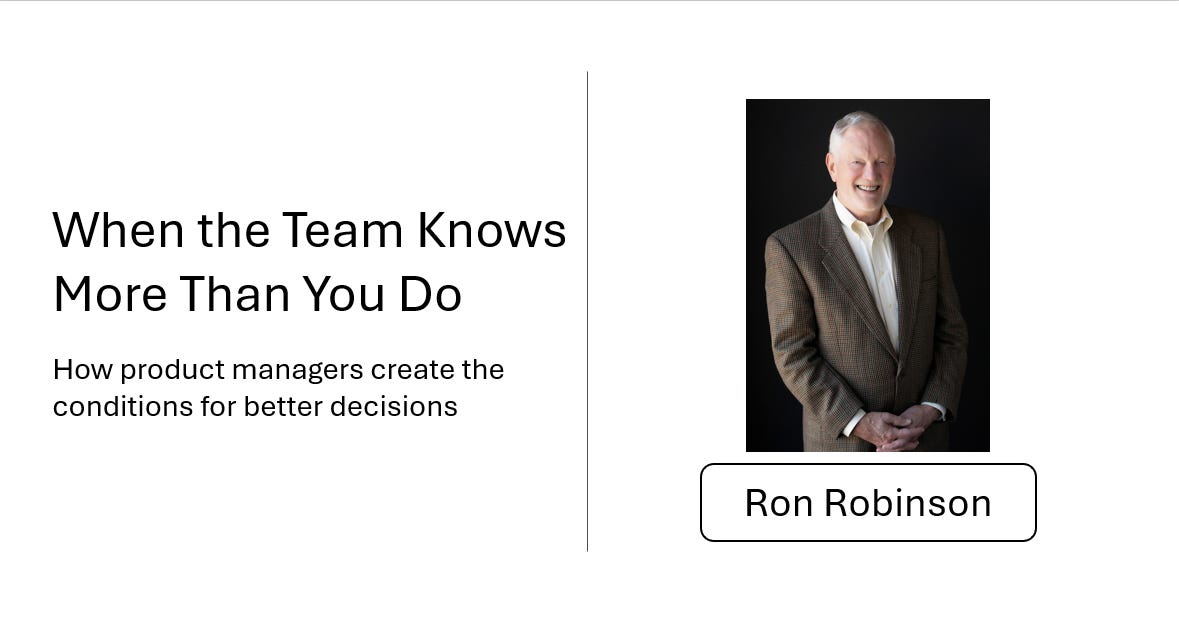
We have a guest with us, Ron Robinson. Ron has published 4 books on business performance. He is known for overcoming disruption and building compassion and resilience.
This week is a little different from the usual format. Ron brings the stories; I bring the product management perspective. Together, we’re looking at how these situations apply to product managers when expertise is distributed across a team.
At a glance
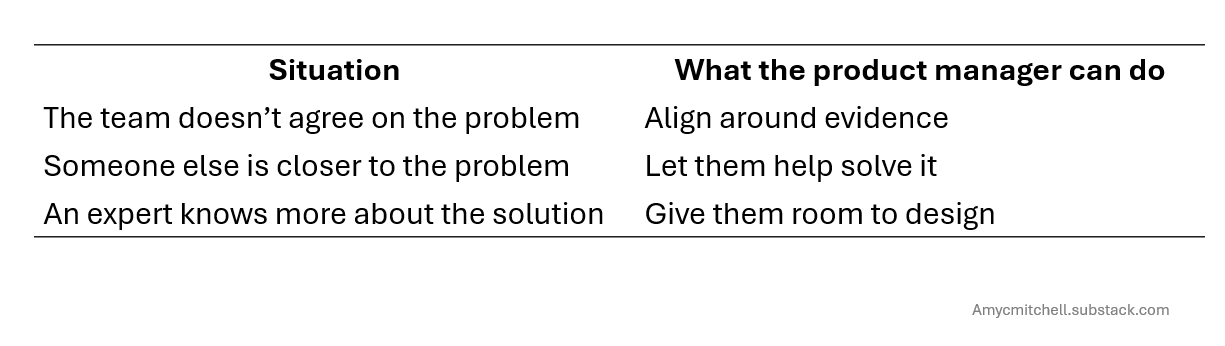
The common thread: product managers can stay accountable for the outcome without being the person making every decision.
1. Align around reality before aligning around a plan
Ron’s story: first create a shared picture of reality
I was asked to join the McDonald’s leadership team to win in the competitive Washington, DC region. The leadership team wanted a new restaurant model to gain market share.
We studied our competition and our own capabilities. In teams, we visited competitive restaurants at noon and counted cars in parking lots. We drove through drive-throughs and measured time to delivery, how hot the meal was, how accurate the order was, quality of the food and how polite the service people were. We then sampled our own restaurants using the same measurements. We were ready to design a plan.
The planning session included stakeholders such as “the bread man” (the bun supplier) and other suppliers. Everyone agreed on goals and tasks for building new restaurants and increasing customer satisfaction.
What changed
At the end of the session, the team bought into the new restaurant model. Leadership challenged them to build 30 restaurants in one year with the new model. They and their families would be treated to a week’s vacation in Hawaii if they could hit the goal. The two development groups (construction and real estate) reorganized and planned together. They built not 30 but 32 restaurants and went to Hawaii.
The product management perspective
Product teams often try to align on a solution before they agree on what they are seeing. That puts the product manager trying to reconcile competing opinions. In this case, Ron helped the team build a shared picture of the problem.
Start with evidence. They studied competitors and their own capabilities before deciding what to do.
Make the strategy visible. Everyone understood the competitive challenge and the goal.
Bring the people who execute into the strategy. Suppliers, operators, employees, finance, HR and marketing all participated.
Turn strategy into ownership. Each group left with goals and responsibilities.
2. Don’t solve every problem yourself
Ron’s story: let people own the decision
The Eastern Band of Cherokee Indians (EBCI) needed us to provide management development for tribal programs. I was asked to be part of that initiative. When training EBCI management, a construction manager became a star pupil.
After learning to listen, he started conducting Monday morning meetings with his crew. He asked, “What do you need to do your jobs better?” They responded, “New boots!” Many had boots that leaked and made working uncomfortable. He got them new boots.
At their next meeting he asked, “What do you need to have a good week?” They responded, “We don’t have the tools we need in our trucks.” He suggested they take the first hour of the shift to survey their trucks, order any missing tools, and get organized.
What changed
The following Monday, the construction manager reported in class that his crew leader told him, “We know you have class today, but don’t worry. We have everything taken care of. Not only did they take care of everything, but crew production improved!” he said with a grin.
The EBCI construction manager involved his crew in the first decision regarding boots and empowered them to fix the truck inventory in the second decision.
The product management perspective
Don’t solve every problem yourself simply because you’re the product person:
Start with evidence before asking teams to choose a solution.
Ask who is closest to the problem before taking ownership of it.
Give teams the context so they can make the decision.
Step in when a decision affects the outcome or creates cross-team consequences.
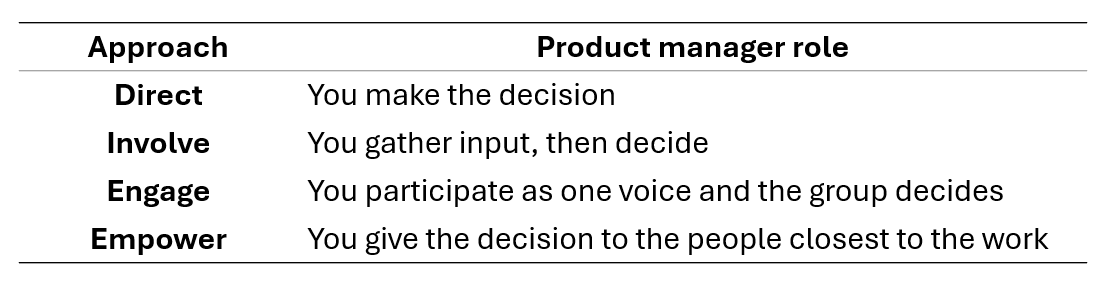
The product manager’s job is to decide how each decision is made:
3. Accountability doesn’t require control
Ron’s story: Giving experts room to design
Air Canada was transforming from government-owned to a publicly traded airline. Our consulting firm was contacted, and I offered a proposal to coach union members and management on making decisions together.
As we progressed, Bill, the station manager for Winnipeg, mentioned that he was going to design a new laboratory for the station. I asked what he thought of putting the technicians in charge of designing their lab.
Several weeks later, Bill invited me to join him for the grand opening. The laboratory sparkled with new tables and equipment arranged in circles in each half of the room. Bill explained that he had delegated everything to his technicians.
What changed
The technicians designed their space to facilitate a smooth workflow. Each side of the room was organized to accommodate specific research activities.
Bill admitted he would never have conceived of such an arrangement. Several months later, Bill announced they won their first and second outside maintenance contracts.
The product management perspective
Don’t confuse owning the product with designing every detail.
Identify where expertise actually lives.
Give domain experts enough context to make good decisions.
Stay accountable for the product without becoming the bottleneck.
What changes for product managers
Ron’s stories show three ways to create the conditions for experts to solve their problems. Like product managers, Ron was part of the teams, but he didn’t have to be the center of every decision.
Product managers are deliberate about where they lead and where others lead:
bring people into the problem first
listen to the people closest to the work
give experts room to design
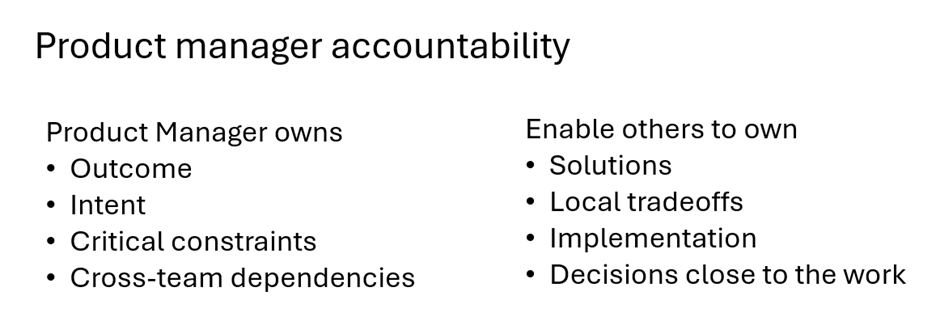
Product managers make sure the team has the right context, direction and ownership to make the right decisions. And they step in when a decision affects the product as a whole.
Thank you to Ron
Thank you to Ron for collaborating on this article. I appreciated his insights from coaching leaders.
To learn more about Ron:
- His website: ronspeaking.com
- His newsletter: RonSpeaking.substack
He updates both places on how to work better in today’s changing world.
Looking for more practical tips to develop your product management skills?
Product Manager Resources from Product Management IRL
Product Management FAQ Answers to frequently asked product management questions
Connect with Amy on LinkedIn, Threads, Instagram, and Bluesky for daily product management insights.
Discussion about this post