
The Completeness Trap
You don't need more detail. You need a smaller decision.

Jon’s first big product initiative wasn’t supposed to go like this.
“You aren’t focusing on the right details here,” his boss said.
“This is the third time I’ve asked for this information. If we don’t get this feature out soon, sales will miss the forecast again.”
He leaves the meeting with a familiar feeling that no longer feels temporary: he’s behind, but not sure on what.
This is one of the most common failure modes in cross-functional product work and one of the hardest to recognize while you’re in it.
If you’ve ever felt like:
Progress means filling in more slides, not making decisions
Every stakeholder wants something different
And you’re being asked for details without clarity on direction
You’re likely in the Completeness Trap. This shows up whether you’re working on a feature, an initiative, or a full product; what changes is the scale, not the pattern.
A few months earlier, this initiative looked like a clear step forward.
Jon had just delivered a telemetry report on capacity usage for their largest customer. It went well. Leadership noticed.
So when taking that capability to all customers, he was excited to own it.
It felt like a real product moment.
Sales supported it immediately. They even suggested enhancements that could improve uptake. Finance helped shape the business case and flagged important cost targets. Engineering raised concerns early: the cost targets would be difficult to hit in the first release, though they weren’t convinced the feature would even see strong demand initially.
Still, there was momentum. And ownership.
Now Jon is stuck in something different.
Every conversation adds detail, but nothing feels settled.
And now something that started as his first meaningful product responsibility is starting to feel like a performance problem.
What’s happening to Jon is a predictable failure mode in ambiguous cross-functional work.
It has a name: the Completeness Trap.
Why this stalls
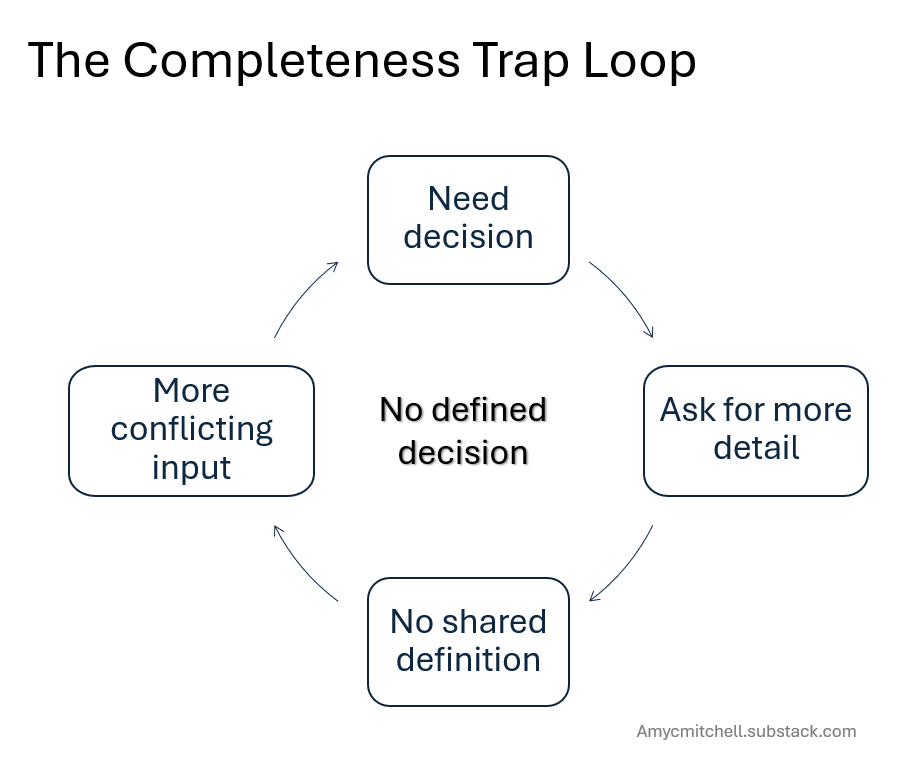
It looks like a coordination problem. It isn’t. It’s a definition problem.
No one has clearly defined what decision is being made.
So the team substitutes something else:
“Let’s get the details right first.”
Each function optimizes for its own concerns:
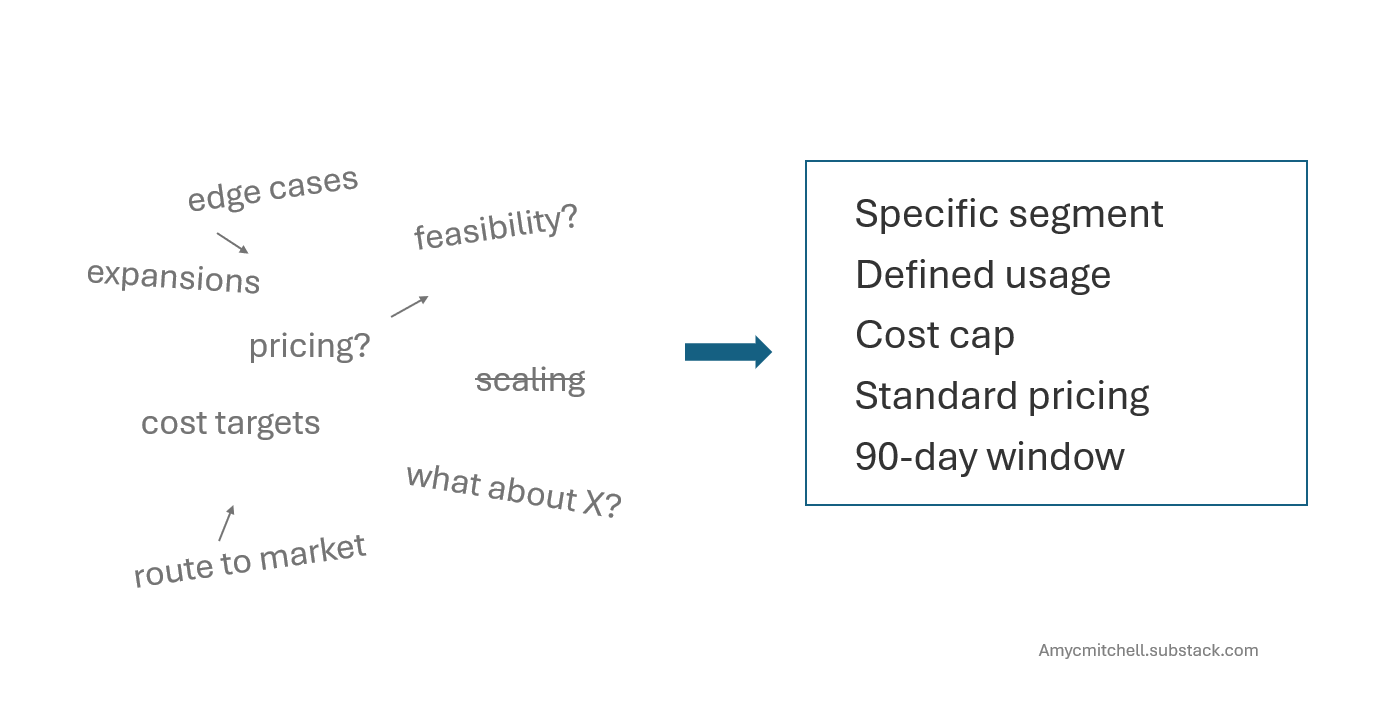
Sales pushes for edge-case flexibility
Finance looks for scalable control mechanisms
Delivery evaluates feasibility in isolation
Product tries to reconcile everything at once
And somewhere along the way, “progress” becomes:
How much have we filled in?
Instead of:
Are we ready to decide?
The trap
The Completeness Trap is when teams replace decisions with detail.
What makes the Completeness Trap difficult to see is that no one is doing anything wrong.
Sales is trying to protect revenue.
Finance is trying to protect margin.
Engineering is trying to protect feasibility.
Leadership is trying to protect delivery certainty.
And the product manager is left trying to reconcile all of it by adding more detail.
But detail only redistributes tension. Avoiding the tension by investigating details ends up delaying progress.
Jon’s situation is missing a structure for decision-making.
And once you see it that way, the path forward stops being about alignment and starts being about design.
There are three moves that break the Completeness Trap:
Shrink the problem until a decision becomes possible
Define constraints before expanding detail
Turn objections into boundaries, not blockers
These are ways of forcing decisions in ambiguous situations.
Make the decision smaller
In Jon’s case, the organization is trying to answer a large question:
“Should we roll this capability out across all customers?”
But that question is too broad for the current level of uncertainty.
So instead of forcing clarity through more detail, the first move is to change the shape of the question itself.
Not:
“How do we solve everything correctly?”
But:
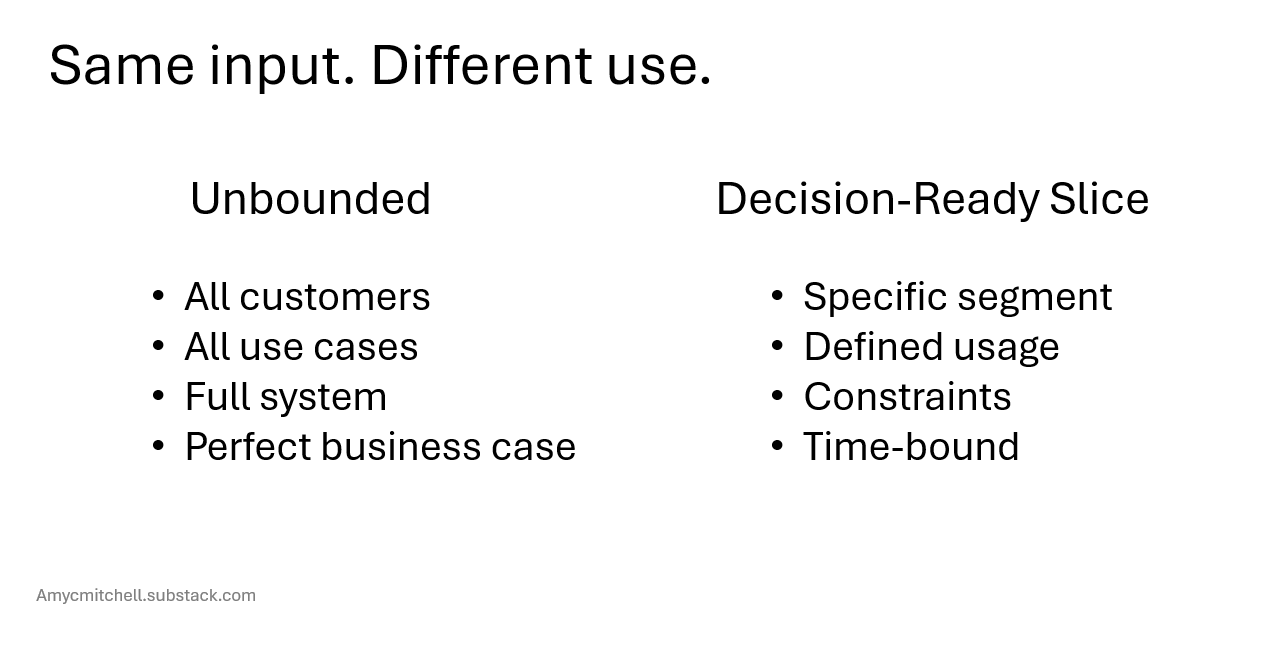
“What is the decision-ready slice of this?”
That usually means defining a bounded rollout, such as:
a specific customer segment
a constrained usage scenario
a limited commercial structure
or a time-boxed 60–90 day window
The point is to create a version of reality where the organization can actually observe outcomes and make a decision.
This is where most teams hesitate because shrinking the problem feels like admitting it isn’t ready.
For Jon, it would feel like this:
The initiative is already tied to a major customer story
Sales is expecting it to support forecast recovery
Leadership is watching delivery timing closely
But that delays the moment of commitment.
What’s actually missing is not scope. It’s a decision-ready slice.
A decision-ready slice is the smallest version of the problem that allows the organization to answer one question with real evidence:
“Does this work well enough, under controlled conditions, to justify scaling?”
For Jon, this feels like lowering ambition. In reality, it is the only way to preserve it.
Why this feels risky
Finding a way to reset the Completion Trap means shrinking the problem and setting a decision-ready slice. You still need to deal with strong personalities and delivery urgency.
So the question is:
“What is the smallest structural move that still changes how decisions get made under pressure?”
Setting a decision-ready slice doesn’t remove pressure. It gives it structure.
Turn objections into boundaries
This is where most product managers lose control of the model.
The moment you propose a “smaller slice,” stakeholders start doing what they are trained to do:
Sales expands use cases
Finance tests downside risk
Engineering challenges feasibility edge cases
And suddenly, the “slice” starts growing again.
So the problem is when objections are treated as inputs into redefining the slice.
The shift is subtle but critical:
Objections are not used to reshape the decision-ready slice.
They are used to define the boundary conditions of it.
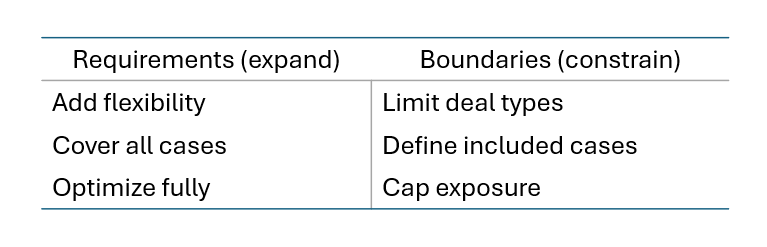
A boundary condition is different from a requirement.
It defines the limits within which the decision will be made.
For example:
Instead of “we need flexibility for all deal types”
→ “within this slice, only standard deal structures are in scope”Instead of “cost needs to work at scale”
→ “this slice is evaluated under capped usage conditions”Instead of “we need full engineering readiness”
→ “this slice uses existing system capabilities only”
The key difference is this:
A requirement asks for inclusion.
A boundary condition enforces exclusion.
This sounds clean in theory. It rarely is in practice.
Here’s what it looked like for Jon:
Why this works (even here)
At this point, it’s easy to think:
“This only works if you have control over scope.”
Jon doesn’t.
His boss is already frustrated.
Stakeholders are already fragmented.
The customer is already using the feature.
And there is pressure to show progress quickly.
So this feels like a recovery problem.
But that’s exactly where the Completeness Trap becomes visible.
Jon is missing a shared definition of what “good progress” looks like right now.
Without that, every action he takes will be evaluated differently:
Leadership sees delay
Sales sees under-delivery
Finance sees uncertainty
Engineering sees overreach or under-scope depending on direction
So Jon’s focus is changing the structure of what they are reacting to.
And that is where the “decision-ready slice” becomes practical.
Breaking the pattern
He fixes this by doing something that feels risky in the moment:
He goes back to his boss first. With a reframed question.
“We’re getting a lot of detailed input, but it’s not converging into a decision.
I think we’re trying to solve for full rollout before we’ve proven a version that works.
I want to propose a bounded version of this so we can decide what to do next.”
This is not a fully formed plan.
It’s a shift in how progress is defined.
His boss doesn’t immediately agree.
But for the first time, the conversation changes.
From:
“Where is the missing detail?”
To:
“What exactly are we trying to decide right now?”
Jon then does the harder part.
He defines a decision-ready slice.
A limited set of customers similar to the original use case
A constrained usage model that caps cost exposure
A standard commercial structure with no variations
A 90-day window to evaluate actual usage, cost, and willingness to pay
And just as importantly, he defines what is not included.
No edge-case configurations.
No expanded packaging options.
No system-level optimizations.
Then he brings it back to the group.
This is the uncomfortable meeting.
Because for the first time, Jon is not collecting input.
He is presenting a boundary.
And asking a different question:
“If we operate within these conditions, is this enough to decide whether we scale this or not?”
The reactions come quickly.
Sales pushes on flexibility.
Finance questions margin exposure.
Engineering raises feasibility concerns.
Just like before.
But something is different.
The conversation doesn’t expand.
Because the slice is not up for redesign.
The discussion shifts to:
“Does this bounded version answer the question we care about?”
And for the first time, the team is reacting to the same version of the problem.
Jon doesn’t win every argument.
Some constraints get adjusted.
But the boundaries hold.
And that’s what matters.
Because within those boundaries:
Finance can model risk with actual limits
Sales knows what is and isn’t sellable
Engineering knows what they are committing to
Leadership can evaluate timing and impact
Not perfectly.
But concretely.
A week later, Jon goes back to his boss.
Not with more detail.
With something different:
“Here’s the version we’re proposing to move forward with.
Here’s what we’ll learn in 90 days.
And here’s the decision we’ll be able to make after that.”
This time, the conversation is shorter.
It’s about whether to proceed.
Conclusion: what actually changed
Jon didn’t solve everything. He did something harder: he made it possible to decide.
A shift in the unit of work breaks the Completeness Trap.
It moves you from an unbounded problem that invites endless input
→ to a bounded decision that forces convergence
Your job as a product manager is to define the conditions under which a decision can be made despite it.
And sometimes, the most important move you can make is deciding where detail stops, so the organization can finally move.
Common questions in the Completeness Trap
Won’t stakeholders just reject a smaller slice?
They might. That’s not the point.
The goal of a decision-ready slice is forcing a reaction to a bounded proposal instead of an unbounded one.
Unbounded work expands. Bounded work forces clarity
Isn’t this just delaying the real decision?
No. The decision is already being delayed by the expanding requests for details.
What looks like progress is actually ongoing deferral through detail accumulation.
What if the customer is already using the feature?
That’s exactly when the trap is most visible.
Usage without boundaries creates the illusion of adoption without clarity on value, cost, or scalability.
A slice is about defining what part of that usage is being evaluated.
My boss is already asking for detail. How do I introduce this?
You introduce it as a response to the current lack of convergence.
That repositions it from abstraction → progress mechanism.
Looking for more practical tips to develop your product management skills?
Product Manager Resources from Product Management IRL
Product Management FAQ Answers to frequently asked product management questions
Premium Product Manager Resources (paid only) 4 learning paths, 6 product management templates and 7 quick starts. New items monthly!
TLDR Product featured Product Management IRL articles recently! This biweekly email provides a consolidated list of recent product management articles.
drpp The Drip featured Product Management IRL articles. This newsletter has handpicked product management articles every day, summarized to give you the big picture of product management and tech.
Connect with Amy on LinkedIn, Threads, Instagram, and Bluesky for product management insights daily.
I love the article - but recognizing the completeness trap is not easy. isn't a phased rollout strategy - a better path which should be included in prd?
makes sense. but I still believe there should be a some document- I often struggle with a decision making playbook or doc and would love to understand how do you advocate and cement decision . the boundry formulation is amazing strategy