Where Product Meets Finance
Five Shifts to Help Product Managers Avoid Delays, Earn Trust and Grow Responsibly

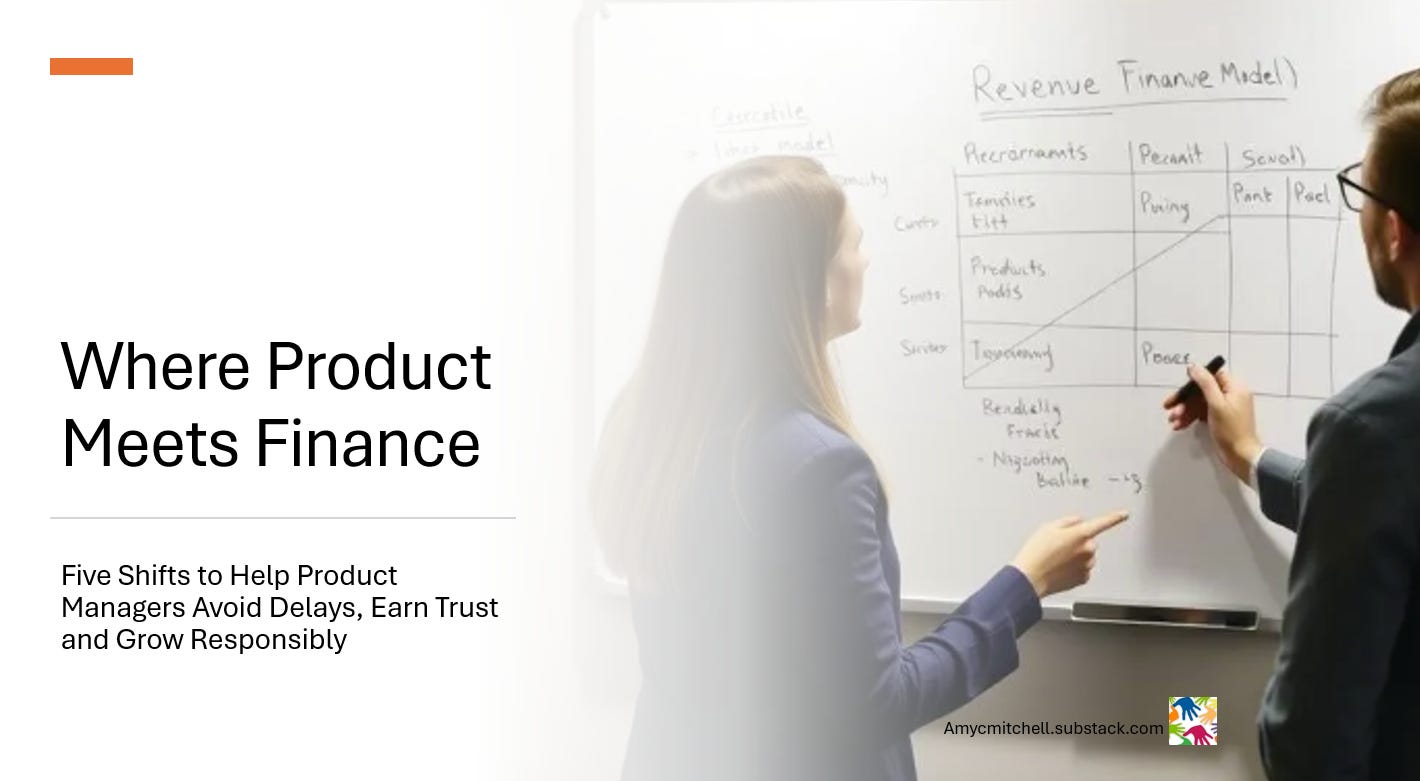
You’re meeting with Finance, Tax, and Accounting about your upcoming product launch. The offer is similar to a previous one, but this time it’s bundled differently—raising concerns about how it interacts with financial automation and reporting systems.
You summarize what you're hearing to help the group stay aligned… and then Accounting cuts in:
"Isn’t that what I just said?"
It stings. You were trying to clarify. But your recap glossed over key financial implications—and your peer noticed.
It’s a common misstep. Many product managers unintentionally alienate financial teams in 30-minute meetings, not realizing how much trust and clarity are needed when the stakes are this high.
You might relate. These moments are signals. In this article, you’ll get five simple shifts to turn these signals into better collaboration with Finance.
What Finance Wishes Product Managers Knew
Effective collaboration starts with understanding what Finance, Tax, and Accounting actually do—and what’s at stake if they’re misunderstood:
Accounting ensures reporting accuracy and compliance
→ Mistakes here create audit risks and misstatementsTax manages exposure across jurisdictions
→ Product bundling and classification can have serious legal implicationsFP&A handles forecasting and planning
→ Surprise shifts in assumptions can ripple across the company

These teams need more than a quick summary. They need accurate framing, early engagement, and shared understanding.
What they want from product managers:
Bring them in early—especially when revenue or margin is involved
Recognize that subscription models introduce complex revenue recognition rules
Understand that accounting and tax policies evolve—building a new offer often means re-evaluating how value is recognized and where
You don’t need to have all the answers—you just need to respect the complexity of theirs.
Finance’s expectations can feel opaque—until you realize how differently product and finance approach ambiguity, risk, and decision-making.
Why Product Managers Miss the Mark
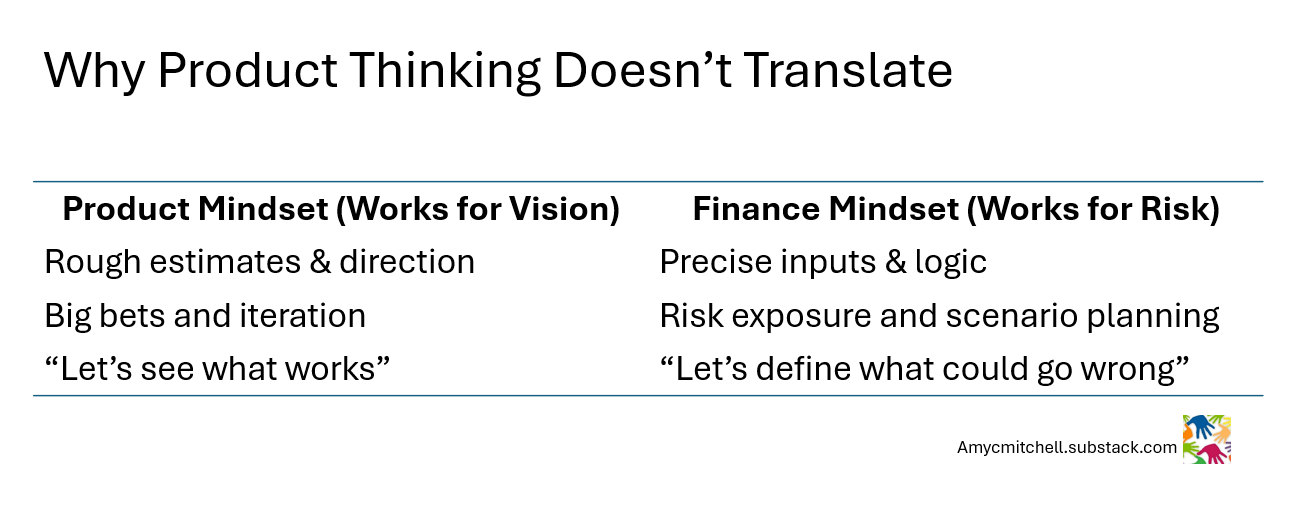
Product managers are coached to think in terms of rough estimates and directional tradeoffs. That mindset works when navigating ambiguity across design, engineering, and user research.
It doesn’t work with Finance.
Financial teams prioritize:
Precise terms: ARR, bookings, margin
Structured logic in assumptions
Concise, grounded communication
Shared vocabulary and consistent definitions
Reasonable requirements for financial roles.
Common product manager missteps:
Speaking in abstractions (“This is a bet on growth”)
Assuming shared context (“Of course, this will improve revenue”)
Oversimplifying or reframing (“So basically, you’re saying…”) in ways that distort meaning
These habits erode trust—and when trust breaks, launches are delayed, and opportunities shrink.
What to Try Instead (Starting Today)
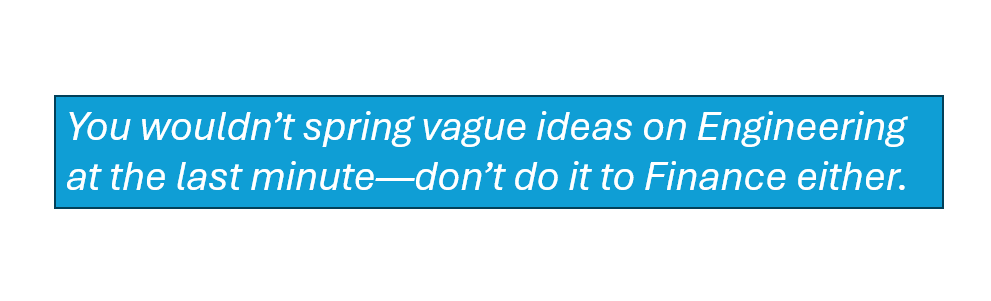
Your product strategy needs to work in the market and in the business model. That means Finance isn’t a late-stage checkpoint. They’re a partner—just like Engineering or Marketing.
Here are five shifts that help you show Finance you understand the business—not just the product:
Shift 1: Communicate business goals, not just feature functions
Focus first on how your product change supports growth or retention. Let Finance ask about the technical details if they need more.
Shift 2: Ask for help in explaining financial constraints
Instead of recapping a financial topic for your stakeholders, get the explanation in the words of finance. Don't attempt to represent a complex topic such as revenue recognition, tax entities or margin dilution alone.
Shift 3: Mirror the structure of finance
Listen to the way finance discusses your product and follow their lead. If finance discusses the average customer in terms of revenue per month, then respond in those terms. Instead of discussing estimated customer growth, follow finance's model of estimated cost per customer.
Shift 4: Ask for the model, not the number
In true partnership, understand how finance is modeling the product. Work on assumptions and estimates together in the same model. Finance is already modeling your product. When you understand what goes into the model, then you can collaborate on the model impacts resulting from your product changes.
Shift 5: Say less, more cleanly
Keeping precision in mind, be ready to explore changes based on grounded assumptions. The finance team needs to know basic assumptions and reasoning to evaluate your changes. This means you need to distill your input to 1-2 clear sentences. If you can't do this, you might not have the right level of clarity yet.

You Don’t Need to Be an Expert—But You Do Need to Engage
These shifts don’t require deep accounting or tax knowledge. What they do require is curiosity, clarity, and a willingness to step into Finance’s world.
Want to build fluency over time? Try this:
Ask Finance to walk you through how they model your product
Learn the key financial metrics that shape your business (CAC, LTV, ARR, payback period)
Study how Finance presents your product in exec readouts—what terms do they use? How do they frame performance?
Product Growth Depends on Financial Collaboration
Product growth isn’t just about roadmaps and user insights. It’s also about building offers that are financially viable and executable at scale.
If Finance trusts you to carry their thinking forward, you’ll ship faster, influence more, and avoid costly delays.
When you treat Finance like a partner—not a blocker—you unlock a whole new layer of product leadership.
Looking for more practical tips to improve your product management skills?
Check out Product Management Resources for free product management templates and guides.
Become a paid subscriber and get more weekly tips. Last week, paid subscribers learned about being more strategic. Quit Catching Every Risk!
Paid subscribers get ad-free newsletters and access to 3 learning paths, 5 templates and 7 quick start guides. 🎁
TLDR Product listed Product Management IRL articles recently! This biweekly email provides a consolidated list of recent product management articles.
Connect with Amy on LinkedIn, Threads, Instagram, and Bluesky for product management insights daily.
Discussion about this post