
Execution Problems Are Often Workflow Problems
Design workflows that keep product initiatives moving

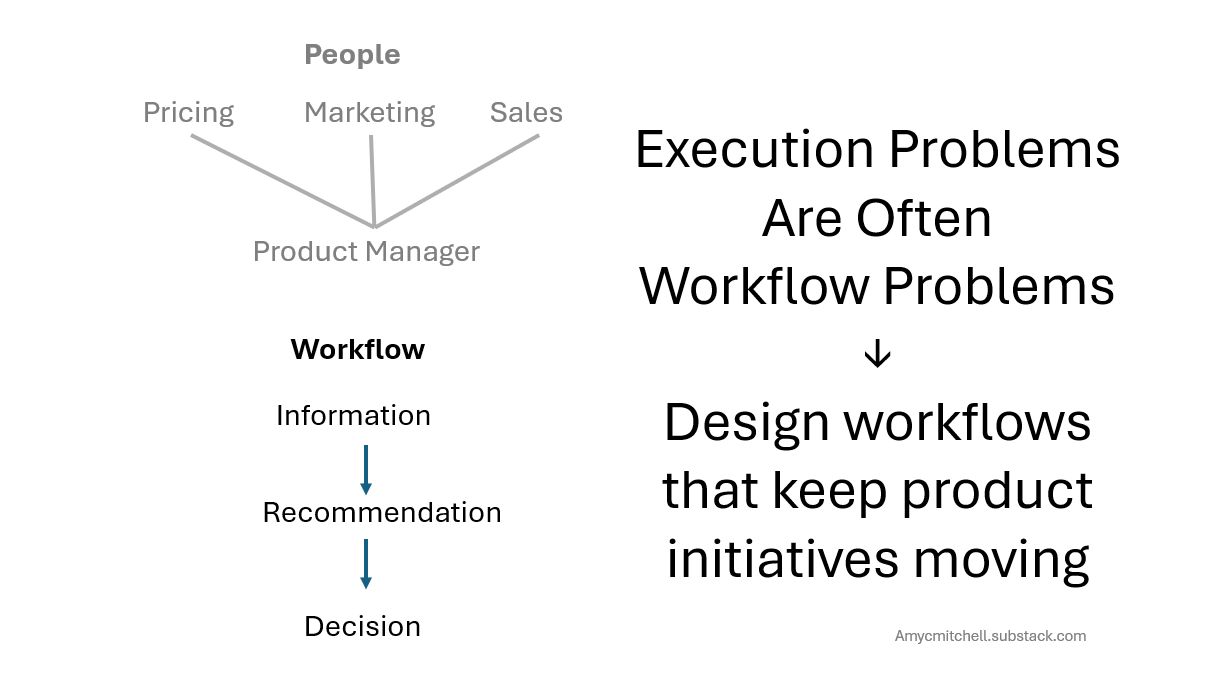
You finally got the green light on a critical product initiative. Yet every week slips further behind schedule.
It could be another product manager.
A functional partner.
An executive stakeholder.
A team that’s overwhelmed.
Someone who debates every decision, misses commitments, or simply responds too slowly.
The natural reaction is to improve communication, strengthen the relationship, or create even more alignment.
But those efforts often make execution slower.
The real problem is that your workflow assumes every dependency will execute reliably.
Once that assumption breaks, your own execution breaks with it.
Instead of avoiding dependencies, you can redesign your workflow so collaboration improves execution instead of becoming a prerequisite for it.
That starts with changing the question you’re asking.
Stop asking “How do I work with this person?”
Your usual reaction when you hit an obstacle is to directly fix it. Or work toward consensus. You want to cooperate.
Consensus isn’t the objective of every interaction. Sometimes the objective is learning. Sometimes it’s refining a recommendation. Sometimes it’s making a decision.
There are three workflow principles for execution:
1. Separate information from decisions
2. Reduce unnecessary synchronization
3. Make execution visible
The result: execution continues despite unreliable dependencies.
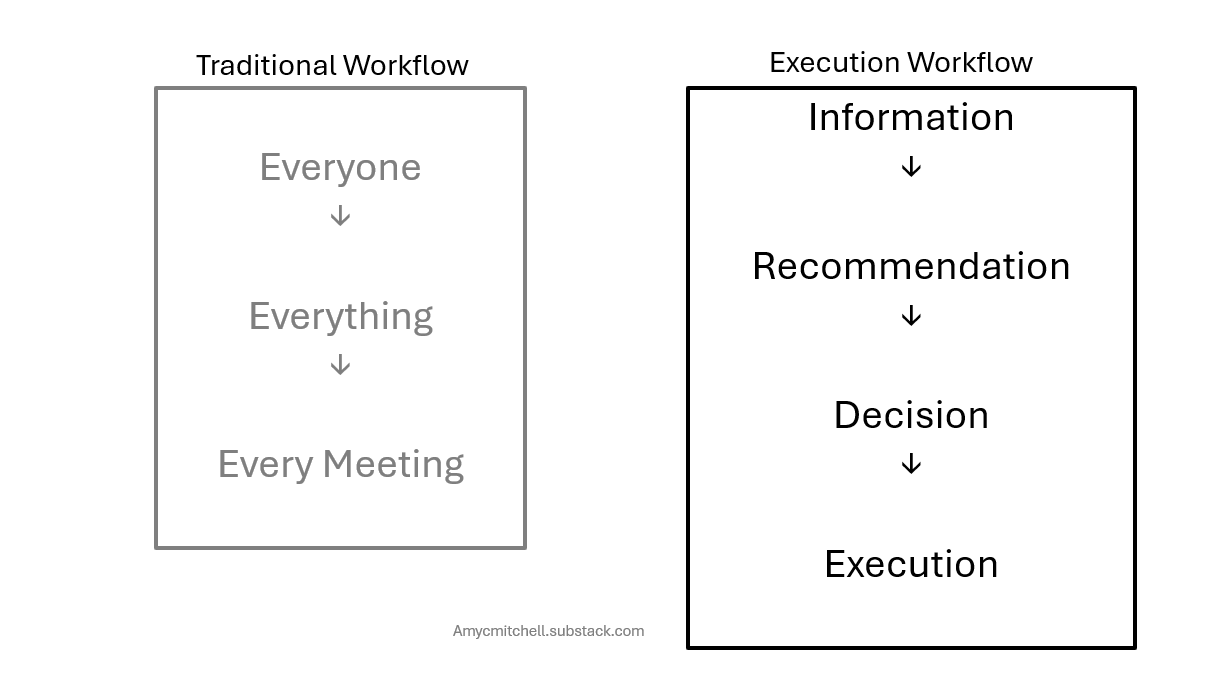
With the traditional workflow: One dependency fails. Everything stops.
With execution workflow: the work isn’t organized by people. It’s organized by purpose.
The good news is you don’t have to wait for every dependency to improve before you can improve execution.
Reduce dependency instead of reducing collaboration
Collaboration remains essential. The workflow determines when and how collaboration happens.
But collaboration doesn’t require every conversation to happen with every stakeholder present.
Effective workflows separate learning, debate, and decision-making into different moments.
A step product managers can take is removing unnecessary synchronization.
Examples of synchronized collaboration:
One product manager gathers information and shares it.
Debate happens before stakeholder meetings.
Stakeholders validate recommendations rather than watching them be invented.
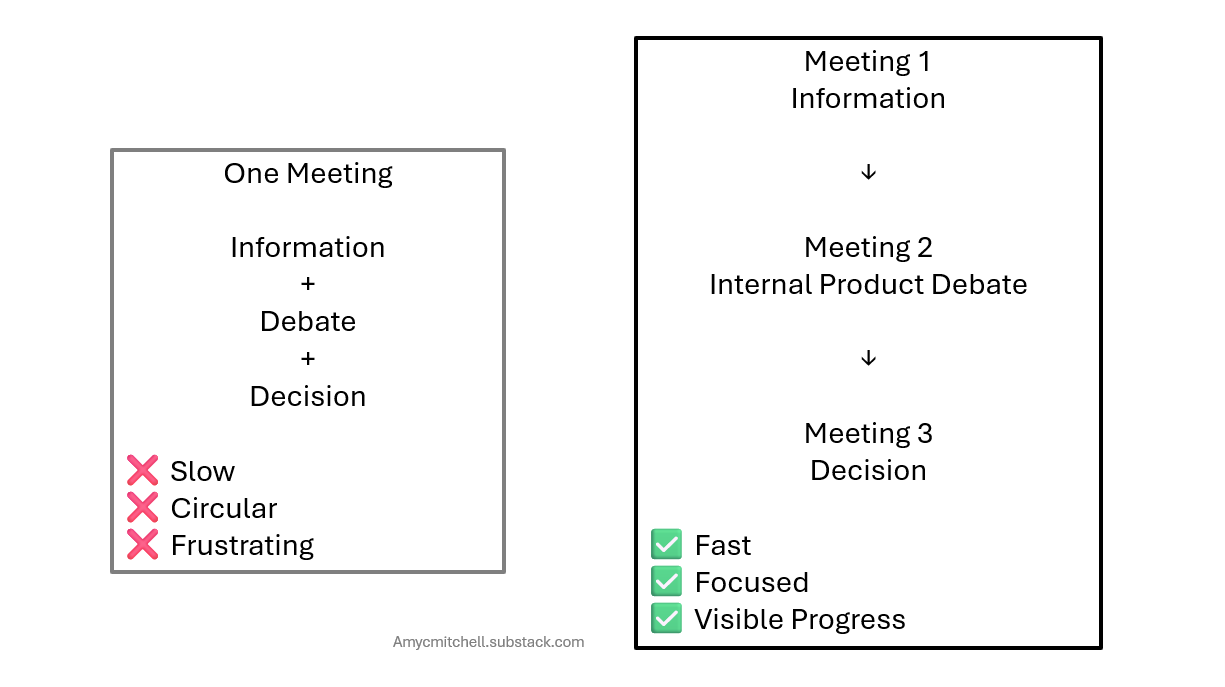
A way to keep your initiative moving is to sequence the work into multiple steps. Building blocks of success.
Once you reduce unnecessary synchronization, the next step is organizing work for execution.
Separate work by purpose
The breakthrough is categorizing your work for success. Think of product work in three buckets:
Bucket 1: Information gathering
Learning.
Collecting constraints.
Building understanding.
Bucket 2: Internal product work
Debate.
Explore alternatives.
Refine recommendations.
Bucket 3: Decision & Execution
Present recommendations.
Make decisions.
Assign actions.
The mistake is allowing all three to happen in every meeting.
Each bucket has a different objective, different participants, and a different definition of success. Separating them keeps work moving. This is how sequencing helps.
Multi-step product workflows need single-purpose meetings to get results. Inviting everyone to every conversation often mixes learning and decision-making into a single meeting.
Product managers who protect the workflow from distractions often get to outcomes faster.
Protect the flow of execution
Every product initiative has bottlenecks. Product managers get tough problems to solve. If there is widespread agreement, then there is no need for a product manager to drive a new outcome.
So by definition, you are going to encounter obstacles and dependencies. And product managers want to improve bottlenecks.
An alternative is to redesign the workflow for results. You still need to handle the buckets of information gathering, internal product work and execution.
Organizing work by purpose naturally changes how execution becomes visible.
Make execution visible
Leaders and stakeholders evaluate your visible progress.
The teams working with you want productive conversations with you. Each encounter with product needs to make progress. Cross-functional partners value conversations that have a clear purpose and lead to progress.
Making execution visible is the key to controlling your workflow. Each bucket of product work uses execution to stay on track:
Gathering information controls the participants to real interest. Limit to participants who have information relevant to the meeting objective. Learning is for finding solutions.
Internal product work is a forum for debate. But execution requires cutting off side issues and circular discussions. Execution gives collaboration focus.
Decision and execution make progress visible. Execution keeps discussions anchored to the decision that needs to be made. New ideas can be captured without changing the meeting’s objective.
Visibility becomes part of the workflow.
Closing - Workflow execution for success
Product managers spend years learning how to prioritize work and influence stakeholders. As product initiatives become more complex, another skill becomes just as important: designing workflows that keep execution moving across teams.
Every product manager eventually encounters an unreliable dependency. The product managers who continue delivering are the ones who intentionally shape how information is gathered, decisions are made, and execution becomes visible.
A resilient workflow helps every conversation contribute to progress, every meeting serve a purpose, and every dependency move the initiative closer to delivery.
When execution becomes the priority, workflow design becomes part of the product manager’s craft.
Q&A
Isn’t it wasteful doing all these work arounds?
The harm from exposing product internal debate can delay product work. You might not achieve your outcome and possibly hurt your credibility by combining too much in a single meeting. It’s about avoiding unnecessary delays.
Won’t I get in trouble for excluding key team members?
No. Gathering necessary information and reporting back is an efficient way to advance your product work. Share what you learned, explain why participants were chosen for that conversation, and involve people when their expertise is needed. Sequencing participation is different from excluding people.
What if my manager expects everyone to be included?
The workflow still includes everyone.
It simply sequences participation around the purpose of the work.
Information gathering, internal product discussion, and execution happen at different times.
What if the unreliable dependency owns part of the work?
Design the workflow so ownership remains clear while dependencies become smaller, more specific, and easier to complete.
How do I know if I’ve become too dependent on one person?
If one missed meeting...
or one unanswered message...
or one debate...
stops your initiative...
your workflow probably needs redesigning.
Looking for more practical tips to develop your product management skills?
Product Manager Resources from Product Management IRL
Product Management FAQ Answers to frequently asked product management questions
Premium Product Manager Resources (paid only) This month’s guide is about AI-assisted product initiatives. It helps you build context that your whole product team can use.
drpp The Drip featured Product Management IRL articles. This newsletter has handpicked product management articles every day, summarized to give you the big picture of product management and tech.
TLDR Product featured Product Management IRL articles recently! This biweekly email provides a consolidated list of recent product management articles.
Connect with Amy on LinkedIn, Threads, Instagram, and Bluesky for product management insights daily.