
When Product Understanding Stops Spreading
How strong product teams build shared understanding before one person has to carry everything

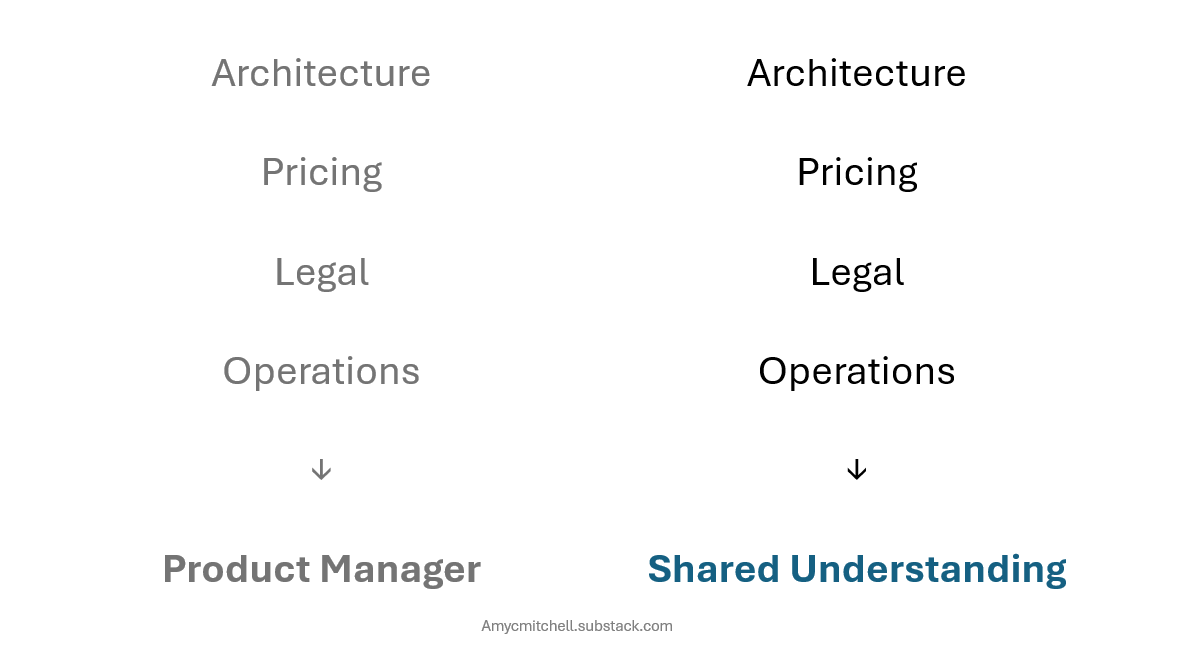
Your product work is going well. Decisions get made. Everyone believes progress is being made.
And yet.
Every few days you find yourself reconnecting everything.
You remind engineering why finance changed the pricing model.
You explain to operations why a customer request affects onboarding.
You update requirements because a legal discussion quietly changed what can actually be sold.
At first, you think a slide explaining the product strategy would help. But then you realize it is something different.
You realize something unexpected. You’re carrying the initiative’s understanding.
The strange part is that you probably didn’t plan for this to happen.
The surprising realization
Like many product managers, you’ve nurtured an idea into a real thing. A feature, an enhancement, a service or a product is coming together.
Your understanding is concentrated. You know what each function can do.
And each team is busy telling you:
Nothing new here
Or
This is a huge change
You pause. Maybe the strategy and requirements aren’t clear. You patiently explain again.
On the second repeat, you realize the understanding of the initiative lives in your head.
Cognitive concentration is what happens when understanding accumulates in one person.
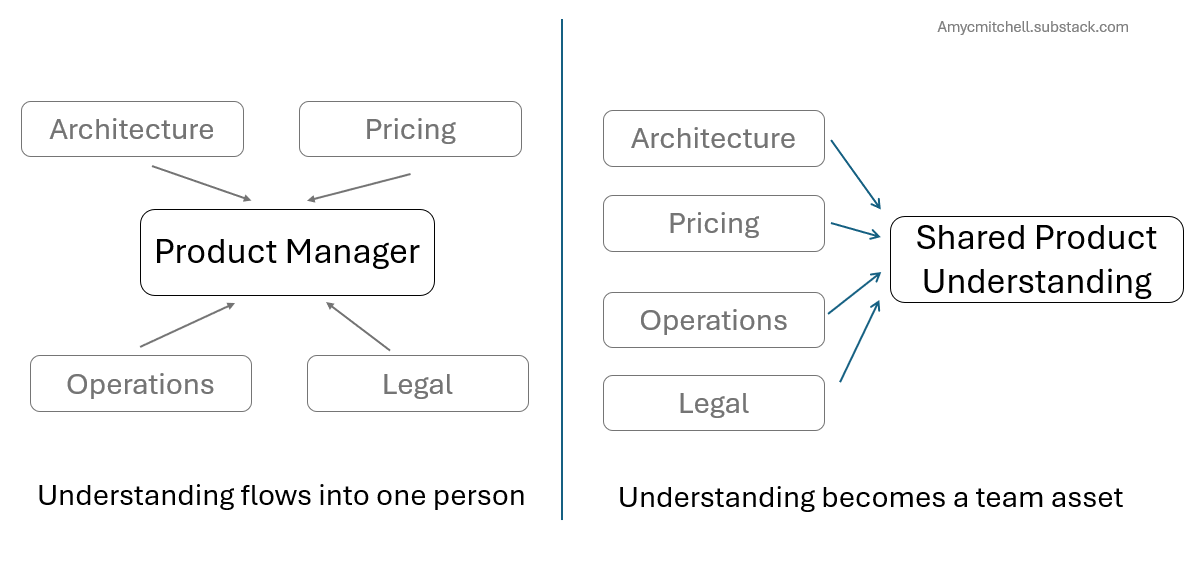
Once you recognize the pattern, the next question becomes: Why does this happen even on well-run product teams?
Why coordination doesn’t solve it
For years, product work scaled through coordination.
Program managers.
Scrum masters.
Delivery leads.
Better planning, tracking and communications kept product initiatives on track.
But coordination solves a different problem. It assumes the product team has a common understanding of the solution.
Coordination moves work.
Shared understanding improves decisions.
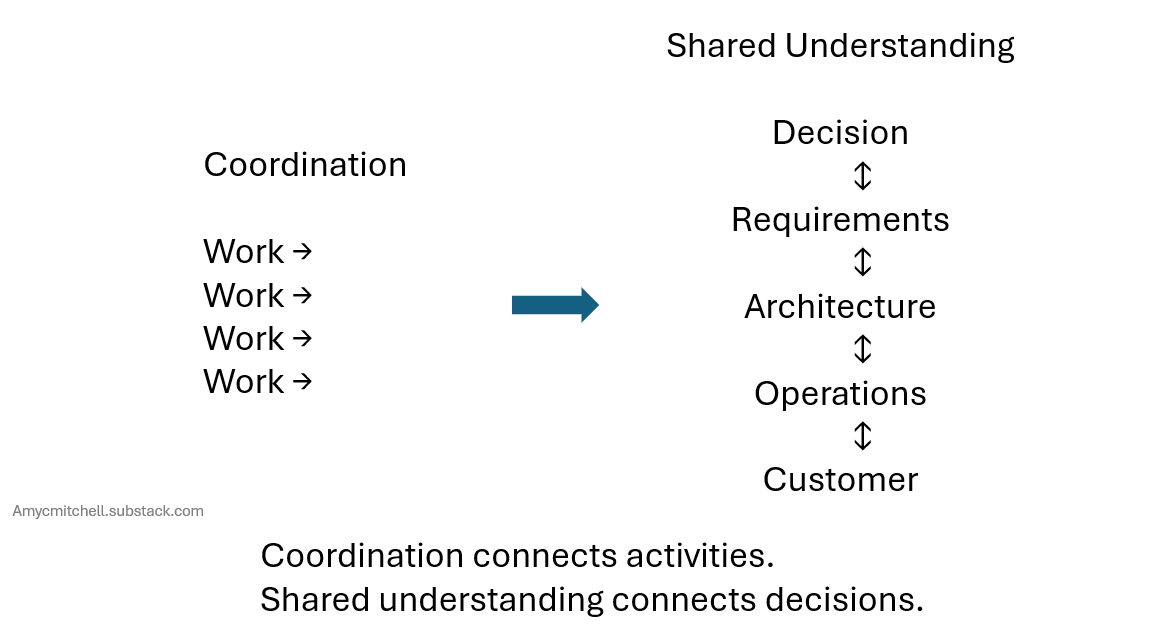
If coordination isn’t the issue, how do you know understanding has started to concentrate?
Recognize the problem
You may be experiencing cognitive concentration if
Every meeting ends with you explaining why today’s discussion matters to the product.
Teammates remember decisions but not the reasoning behind them.
Cross-functional discoveries never make it back into the requirements unless you do it.
Program managers keep work moving but rarely identify second- or third-order impacts.
Progress feels dependent on your presence; when you’re out, the initiative slows because no one else has the whole picture.
The pattern is less about workload and more about cognitive concentration: too much of the initiative’s understanding lives in one person’s head.
And the way to change this pattern is building a shared understanding. The goal is to help understanding spread naturally across the initiative.
Understanding only scales when it spreads.
Four ways to help understanding spread
As products have become more interconnected through architecture, pricing, operations, finance, AI capabilities, legal constraints, and evolving business models, the scarce resource is shared understanding.
Expand who contributes
Instead of you carrying the knowledge depth of each area, you can get a valuable evolving understanding from the subject matter experts on your product team. You can extend to include centralized experts in your organization.
This means creating more opportunities for other people to strengthen the initiative’s understanding before everything comes back through you.
Ask
Who else should help maintain understanding?
Try
Ask each subject matter expert,
“What changed this week that everyone else should know?”
Watch for
Pricing changes, for example, may affect positioning, packaging, or requirements. More than price.
Expand what gets discussed
Resist asking “What’s next?” after key developments or decisions. Instead, ask questions that get people thinking about what they learned:
What assumptions changed?
What requirements changed?
What new risks came to light?
What decisions need revisiting?
These questions encourage going deeper instead of surface-level status.
It’s normal for nobody to answer. They’re learning a new way of thinking.
Ask
What changed because of this?
Try
Start small with questions that expand shared understanding.
Watch for
Engineering has a risky architecture change coming up. Instead of monitoring engineering’s delivery, you ask program managers, architects and engineers about the new risks.
Expand where understanding lives
Lightweight artifacts help everyone understand the product initiative. For example,
Key assumptions
Decision logs
Requirements changes
Open questions
These can be added to active projects and PRDs.
You’re creating a place where understanding can accumulate instead of disappearing. It’s ok if no one reads it; it is there when you need it.
Ask
Where can someone discover this later?
Try
Get one topic into a shared space for wider understanding.
Watch for
You get to celebrate a delivery after writing assumptions in a shared space.
Expand who applies it
Some people are naturally detail-oriented. Others are relationship builders. Others have deep domain expertise. Build on these strengths instead of depending on a detail person to suddenly define a pricing strategy.
Shared understanding increases the quality of the information you’re making decisions with.
Ask
Who could act on this understanding better?
Try
Give people a chance to use their strengths on end-to-end problems.
Watch for
A team member who excels at coordinating to organize working meetings.
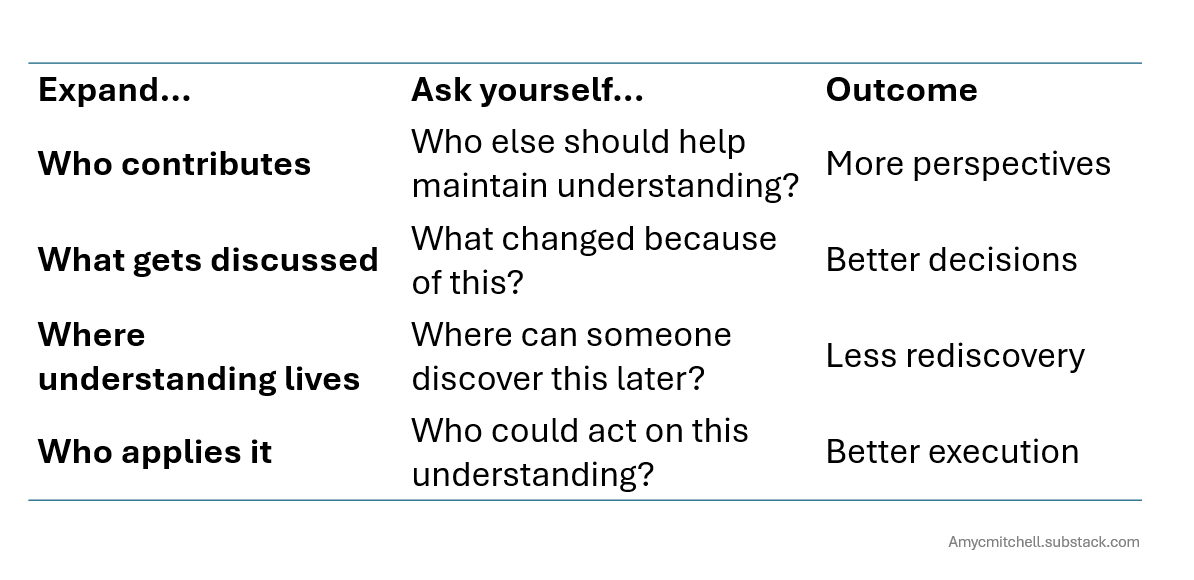
None of these practices eliminates your responsibility as a product manager.
Together, they increase the initiative’s ability to understand itself.
Conclusion - how a team scales reasoning
Most product initiatives slow down because understanding stops spreading.
Eventually, one person becomes the connection between architecture, operations, pricing, customer feedback, legal, and delivery.
That approach can work for a while.
It doesn’t scale.
Strong product teams create ways for understanding to grow beyond any individual.
Every successful product eventually becomes too large for one person to fully understand. The teams that continue to grow are the ones that make understanding easier to build, easier to share, and easier to extend. That’s how product work scales.
Q&A
Isn’t it more efficient for a single person to understand these system-level impacts?
Most products are part of complex systems. One person can’t be effective at scale. The single person becomes the bottleneck to scaling. Standing on the shoulders of giants lets products scale.
How do I know this is working?
You’ll notice you spend less time reconnecting conversations and more time making product decisions. Other people begin bringing implications to you instead of waiting for you to identify them.
Does this mean giving up ownership?
No. Ownership doesn’t mean personally holding every connection. It means ensuring the initiative continues building shared understanding.
What if nobody participates?
Start with one conversation. One artifact. One expert.
Shared understanding grows incrementally.
You’re increasing capacity, not redesigning the organization.
How does a product manager communicate well and still not see shared understanding?
Your drive to develop shared understanding might be greeted by silence. Change is still happening even through the silence. The real benefit is increasing the cognitive capacity of the product team.
There are no product builders in the team. How can I strengthen something that isn’t there?
Product teams often have extended teams who understand the space of the product. Sometimes another product that touches your product or common customer teams. You find common ground with them to get product builder understanding part-time.
Looking for more practical tips to develop your product management skills?
Product Manager Resources from Product Management IRL
Product Management FAQ Answers to frequently asked product management questions
Premium Product Manager Resources (paid only): This month’s guide focuses on AI-assisted product initiatives. It helps you build context that your whole product team can use.
TLDR Product featured Product Management IRL articles recently! This biweekly email provides a consolidated list of recent product management articles.
drpp The Drip featured Product Management IRL articles. This newsletter handpicks product management articles every day, summarizing them to provide you with a comprehensive overview of product management and technology.
Connect with Amy on LinkedIn, Threads, Instagram, and Bluesky for daily product management insights.