When Does Onboarding Become a Product Problem?
How product managers turn repeated implementation work into a path to adoption

Your product is ready. Your customer isn’t.
A new customer has bought your product or feature. But the customer still has work to do before they get value from it:
The customer testing your feature has to contact your support team for a special license
The security team can’t find API authorization examples
A developer following the documents is getting a weird error message
Someone from your team jumps in and gets the customer unstuck. And the customer moves forward.
And then the next customer hits similar but different problems.
None of these issues look big enough to become a product priority. But together you worry about revenue delays.
This happens when customers have to do meaningful work before they can use your product:
Enterprise software that needs configuration or security approval
APIs and platforms that developers have to integrate
Products that need data migration or provisioning
Products where services teams configure the same things for each customer
The product manager problem is the same: how much of the work to adopt your product should the customer have to figure out for themselves?
You need a way to recognize the work that should become part of the product.
This is where a Golden Path comes in.
Related article: When your product growth depends on developers: Connecting developer friction to product adoption
The problem isn’t any one failure
Every new customer has some work to do after buying your product. Often customers need your product team to help with:
Credentials
Access to documentation
A way to test
A feature or product walkthrough
Many products handle this by:
Credentials emailed to the buyer
A central documentation hub with a developer toolkit
A sales engineer who gets access to a sandbox
An implementation project manager who provides setup examples
And the personal touch is valuable for the first few customers. But as the number of customers grows, the manual effort can quietly begin delaying product adoption.
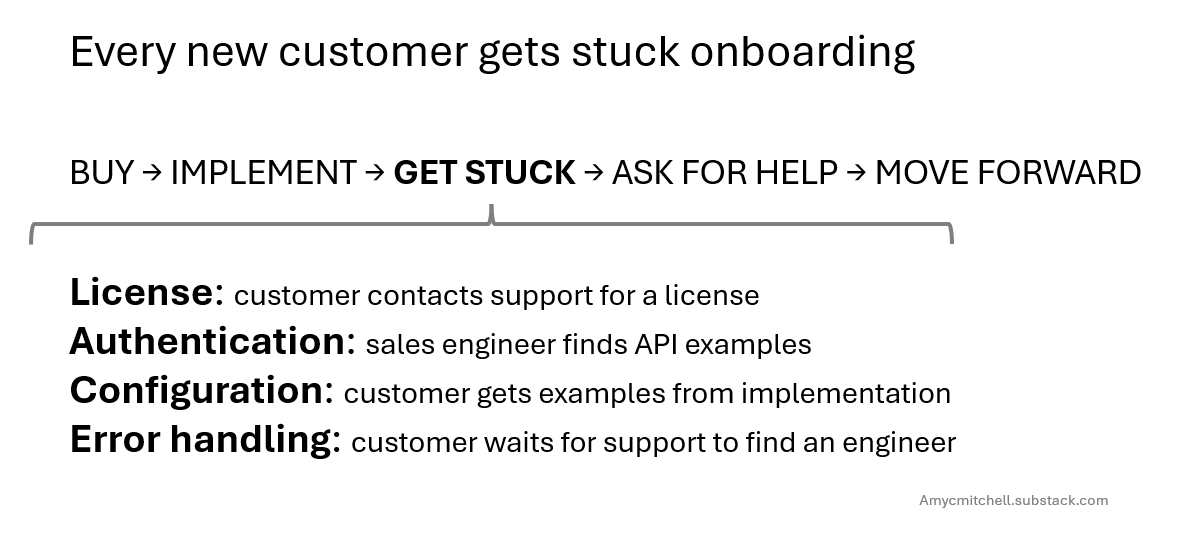
Different teams keep solving different exceptions. Revenue can be delayed. Adoption suffers.
The problem is that you don’t know which type of help should eventually move into the product.
What should become product?
The product manager dilemma is deciding which exceptions should become part of the product. The tradeoffs are about
What is in the customers’ environment: user identities, access controls, and automation architecture
What applies to a majority of customers
What product capabilities and interfaces are supported
Evaluating what moves to product and what is a one-off option for the next customer requires product managers to prioritize this customer work along with other product initiatives.
But you can’t prioritize work that you can’t see. Before making product decisions, you need to see all the work the customer is doing to put your product into service.
Turn the customer journey inside out
Your customer journey map shows the work for your organization in selling products. Most customer journey maps focus on what your company does.
Purchase → contract → implementation → support → adoption
But a customer doesn’t see your product that way. They see it as jobs they have to complete:
Purchase → get access → configure → test → integrate → get approval → go live → operate.
For the developer getting your product ready for production usage, they have multiple steps:
Get the credentials from your welcome email
Configure authentication for users
Find an API example to copy
Provision the initial environment
Go through security review
Set up monitoring
Take that customer journey map and turn it around to the customer efforts.
Once you can see the customer work, you can outline the path most customers will follow. That path becomes your Golden Path.
Build the Golden Path
The Golden Path is the repeatable way you want most customers to go from purchase to successful use.
Not every customer follows it.
It is a good way to avoid onboarding delays because it replaces the tribal knowledge your product team has built up from working with your product. For example, your test team knows the right default values for environmental variables because they implement the product before testing.
The Golden Path starts as an internal document that product managers and engineering define. It contains:
The ideal onboarding flow
The required steps
The metrics (time to first value, start of invoicing)
This is your blueprint for evaluating improvements.
There is also a productized external version of the Golden Path (the developer-facing experience). This contains:
Onboarding automation (installer, startup wizard)
Quickstart guide
API examples
CLI templates
Self-service provisioning
Guided integration flows
This is what the customers actually use.
Both the internal and external Golden Path versions create an onboarding experience that is aligned with your product.
Productize the Golden Path
At this point you have the key ingredients of the Golden Path:
Internal blueprint showing the customer steps from purchase to production
External Golden Path linking developer tools and documents for a developer
But just because you have slides or a document doesn’t mean you are done yet. A documented path is useful. A path that still depends on teams remembering what to tell customers is not yet a product capability.
The next steps to productize the Golden Path are:
Discover: review it with developers inside and outside your organization
What developer tools customers use
What the customer environment requires
Which developer tools the path depends on
Update: add the missing pieces
Prepare: cycle to maintain with feedback
Iteration plan
Versioning and shared location
Linked to engineering and documentation cycles
Release: notify product team and stakeholders
Launch: notify customers (via future customer portal and product features)
External websites
In-product notifications
Sales, customer and partner portals
The early user of the Golden Path is your product team. It is the central agreement on the best path for a customer to prepare your product for production usage.
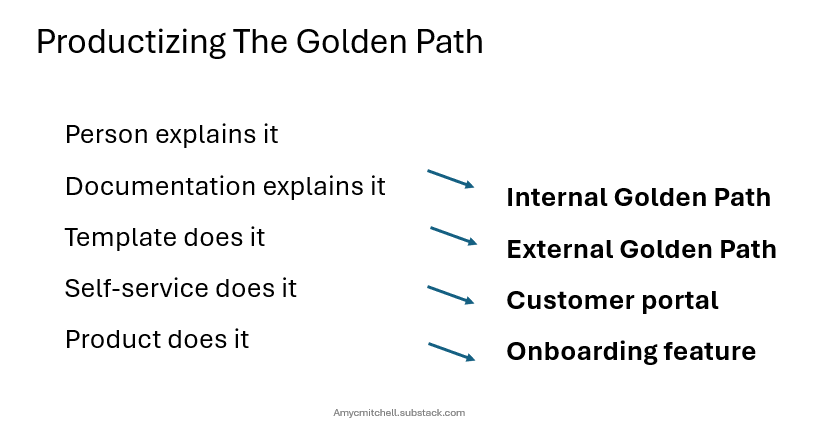
After establishing the Golden Path, product managers can prioritize changes based on customer implementations and roadmap.
New free resource: The Developer’s Guide for Product Managers shows the typical work a developer and their organization have to complete between purchasing a product and putting it into production.
Use it to ask: What work is the customer doing today that the product could eventually do for them?
It is a starting point. You can replace these steps with what your customers actually do.
Give the Golden Path an owner
If nobody owns the path, the customer ends up discovering and creating it for themselves. Like other product capabilities, product managers own the outcome and the path, with engineering, documentation, services, support and account teams contributing to the outcome.
The Golden Path becomes an embedded capability of your product. For example, the UI, the regression testing, the licensing, and the product performance are capabilities maintained by the product team. This means the developer experience and Golden Path are included in features and the roadmap like the other product capabilities.
As a product capability, the Golden Path is kept current by the product team:
Engineering: Developer tools implementation
Technical documentation: guides, quickstarts and examples
Services: Customer feedback through support cases
Account teams, analytics: failing steps, customer hold-ups
After the Golden Path is established, product teams can set up leading indicators for product adoption and customer satisfaction.
For example, if five customers follow the same path but each needs help from engineering three times, you don’t quite have a repeatable Golden Path. You have a repeatable request for engineering help.
Measure whether the next customer gets easier
Besides providing a way to guide developers to integrate and maintain your product, the Golden Path makes the next customer require less help.
The core measures of a valuable Golden Path are:
Time to first value: how long it takes a customer developer to reach the first meaningful outcome, such as first integration or first workload
Golden Path Completion Rate: the percentage of onboarding journeys completed through the Golden Path instead of a manual path
Drop-off points: where the flow is abandoned and which steps fail
Manual interventions: the number of times a person had to step in to get the customer through the path
Support tickets related to onboarding: track support tickets for onboarding and resolution time
These tie into business growth by:
Faster revenue recognition because developer onboarding is shorter
Higher customer retention from seeing the product value earlier (TTFV)
Higher expansion from a better developer experience
Make onboarding compound
With the Golden Path, you have a common language to take a customer from purchase to production with your product.
Initially, you see time savings because everyone has a common understanding of the steps the customer takes to integrate and manage your product. The product team now has a container for feedback and improvements.
As your product iterates, the Golden Path improves from feature work and feedback.
Every customer implementation makes the next one easier.
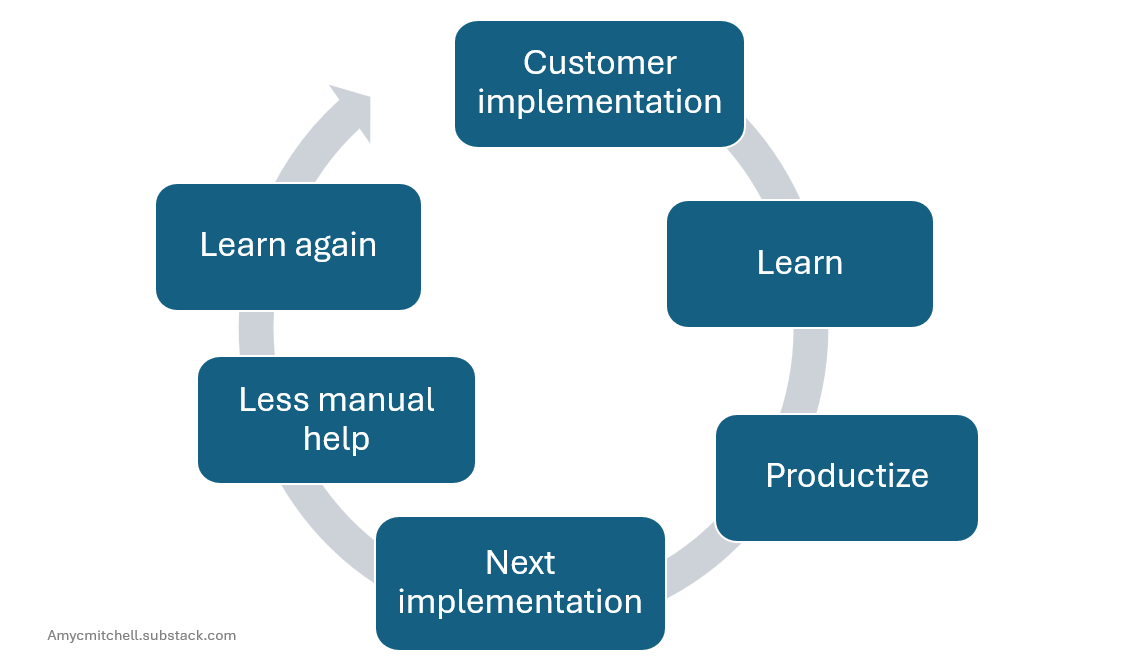
Conclusion - Productizing the Golden Path
The first few customers will always need help.
Productizing the Golden Path gives you a way to learn from each new customer.
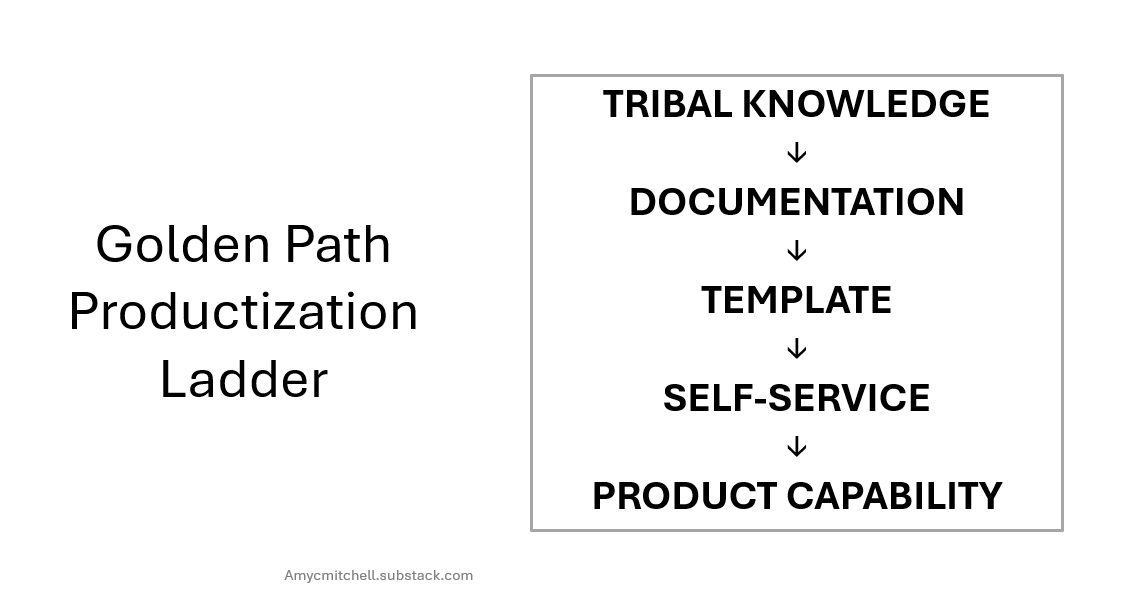
Some problems stay customer-specific. Others repeat enough to become a product improvement. Over time, documentation becomes a template, then a template becomes self-service and self-service becomes part of the product.
The measure of progress moves from rescuing the latest customer to the next customer going farther with less help.
The product learns from every customer instead of making every developer learn the product.
Golden Path Q&A
What if every customer is different?
The goal of the Golden Path is to stop exceptions from becoming the default. When exceptions become the normal way customers get to go live, the product team has a product problem to solve.
Isn’t the Golden Path part of the implementation process?
Implementation owns getting each customer live. Product managers own learning how to make the next customer easier to get live.
Isn’t the Golden Path part of the developer documentation set?
Documentation is one part of the Golden Path. The capability connects documentation, developer tools, and customer workflows into a customer outcome.
What if engineering already has all these tools?
Engineering tools are components in the Golden Path. Customers need the connections to their workflows to get value from the tools. Customers can have CLI, APIs, Terraform providers and documentation, but still have no clear way to get from purchase to production.
What if we don’t have enough customers to see a pattern?
Start with what you use with the product and then each new implementation can add to your Golden Path.
What if customers have trouble going from testing to production?
The next challenge is what happens after a developer successfully tests the product and the organization requires additional steps to make it production-ready. The next article in this series will cover the steps for a smooth transition to production.
More practical tips to develop your product management skills:
Product Manager Resources from Product Management IRL
Product Management FAQ answers to frequently asked product management questions
Product management newsletters featuring Product Management IRL articles:
Mind the Product: Curated product insights from around the web. No fluff. 5-10 minute read.
TLDR Product: Biweekly email with recent product management articles.
drpp The Drip: This newsletter handpicks product management articles every day, summarizing them to provide you with a comprehensive overview of product management and technology.
Connect with Amy on LinkedIn, Threads, Instagram, and Bluesky for daily product management insights.
Onboarding is such an important topic to get it right. It is the first of the experiences your customer sees.
I'd track changes in customer mix alongside the fall in manual interventions. If the next customer has a simpler security setup, onboarding can look better without the Golden Path having improved. Comparing customers who faced the same difficult step would give the team a better reason to believe that its work removed the problem.