
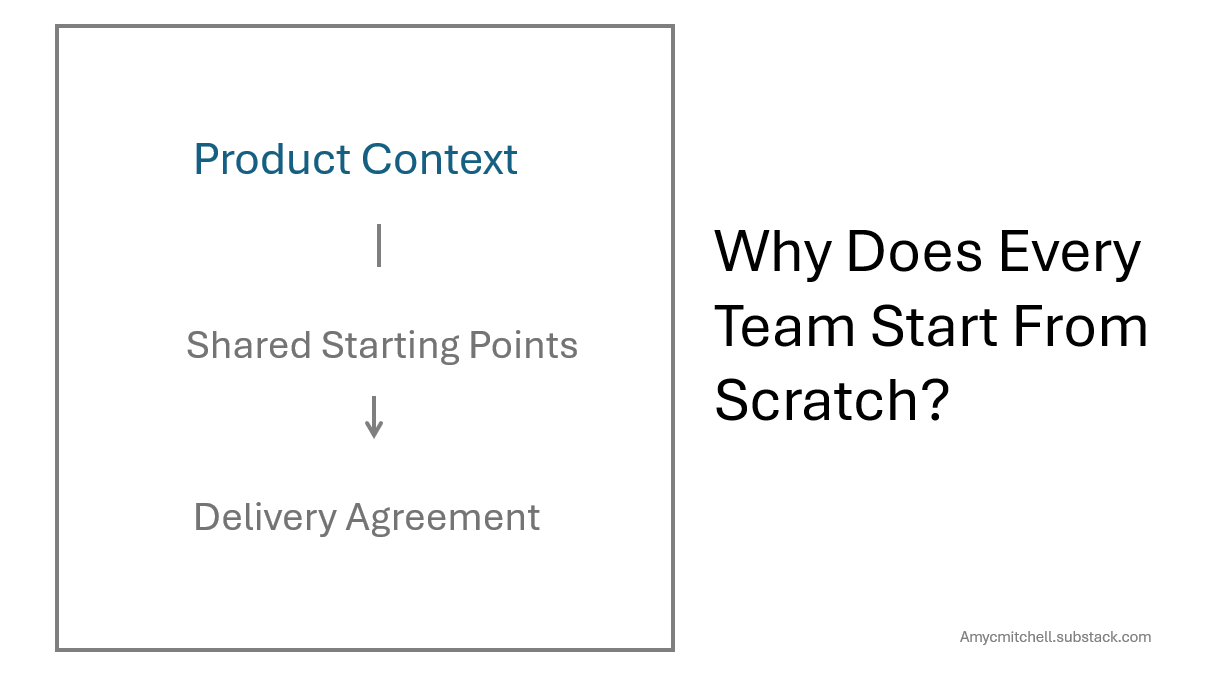
Why Does Every Team Start from Scratch?
Product context gives every function a better starting point

“There is no story here.” This is the response to your latest product initiative.
The initiative seems straightforward: customers are asking for something better, the opportunity is growing, and the leadership team wants to deliver it.
Advice from a coworker: “Do a roadshow. That worked last time.”
The program manager wants to schedule a series of workshops to align the team.
You know what comes next: everyone will start from scratch. Your context from researching the opportunity and convincing leaders covers more about the reasons for the initiative than you’ve ever had before.
Each team wants enough context to contribute their part.
This article covers an alternative way to enable each team to deliver their part.
Collaboration Isn’t the Work
Most teams know how to collaborate. More collaborating doesn’t lead to understanding.
Teams are raising real issues in understanding what the initiative means for them:
Marketing needs the narrative to fit what has already been communicated
Pricing is looking for commercial understanding
Program managers are seeking dependencies and plans
Architects want to discern the design changes
The same understanding gets rebuilt over and over.
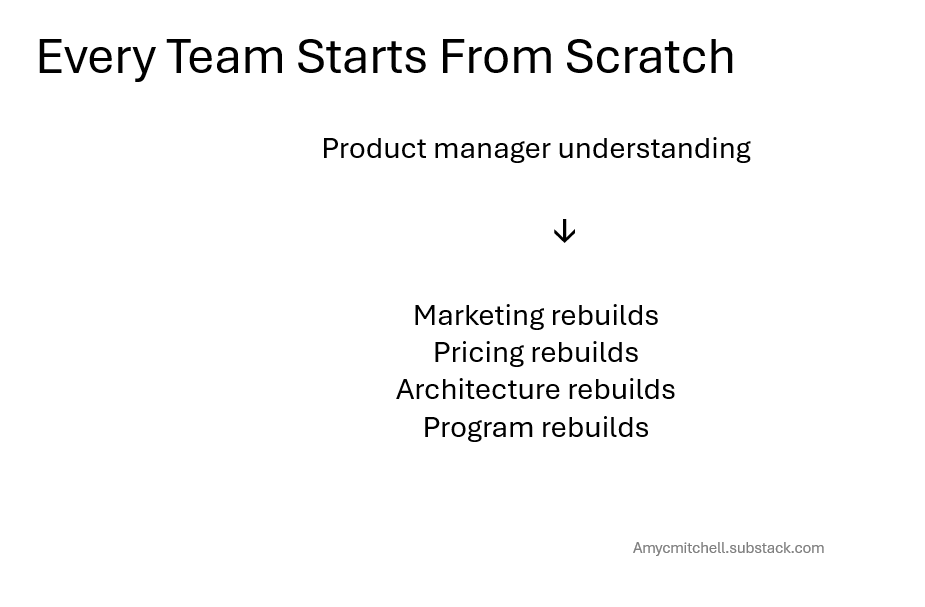
The issue isn’t collaboration. The issue is that every function starts with too little context.
Product Context Changes What You Share
You created product context as you learned the opportunity and potential solutions. You don’t need more understanding.
The rest of the team needs enough understanding to contribute.
In the past, you took your summary slides to each team and collaborated until you could agree on a plan. Often, a program manager organized a workshop to get the product team aligned. This got each team the context they needed.
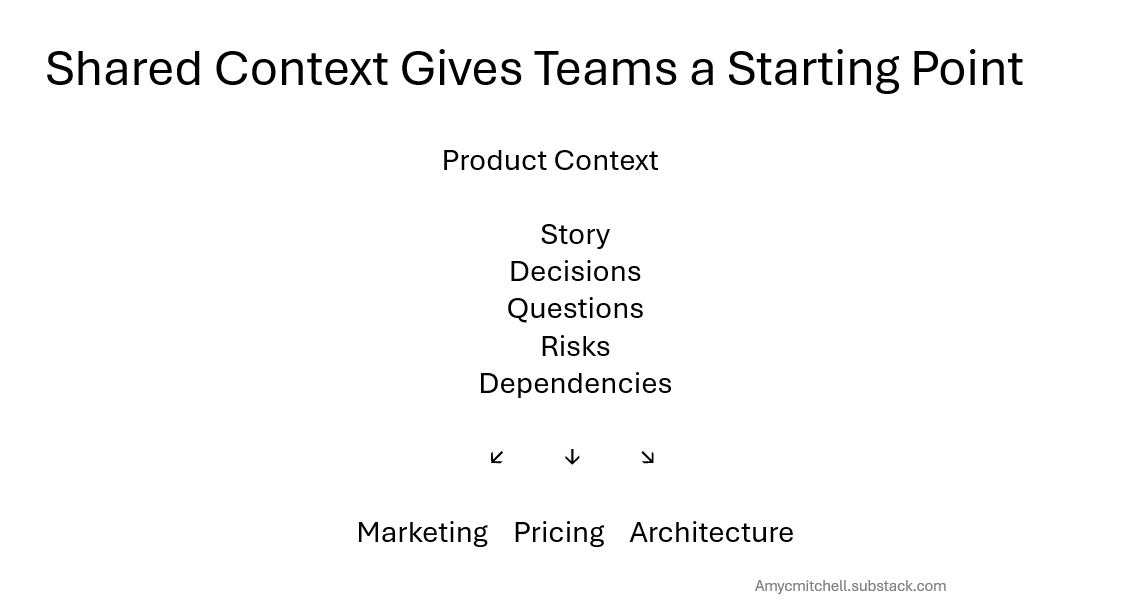
Instead of sharing one summary deck, you start sharing starting points. Just enough context for each function to begin.
Each function needs:
Story
Decisions
Questions
Risks
Dependencies
These become shared context assets.
Workspaces Emerge Naturally
Each cross-functional team has their own context and AI tools. They don’t need the entire picture to contribute effectively.
Each function puts the pieces together differently. Decisions, questions and risks have a unique impact on the teams.
Each function’s context evolves as you head toward an agreed plan.
More collaboration isn’t usually the missing ingredient. Delivery is waiting on agreements.
As functions learn, they naturally develop their own working context.
Each team develops a workspace that evolves at different rates. The functions evolve their workspaces together.
You and the product team reach delivery agreements and the workspaces and product context match. The delivery agreements can be tracked as usual with the product development process.
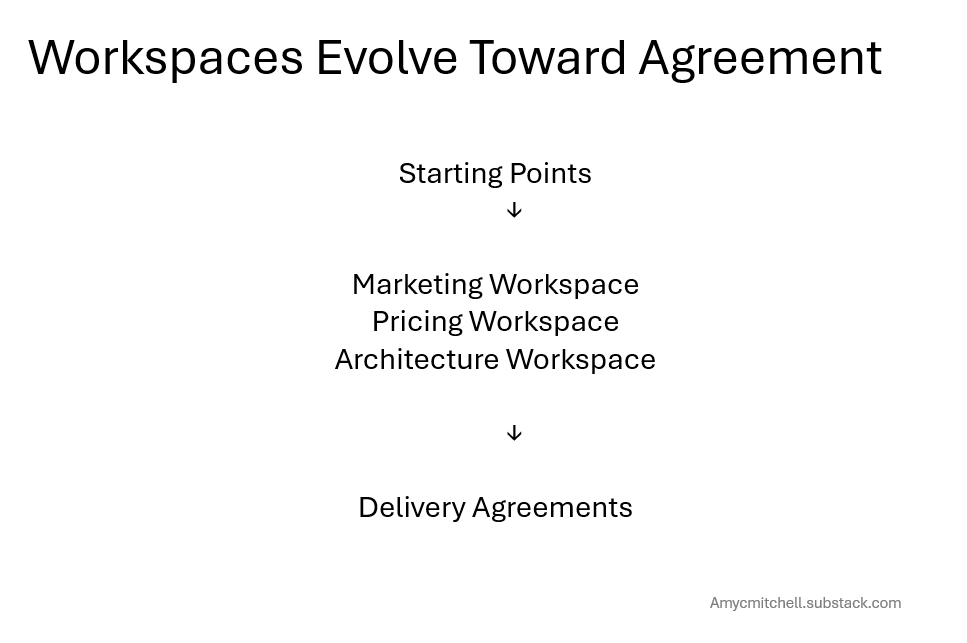
The product manager’s job increasingly becomes helping the workspaces evolve together.
Product Managers Enable Context
Product manager job before context:
Maintain requirements.
Product manager job with context:
Help workspaces evolve together.
Less time:
Repeating decisions
Updating slides
Running alignment meetings
More time:
Helping functions succeed
Surfacing risks
Making decisions
Creating agreements
Closing
Product context helps you understand the initiative.
Delivery depends on helping others contribute.
Every team starts faster when they begin with context designed for the work they’re trying to do.
Product managers spend less time creating understanding and more time helping functions succeed.
The interesting question is how to help every function stop starting from scratch.
Curious about the mechanics?
This article focused on the idea.
I’ve put together From Context to Delivery to show the practice (paid subscribers). This is a practical guide for AI-assisted product initiatives:
Shared context assets
Portable workspaces
Learning loops and enablement loops
Versioning and delivery agreements
Templates and examples using today’s tools
Last article on creating context:
Looking for more practical tips to develop your product management skills?
Product Manager Resources from Product Management IRL
Product Management FAQ Answers to frequently asked product management questions
Premium Product Manager Resources (paid only) Templates that I use to explain ambiguous product situations like business opportunities, customer journey and operating principles. New items monthly!
drpp The Drip featured Product Management IRL articles. This newsletter has handpicked product management articles every day, summarized to give you the big picture of product management and tech.
TLDR Product featured Product Management IRL articles recently! This biweekly email provides a consolidated list of recent product management articles.
Connect with Amy on LinkedIn, Threads, Instagram, and Bluesky for product management insights daily.