
What Product Managers Learn Between the Frameworks
The lessons product building teaches over time

Product management has never been easier to learn.
There are books on discovery, courses on strategy, templates for PRDs, podcasts about leadership, and now AI that can explain almost any framework in seconds.
Yet many of the lessons that shape you as a product manager don’t come from any of those places.
They show up while you’re trying to solve a messy problem, wondering why an executive changed direction, watching an organization shift beneath your feet, or realizing an important insight has quietly disappeared into yesterday’s AI conversation.
After talking with product managers across different companies, one pattern keeps appearing: there is a hidden curriculum in product management. These are the lessons you recognize after you’ve had time to connect the dots.
Here are four lessons that often become obvious after you’ve built a product and looked back.
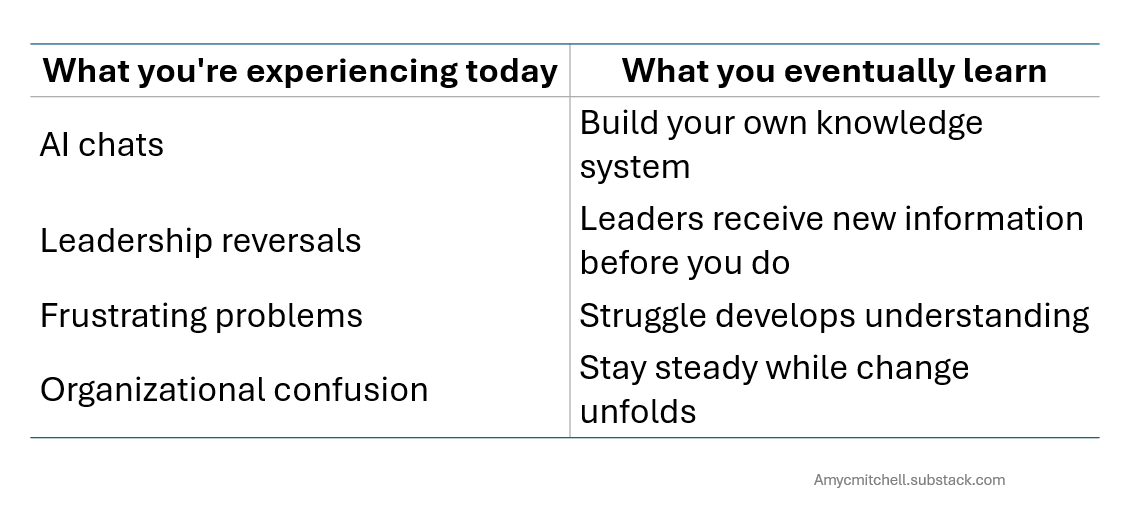
These lessons are about the habits that help you keep learning while you’re building products.
Lesson 1: Your AI isn’t building your knowledge
You’ve spent a week using AI to explore competitors, summarize interviews, refine messaging, and polish an executive summary. Then someone asks, ‘Can you share the key insight?’ Suddenly, you’re scrolling through a long chat history trying to find the breakthrough you remember having.
AI doesn’t know what an insight is vs what you already know. When you learn something, capture and curate it. Your future self will thank you when you want to share it.
Preserve what matters
Strong product managers don’t confuse AI conversations with knowledge management.
They build systems that preserve the ideas they’ll need six months later.
Lesson 2: Some problems can’t be shortcut
Sometimes the best learning comes from doing. Struggling with a problem teaches more than getting advice.
It’s about knowing when advice can save time and when you need to prove the advice to yourself.
Getting key domain knowledge on your own:
Advice: A sales engineer tells you what customers need.
Learning: You personally validate how the customer problem behaves.
Understanding your pricing structure:
Advice: Someone tells you the product is overpriced.
Learning: You calculate customer value for yourself.
The pattern to recognize is that you need time to absorb new information.
Work through the evidence
Frameworks can accelerate understanding, but some judgment only develops when you work through the evidence yourself.
Use colleagues’ advice to narrow the search space, not to skip the learning entirely.
Lesson 3: Leadership rarely changes direction without changing information
Last week, the priority was locking the plan for your product initiative. This week, leadership wants help justifying the product opportunity.
A change in direction can feel abrupt when you don’t yet have the context behind it.
Over time, you look for the patterns that changed the information available to leaders. But sometimes the changes are something you can’t see.
Leadership reversals often reflect information you can’t yet see.
Stay curious about change
Some reversals are part of the iteration. Often there is no apparent reason for the change.
Learning to become curious about the change saves you from missing the mark with your product.
Lesson 4: Organizations leak information before they announce it
Product managers often feel unusual signals early because they’re connected to customers, engineering, business stakeholders, and delivery teams.
When product work goes weird, possible explanations include:
A big customer about to leave
A financial metric change
A strategy change
A reorganization or merging of teams
While the pending change is outside of your control, you can control your reaction. Keep yourself from burning relationships when the craziness eventually recedes.
Stay calm during uncertainty
When you see the early signs of unexplained behavior, don’t assume everything is broken. The learning is avoiding being negative. Be the one who calmly adjusts to change.
Conclusion - Being a product manager is a learning experience
Building products gives you hundreds of small experiences every week. Most feel like isolated events at the time. Only later do some of them reveal themselves as lessons.
You’ll catch yourself preserving an AI insight because you know you’ll need it later.
You’ll pause before assuming an executive is being inconsistent.
You’ll give yourself permission to wrestle with a problem instead of rushing to someone else’s answer.
You’ll recognize organizational confusion without letting it turn into cynicism.
Looking for the patterns can help you worry less about today’s confusion and pay more attention to the habits you’ll still be using years from now.
Related articles:
Context engineering in product management
Keeping executives involved in product work
Learning while building products
Handling uncertainty in product management
Looking for more practical tips to develop your product management skills?
Product Manager Resources from Product Management IRL
Product Management FAQ Answers to frequently asked product management questions
Premium Product Manager Resources (paid only): This month’s guide focuses on AI-assisted product initiatives. It helps you build context that your whole product team can use.
drpp The Drip featured Product Management IRL articles. This newsletter handpicks product management articles every day, summarizing them to give you the big picture of product management and technology.
TLDR Product featured Product Management IRL articles recently! This biweekly email provides a consolidated list of recent product management articles.
Connect with Amy on LinkedIn, Threads, Instagram, and Bluesky for product management insights daily.


Enjoyed the line, Leadership rarely changes direction without changing information…still thinking about it