Escalation Strategies for Conflict Avoiders
Escalating issues the right way

When trouble is brewing on your product, how do you escalate an issue without hurting yourself or your relationships? There are productive ways to escalate issues to your leadership team to save time and empower the team.
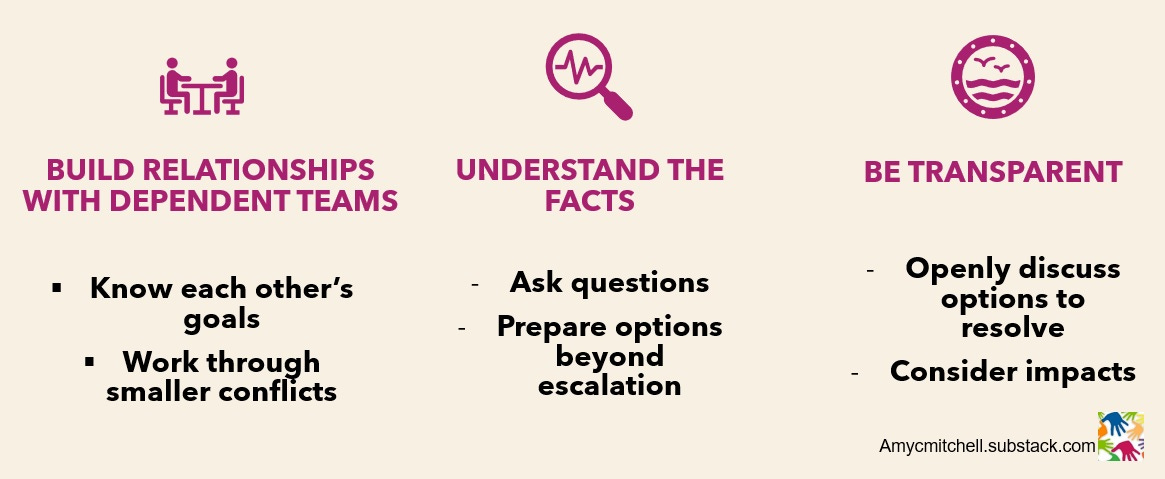
Build Relationships
By building solid relationships across the product team, you have a basis to understand the motivation and drivers behind the behavior you observe. Suppose you and the product architect have been working on a new feature concept for your product. You have been meeting with customers together to understand the customer use case. Your architect starts missing customer meetings and slows the conceptual design.
If you have a strong working relationship with the architect then you can talk through what is preventing the progress on the new product concept. You might find out the architect has been put on a new initiative or has an issue outside of work. In either case, you need to decide how to escalate the impact to the feature concept.
Recognize Issues and Ask Questions
It is challenging to spot an issue when you are working hard on new product concepts because the deadlines are more fluid in the early stages. When you recognize there is an impact, then you can start asking questions to figure out what to escalate to your stakeholders.
In the case of a conceptual feature delay, you would want to learn more about the situation with the architect:
Are there other people on the team who can work with you instead of the architect?
What is the new initiative and why is it a higher priority than your conceptual feature?
When will the joint architecture work be able to restart?
Has anything been communicated so far about this change?
Who in the organization cares about the feature concept?
What is the impact of ongoing delays?
As you discuss these questions with the team, you can start formulating options to respond to the change.
Be Transparent and Deal with Facts
While discussing the questions and possible options, it is easy to become emotional about the extra work of investigating a change in plans. Actually, the faster the investigation leads to a resolution, the work can get right-sized again. Sticking to the facts of the situation without speculating about motivations speeds up the investigation.
At this point, you need to be transparent about the potential escalation and the options to escalate. By being open about the possible changes to consider, you can frequently avoid the need to escalate. No one wants to escalate to stakeholders and leadership except when there is no other choice. You might learn that there is no impact to delaying the conceptual feature.
You might also find that the new initiative means the conceptual feature is no longer needed.
Define Options and Recommendations
After gathering the facts and the options to respond to the change, then you can decide how and what to communicate. If there is minimal impact on commitments and priorities, you can decide not to escalate. In the prior example, it turns out the product architect has been permanently assigned to a new initiative and no longer supports your conceptual feature.
You learned in gathering the facts that the conceptual feature is still important and you decided to escalate to get help from another product architect. You also investigated alternative options such as delaying the conceptual feature and combining the conceptual feature with the new initiative.
Escalate and Close
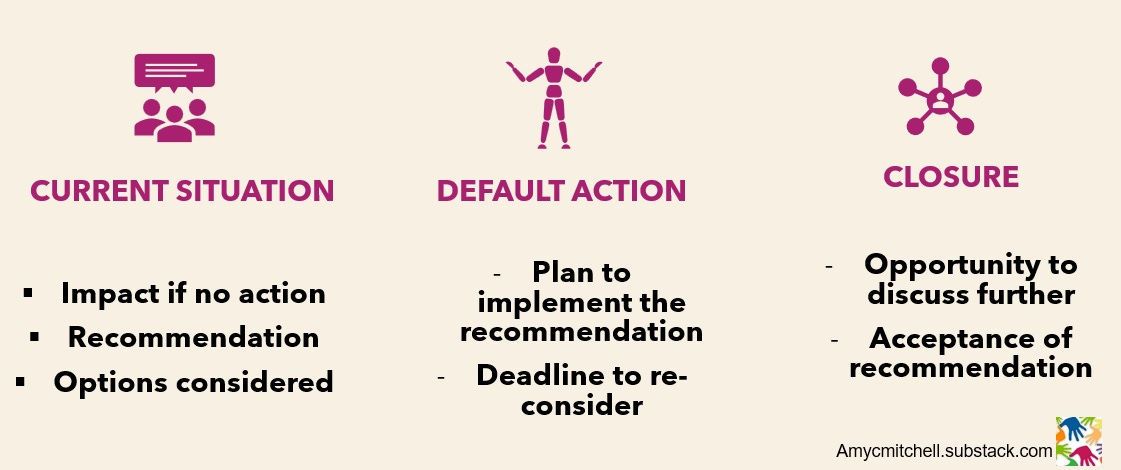
You have looked at 3 responses to the loss of the product architect on the conceptual feature and it is time to escalate. The escalation notification has these major parts:
Current situation: Conceptual feature work is not complete and the product architect is no longer available
Recommendation: Assign a new product architect to finish the definition of the conceptual feature
Options: considered delaying or combining with a new initiative and this is not feasible
Default response: Requesting product architect by the end of the month or conceptual feature will be closed until an architect can be assigned
Schedule to discuss the situation: The topic scheduled for discussion and closure at the next product team meeting
In most cases, the stakeholders accept the recommendation because you investigated the options and discussed the situation along the way.
Conclusion
Usually, there is no reason to rush to escalate an issue to stakeholders. Taking time to investigate options and providing a recommendation leads to a graceful escalation and a reset of expectations.
These are the steps for product managers to escalate the right way:
Build relationships for future escalations
Recognize potential issues and learn more
Be transparent and focus on facts
Define options and recommendations
Escalate and close
This strategy results in resolving the issue while preserving key relationships.
Soft skills are often underrated - thanks for this good piece of advice!