
Spot the Real Blocker in Heated Product Debates
Why most arguments aren’t about what you think

Raised voices on the conference call pull you out of your inbox.
It’s Macy and Beth again. They are debating how to handle the new AI partner.
You try to stay focused, but when those two are in the same meeting, it’s always the same loop.
You wait it out, knowing the call will move on without a conclusion.
Beth insists the partner work should pause until Macy adds a complex feature flag. She says the only safe way to control the AI partner’s code is with a feature flag.
Macy pushes back: making a big change before customers ask for it will slow growth. Sales, Ops, and Legal stay silent.
The call ends like every other: no decision, just fatigue.
Two sharp product managers, both right in their own way, can’t move forward. You don’t have to own the solution to see that clarity is missing.
Even if you’re just waiting for a decision to land, noticing the layers helps you anticipate what’s really holding it up. Also, you can prepare your next move when clarity finally comes.
Recognizing when a debate is really a layered decision in disguise helps everyone move forward faster and with less rework.
This article shows how to spot those layers, pull out of circular debates, and get decisions unstuck.
When debates feel personal, they’re often layered decisions in disguise
The line between a healthy debate and a draining argument is thin in product work. Add complexity with AI partners, cross-team dependencies, external risk and emotions surface fast.
Those emotions are often a signal that people are arguing from different levels of the decision without realizing it.
When that happens, you’re disagreeing about the kind of decision being made:
principles, ownership, product direction, process, or execution.
You might be missing layers when:
Everyone’s repeating their point louder
You start dreading the next meeting
Escalations appear without real progress
Even if you’re not the one debating, these signs are worth noticing. Recognizing a layered decision before taking action can help you plan better, manage expectations and avoid rework later.
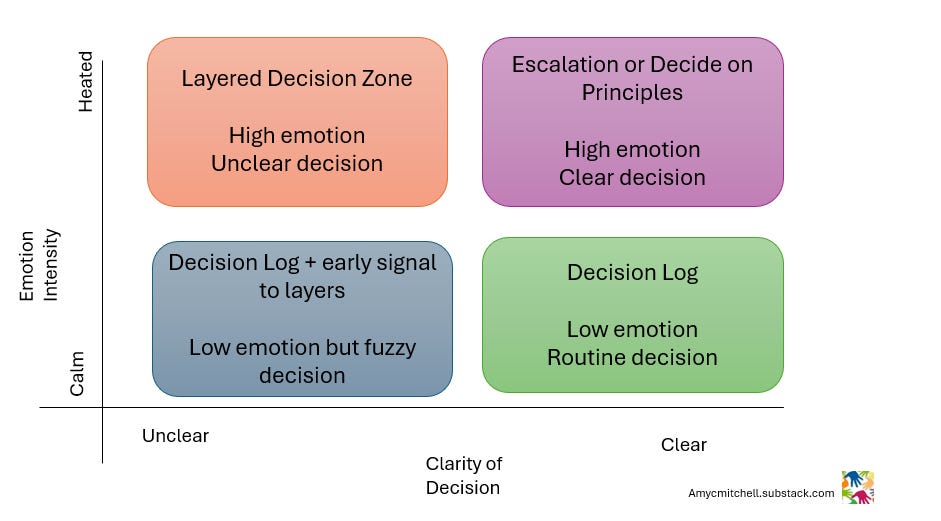
By the time you notice these signs, it can feel awkward to suddenly drop “decision layers” into the conversation. But understanding what’s happening underneath the emotion is the first step to progress.
How to recognize decision layers in real time
Whether you’re leading the decision or just waiting on its outcome, you can spot the clues before things stall.
Try this:
Notice the heat, not just the logic. Emotional charge usually means people are mixing layers.
Ask one clean question. “What decision are we really trying to make right now?” or quietly note your own answer of what you think is being decided.
Check for false escalation. When someone says, “We need leadership input,” ask what input is really missing.
Assume it’s higher than you think. If you can’t tell the layer, it’s probably about strategy or ownership, not tactics.
Once you start spotting these signals in real time, the next step is helping the group re-ground around what actually matters.
Regaining footing once you see the real issue
When you think about a debate through the lens of layers, patterns emerge. Seeing the pattern helps you predict when a decision is ready to stick.
The most reliable way to break out of the loop is to reconnect to shared purpose. For product people, shared purpose is how the decision affects customers or the business.
In the Macy and Beth case, that shift happened when each asked:
“If we did escalate this, what input would we actually need?”
That pause led Macy to zoom out. Instead of defending her stance against feature flags, she reframed around customer and business impact.
She realized the product needed protection from the unknowns of a new AI partner while enabling growth. Once Macy and Beth lifted the conversation to customers and business growth, the lower-layer debate resolved itself.
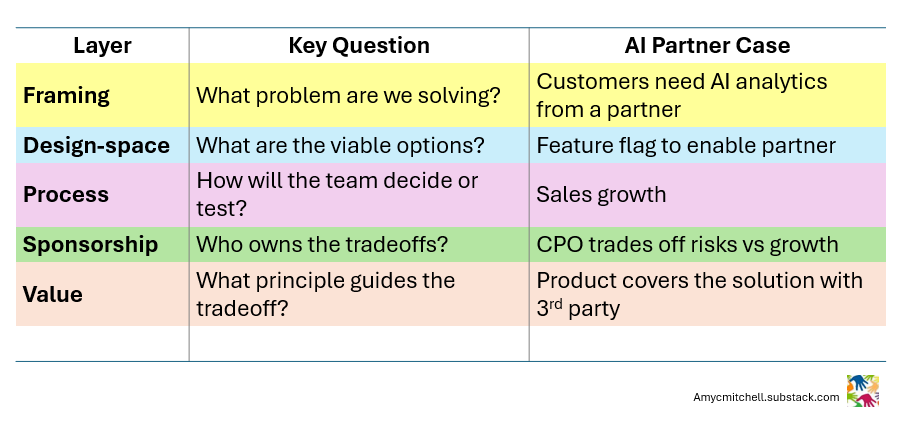
They landed on clarity together, and everyone around them could finally move forward:
Problem to solve: Customers need analytics from the partner
Measurement: Sales growth is the key metric
Sponsorship: The CPO owns the risk-vs-growth tradeoff
Principle: The product extends to a solution with a partner
The feature flag was no longer the argument. The feature flag was the result of an aligned decision.
Paid subscriber resource: Decision Heat Map Toolkit. This short, practical guide helps you figure out which kind of decision you’re actually in:
Calm and clear? Use a Decision Log to capture alignment and move fast.
Heated or complex? Use the Layered Decision Map to spot what’s really blocking progress and get unstuck.
Together, these tools help you decide faster, argue less, and recover credibility after tough calls.
The overlooked step: recovering after a heated debate
When the tension breaks, it’s tempting to move on. Don’t.
You still need to evaluate the impact of the decision. The affected teams need to know what to do now.
Communicate clearly:
What was decided
Why it was decided that way
How it affects the teams involved
In Macy and Beth’s case, they shared why the feature flag was added, how it balanced partner risk and growth, and what principle it reinforced: the product leading the solution.
That simple communication eliminated the uncertainty that had fueled weeks of circular debate.
Even after a breakthrough, the job isn’t done. How you close out a heated debate determines whether the alignment holds.
Conclusion: Recognizing layers is the fastest way out of slow arguments
Every product manager ends up in these loops. Smart people, stuck on repeat.
It’s a signal that you’re mixing different kinds of decisions.
When the heat rises, don’t just push for alignment.
Pause.
Find the real layer.
Reconnect to purpose.
Even if you’re not the decider, you can still be the person who sees the pattern first—and helps the team waste less time.
That’s how you move your team from arguing to deciding.
Decision Layers and Decision Logs for Product People


Looking for more practical tips to develop your product management skills?
Free Product Manager Resources from Product Management IRL
Weekly inside story on my work. Last week: Orchestration for Product Managers (paid)
Premium Product Manager Resources (paid only) 4 learning paths, 6 product management templates and 7 quick starts. New items monthly!
TLDR Product listed Product Management IRL articles recently! This biweekly email provides a consolidated list of recent product management articles.
Connect with Amy on LinkedIn, Threads, Instagram, and Bluesky for product management insights daily.