Beyond Direct Sales
How Product Managers Can Kickstart Channel Partnerships to Grow Revenue

AI and partners go hand in hand. Recent earnings announcements are chock-full of partnership announcements:
NVIDIA: mentioned partnerships 8 times in their 1Q earnings announcement
Microsoft: a separate page of 17 partner announcements in their 2Q earnings
Besides interesting reading on the different pairings in AI, why do channel partnerships matter to product managers?
Reason: These announcements accelerate revenue and scale product reach.
What is the role of product managers with channel partners? Why would a product manager need to consider any other path to reaching customers beyond the direct sales team?
In the world of high tech and AI, product managers are key to driving profitable products for channel partners.
Let's dive into engaging channel partners without derailing your core product and direct sales.
When to Introduce Channel Partners: A Phased Approach
First, establish your product market fit before considering channel partners. Know how your product solves customer problems. By this point, you have focused your direct sales on pricing, positioning and target customers.
Next, evaluate whether partners will add value or add too much complexity. Consider the partners your organization knows, partners your customers use, and any competitors that sell through channel partners. If you find related sales through channel partners, then it is time to consider whether your product is ready for potential channel partners.
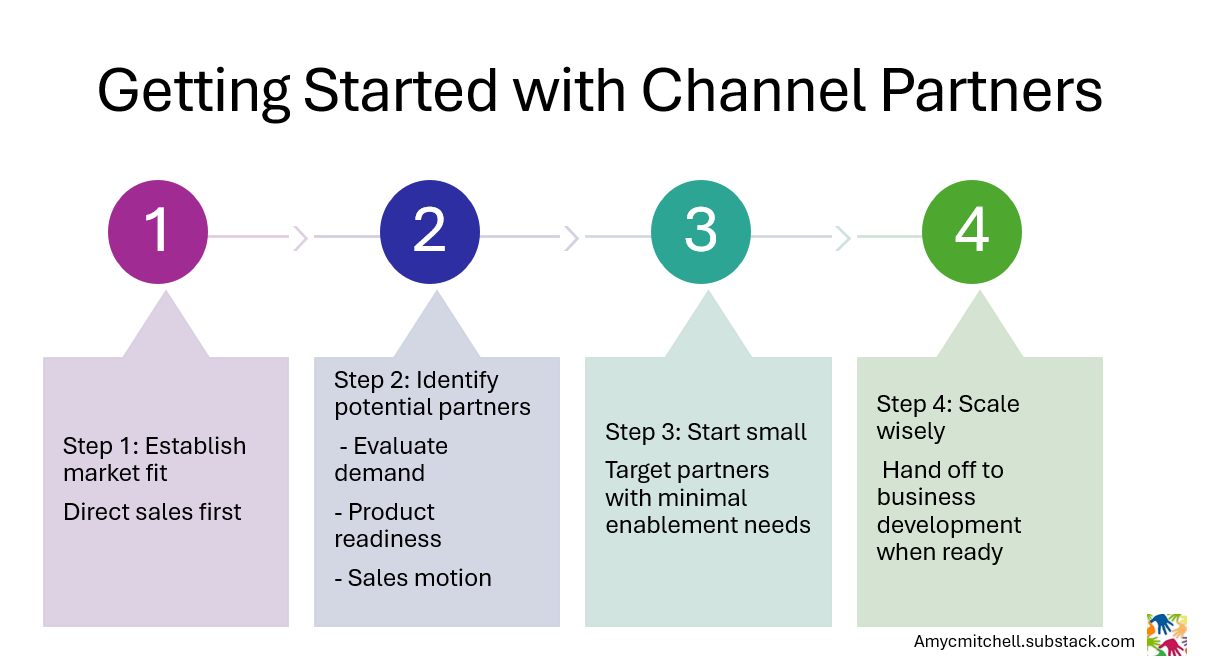
Some of the product readiness signals for channel partners are:
Interfaces: APIs and standard interfaces allow channel partners to add value to your product
Lead time for your product: Channel partners need time to add their value on top of your product after you deliver it
Demand for your product: Channel partners focus on growing markets and end customers' needs
Ability to profit on your product: Channel partners need to make a margin on top of your product.
Avoid sales conflict: Channel partners work best when they complement your direct sales.
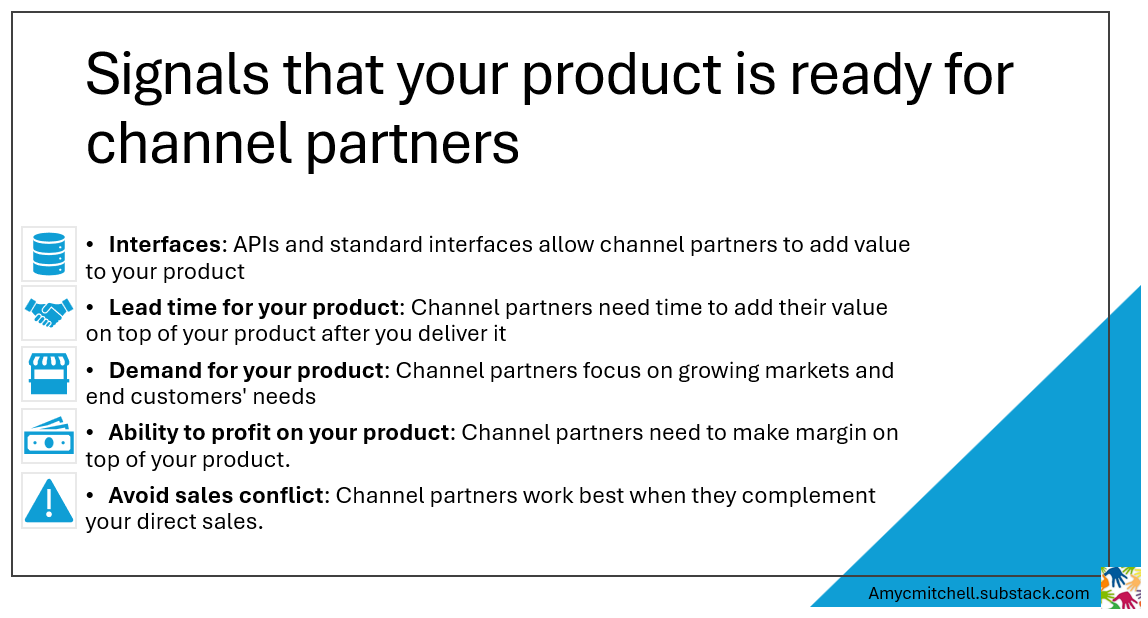
Once you have evaluated potential partners and your product readiness for channel partners, the next step is to target a couple of early channel partners. To prepare for early channel partners, look at 2 key items:
Partners who can sell with minimal enablement:
Substitute your product in a well-established solution
Partners who know your product environment and product (less training)
Customer opportunities that are too small for your sales force
Partners who are requesting your product for new opportunities
Standard agreement that can be reused with multiple partners:
Enables the partner to resell your product
Covers responsibilities such as customer support, training, and enablement
Pricing agreement
Limits of liability
Branding of the combined offer
After getting the foundation of potential partners and a standard agreement, you are ready to explore channel partners who can complement your direct sales to customers.
The Product Manager's Role in Channel Partnerships
Opening a new channel partner is an exciting growth opportunity for product managers. Getting direct feedback from potential partners on use cases, product gaps, and enablement can usually be prioritized with your other roadmap activity.
The trick for product managers is allocating a fraction of time to the new channel partners. Time allocation keeps your focus on direct sales efforts while making progress with a few select channel partners.
As you work with the early channel partners, you will need to balance the new opportunity with your work with direct sales. A few tips to keep in mind:
Understand the partner use case: prioritize use cases that can use your "off the shelf" product with minimum change
Surface product gaps early: partners that need multiple product changes aren't a good fit for early channel partners
Estimate the amount of partner enablement: focus on partners that know your product environment, so you can re-purpose your existing sales enablement material
Keep positioning simple: work with partners that don't compete with your direct sellers; channel partners need to pursue opportunities that are of no interest to your direct sellers
Remember, you are seeding the first few partners. When you have more partner opportunities, you can hand off the partner development to a business development expert in your organization. By keeping product changes small and the contracting simple, you can prevent the partner work from distracting you from direct sales.
Common Pitfalls and How to Avoid Them
The task of onboarding partners should go slowly since you need to work with the outside partner organization. A simple partner contract can take several weeks to negotiate and have legal review. This means you have time to think about how you work with the channel partners.
Here are a few pitfalls to be aware of:
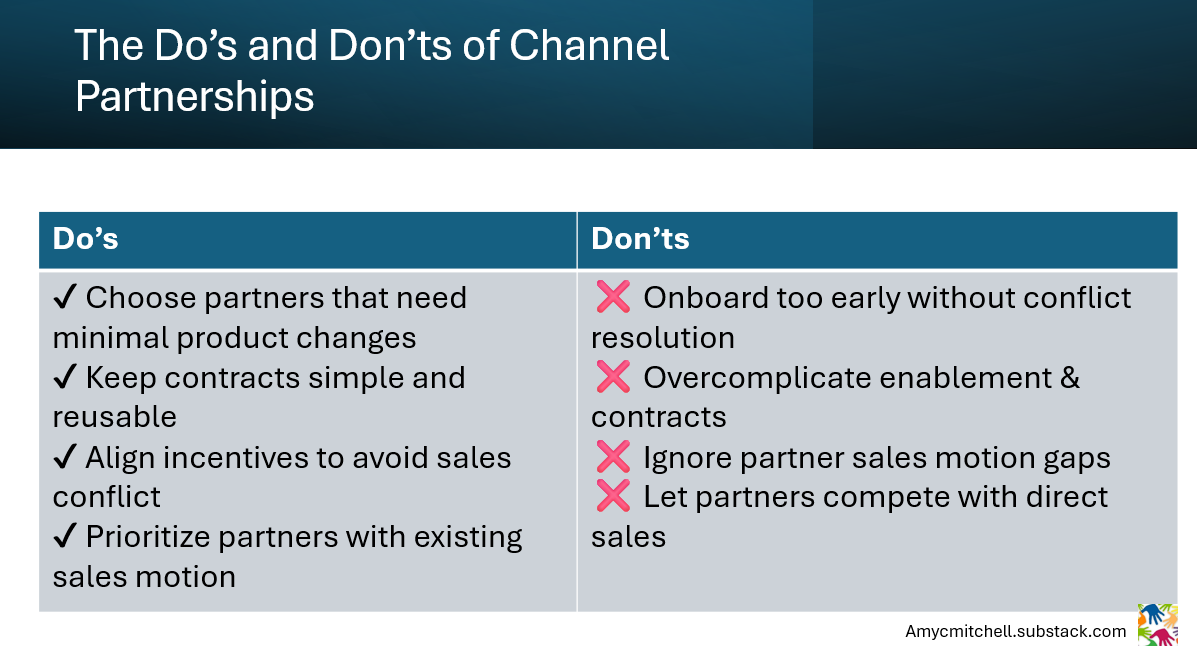
Onboarding partners too early: If there is potential overlap between direct sales and a partner, then it is too early to bring that partner into opportunities. Better to work out any channel conflict before onboarding partners.
Overcomplicating contracts and partner enablement: If the partner contract is complicated or if the partner needs special training to sell your product, then a channel program will eat into your product management time too much.
Partner sales motion is unclear: If the steps to a partner sale are complex, then the process needs to be reworked before going forward with a partner.
These types of issues are not the usual issues for a product manager to handle. You can protect your product from a poor channel partner fit by:
Defining a way to gracefully exit a relationship if these pitfalls arise
Building relationships with experienced business development people in your organization to provide a sounding board once you engage with channel partners
Thinking ahead and having support in your organization will keep you out of trouble.
Conclusion: The Right Partners, at the Right Time, for the Right Growth
Channel partnerships can be a powerful force multiplier for your product, but only when approached with the right timing, strategy, and simplicity. As a product manager, your goal is to create a scalable, profitable path for partners without derailing direct sales or burdening your roadmap. Start small, focus on alignment, and keep an exit strategy in mind.
Because in the world of AI and high-tech, the best partnerships don’t just accelerate revenue—they ensure your product wins in more markets without losing its way.
Last week’s backstory for paid subscribers was about product manager’s performance evaluation from Ahmed Wafaey, senior director of product management at Delivery Hero. Did Wafaey Help My Self-Assessment?
Paid subscribers get access to 10+ templates and quick start guides.🎁
TLDR Product listed Product Management IRL articles recently! This biweekly email provides a consolidated email of recent product management articles.
Check out Product Management Free Resources for free product management resources.
Connect with Amy on LinkedIn, Threads, Instagram, and Bluesky for product management insights daily.
Right partner. Right product. Right phase.
Channel partnerships are an architecture for sustainable scale.
Thanks! Great article! Sharing with my product team now!