
How to Move Forward When the Work is Ambiguous
Stop choosing options. Start designing systems.


Sometimes in product management the simple things hang you up.
Take Tim. He needs to interview customers and share a summary with the team.
He knows the product team needs insights before starting the next iteration. So he fires off a few interview requests. No replies. He sends reminders. Still nothing.
Tim now feels stuck. He starts telling himself that someone else needs to give him clarity or authority before he can make progress. Meanwhile, the team waits, blocked.
You’ve probably been in a similar spot. External dependencies, deadlines, unclear next steps. And suddenly you feel like your agency evaporated.
But here’s the truth: agency isn’t authority. It’s a working skill.
It’s the ability to interpret intent, name the real problem, and shape the path before any execution begins. When you rebuild this skill, the hang-ups of product management get much easier. Your decisions and conversations with leadership regain an anchor.
This article shows product managers how to cultivate agency by:
Naming the real problem
Checking your interpretation before doing the work
Turning ambiguity into a coherent narrative
Testing that narrative with the smallest step
Iterating as you learn
How Product Managers Lose Agency Without Realizing It
Most loss of agency starts innocently.
Leadership mentions a need. You rush toward execution to show progress. You’re moving fast until you hit a roadblock that feels outside your control: timing, access, incentives, missing information.
You assume the problem is external, and the steering wheel falls out of your hands.
This is how agency slips away.
But these moments—where the road gets bumpy—are exactly when agency matters most. Agency is the act of steering through ambiguity, not around it.
The Hangup That Looks Like a Skill Problem (But Isn’t)
When something blocks you, your first instinct is often to ask for permission or direction. But the moment you do that, you’ve paused your own forward motion.
Tim’s situation wasn’t a skills gap. It wasn’t about writing a “better email.”
It was that the outcome (“get customer feedback”) was too vague and disconnected from the real problem.
And this is the pattern product managers face again and again:
Ambiguous requests that seem logical but lack shape.
This is the bumpy road.
And it requires problem-shaping before trying to move forward.
Agency = Problem-Shaping Before Execution
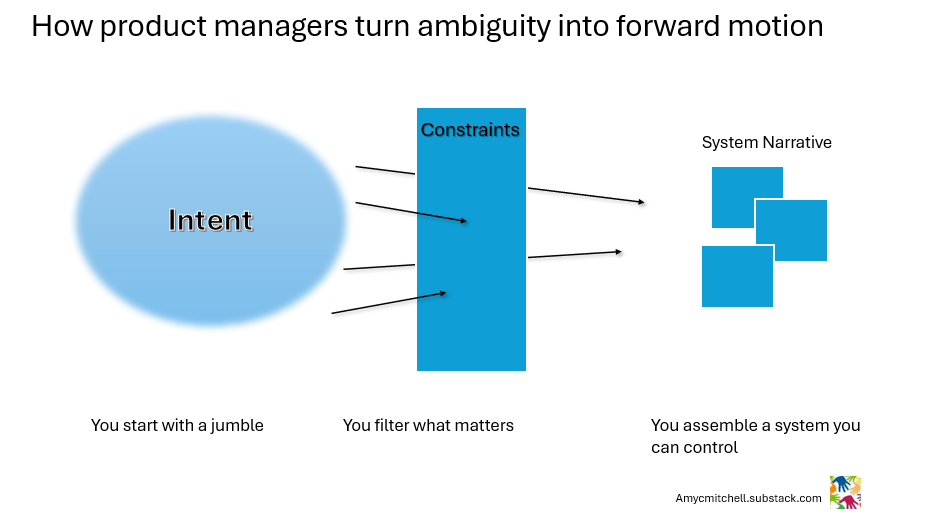
Agency is the product manager’s ability to:
Interpret intent
Name the actual problem
Shape a path with 1–2 concrete moves
Taking weak or inconsistent signals from leadership and translating them into a coherent narrative that can be validated.
This is how you rebuild agency—by turning noise into narrative instead of searching for the “right option.”
How to Rebuild Agency
These steps help you act today without waiting for permission. Here’s how you turn that model into something you can act on today.
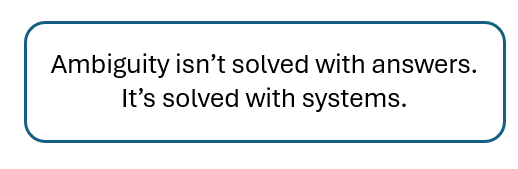
Step 1: Translate the Intent (Even If It’s Fuzzy)
Capture leadership’s intent in one clear sentence.
If the sentence contains options, it’s not intent yet.
Tim’s sentence becomes:
“We can’t understand customer needs if we never speak to customers.”
No tactics. No execution steps. Just the problem.
This becomes the center of gravity.
Step 2: Filter Out Everything That Doesn’t Serve the Center
You now take the clutter—constraints, concerns, ideas, assumptions—and sort it calmly.
The question is simply:
“Does this help solve the center of gravity or protect against failure?”
Tim reduces his clutter:
Interview at least 5 customers → maybe
Must talk to existing buyers → drop
Insights must be available before sprint starts → keep
Busy customers won’t engage → keep
Removing noise reveals a direction.
Step 3: Turn Options Into Roles
With the roles in place, you can finally assemble the system.
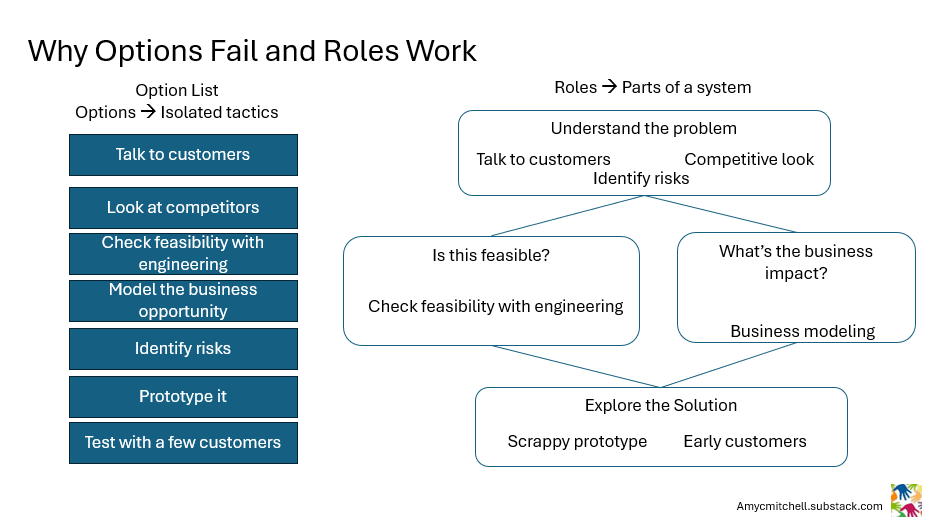
Ambiguous problems can’t be solved by choosing a single tactic.
Options need to be reframed as roles in the system.
Tim reframes his options:
Email → role: initial outreach
Survey → role: quick path for busy people
Conversation opt-in → role: deeper insight for motivated users
Each option is no longer an “answer”—it’s a component in the system.
Step 4: Write the 1–3 Sentence Narrative
This is the step product managers skip—and the one that gives agency back.
You now create a simple narrative that connects:
The center (the problem)
The constraints
The roles
For Tim:
“We need a steady flow of customer feedback. To get there, start with a compelling email linked to a quick survey and offer optional conversations for deeper insight. Start small and adjust based on response.”
This is the system Tim controls—regardless of what happens.
Step 5: Validate the Narrative With the Smallest Possible Move
You’re not validating an option.
You’re validating the system.
Tim sends three emails with a simple reply option.
That’s enough to learn.
Step 6: Iterate From the Narrative, Not the Options
Iteration is no longer “try a different email.”
It’s:
refine the narrative,
strengthen the system,
adjust the roles,
adapt to what you learned.
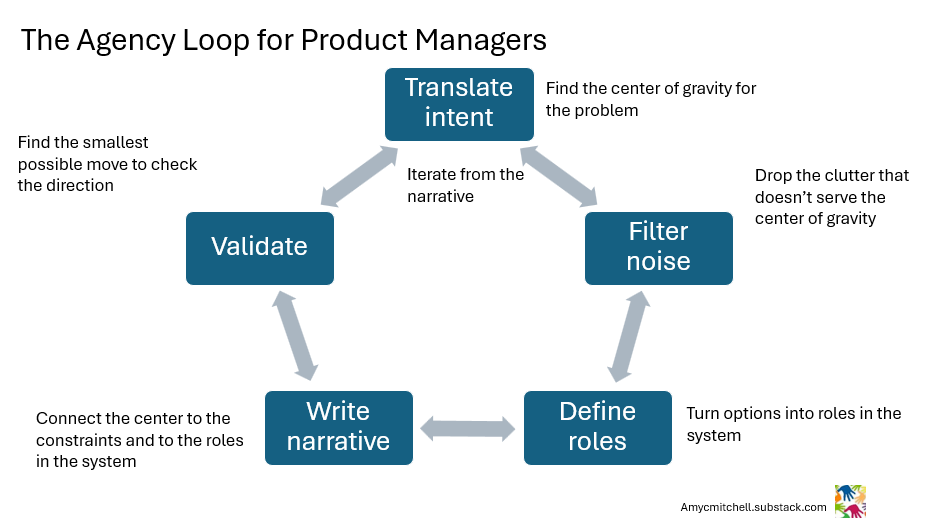
This creates momentum.
And momentum rebuilds agency.
What Agency Feels Like
Agency feels like steering the vehicle again.
You’re not reacting to ambiguity—you’re shaping it.
You’re not waiting for direction—you’re validating the narrative.
When you meet intent with a flexible system rather than a fixed option list, the path becomes clear. And that feeling of having traction again is the start of renewed agency.
Tim didn’t need a better email; he needed a better system. And so do most product managers.
Conclusion: Agency is a tool for product managers
Agency in product management is a practice.
When you feel stuck, don’t push harder.
Don’t ask for more clarity.
And don’t jump to tactics.
Instead:
Name the real problem.
Filter the noise.
Create a simple narrative.
Validate with the smallest step.
Iterate the system, not the options.
This cycle is how product managers rebuild agency—no matter how ambiguous the work, how vague the signals, or how bumpy the road.
You don’t wait for control.
You build the system that creates it.
Looking for more practical tips to develop your product management skills?
Free Product Manager Resources from Product Management IRL
Premium Product Manager Resources (paid only) 4 learning paths, 6 product management templates and 7 quick starts. New items monthly!
TLDR Product listed Product Management IRL articles recently! This biweekly email provides a consolidated list of recent product management articles.
Connect with Amy on LinkedIn, Threads, Instagram, and Bluesky for product management insights daily.